
By Kevin Rademeyer, Sports Journalist in London.
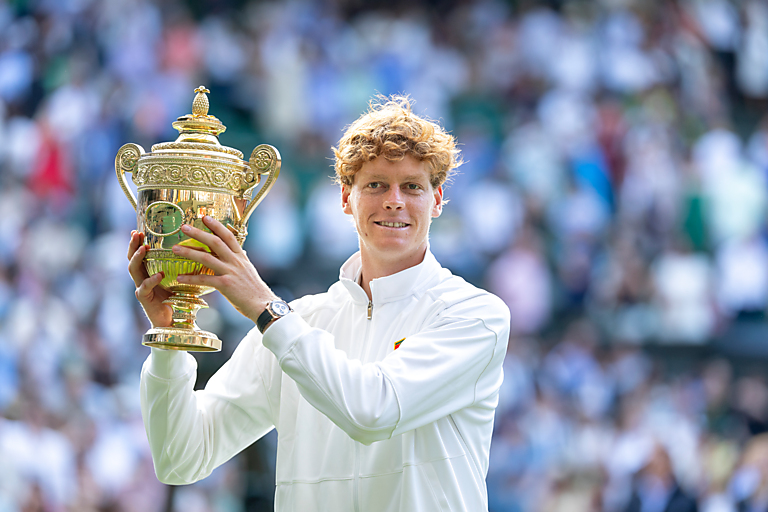
Photo: AELTC/Simon Bruty.
Live from London: There comes a point in every Wimbledon when the draw stops being about possibility and starts becoming about inevitability. The early rounds are filled with stories, surprises and sentiment. By the quarter-finals, the conversation narrows. Experience meets ambition. Champions meet challengers. And increasingly, all roads seem to lead towards two familiar names.
Novak Djokovic and Jannik Sinner.
Tuesday at the All England Club promises to shape the second week of the Championships, with the seven-time champion and the world number one carrying very different burdens as they chase a place in the semi-finals.
For Djokovic, every victory feels like another chapter in a story tennis may never witness again. At 39, he continues to chase an unprecedented 25th Grand Slam singles title. The victories remain impressive, but they no longer come without visible cost.
His four-set win over Roman Safiullin was another reminder that the margins are becoming finer. Djokovic’s tennis was sublime in spells, scratchy in others. Frustration briefly bubbled over when he angrily launched a ball towards the backstop, a moment that immediately revived uncomfortable memories of his disqualification from the 2020 US Open.
It was an unnecessary flash of emotion from a player who can least afford distractions. Afterwards, Djokovic admitted the biggest battle is no longer only against opponents. “The amount of time I spend recovering nowadays is more than I have ever done,” he said. “It’s just the demands of the body nowadays. More wear and tear. I can’t say I always enjoy it. It takes away a lot of the time. But it’s a part of the process.”
Hyperbaric chambers. Cryotherapy. Red light therapy. Electromagnetic recovery treatments. Djokovic’s preparation now resembles that of a Formula One team servicing a championship-winning car. Every detail matters because every match asks another question of his ageing body.
Standing across the net will be Canada’s Félix Auger-Aliassime, a player long regarded as one of tennis’ great unfinished projects. His victory over Alejandro Davidovich Fokina showed resilience as much as quality.
“What’s important is the intentions that you have on the court,” Auger-Aliassime explained. “At the end of the fourth, I’m up a break, but every point I reset and I have to have clear intentions.”
Against Djokovic, intentions alone will not be enough. Execution, particularly on the biggest points, has so often separated the Serbian from the rest of the field. If Djokovic represents endurance, Sinner represents relentless efficiency.
The Italian has quietly settled into the tournament after surviving an opening-round scare. Since then, each performance has carried greater authority than the last.
His straight-sets victory over Japanese qualifier Shintaro Mochizuki was another example of a champion finding rhythm at exactly the right time. Sinner now faces Germany’s Jan-Lennard Struff, but the world number one knows there are no straightforward assignments on grass.
After dispatching Mochizuki, Sinner spoke warmly about the Japanese qualifier’s unpredictable style. “He’s a very good player, especially on grass. His ball is very low. He’s a very aggressive player. Mostly I try to focus on my side of the net. I know that’s the most important.”
That has become Sinner’s defining characteristic. No drama. No emotional swings. Simply an unwavering focus on his side of the court. It is an approach that has made him the most consistent player in the world over the past twelve months.
Elsewhere, Naomi Osaka continues her remarkable Wimbledon resurgence against Karolína Muchová, while Coco Gauff and Jessica Pegula meet in an all-American contest worthy of Centre Court.
Yet there is little doubt where most eyes will drift. One champion is attempting to extend history. The other is quietly building the future. For years Wimbledon belonged to Novak Djokovic, after Federer’s departure. The question now is whether Jannik Sinner is ready to inherit it.