
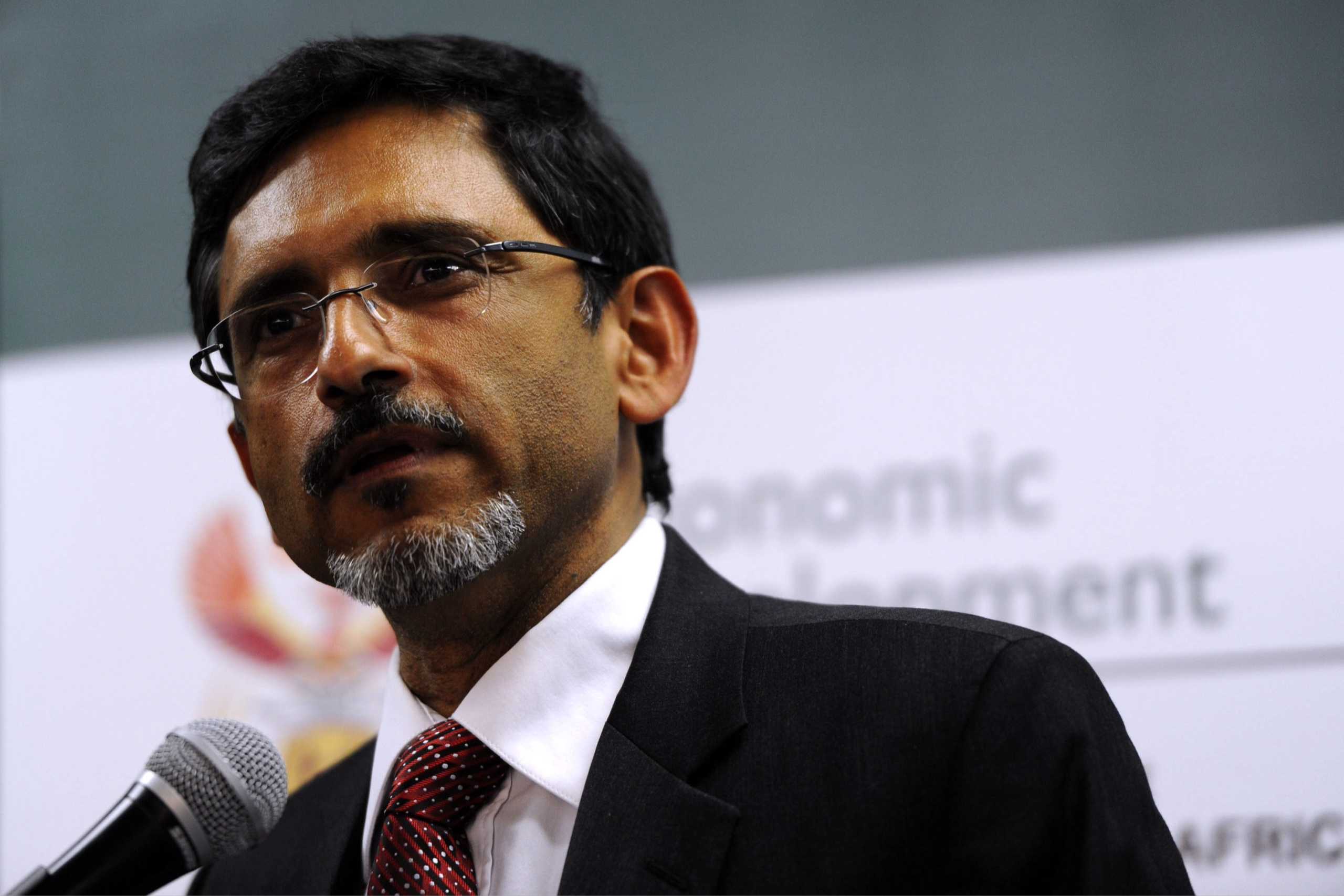
By Lehlohonolo Lehana.
Trade, industry & competition minister Ebrahim Patel announced that he will retire from the national executive, becoming the second minister to announce he will quit.
Patel, 62, joins Public Enterprises Minister Pravin Gordhan in announcing that he won’t be available to serve in the next national executive after the May 29 vote.
The minister plans to spend more time with his family, he said in a statement.
“It has been a great honour to serve my country as a member of Cabinet for 15 years and three terms of office. I have advised the President that I will conclude my service in Cabinet at the end of this 3rd term.
“I wish to thank the President and the ANC for the trust and confidence shown during my period in office and the leadership the President has provided to Cabinet, the country and the continent.
“I wish to thank the many people whose collaboration, generosity with their time and ideas, and deep commitment to building a democratic, fairer society has inspired me and helped us to make solid progress in promoting economic development. I am proud of what we have jointly achieved under challenging circumstances.”
“Under the leadership of the President and the ANC, I am confident a solid foundation has been laid for the incoming Administration and that the new Cabinet will unite South Africans and strengthen further a jobs-rich growth path.
‘After 15 years in Cabinet, I will relax a bit, reflect a lot and then look forward to serving our democracy in new and different ways,” he said.
Patel was appointed as minister of a new department of economic development in 2009 by Jacob Zuma in recognition of Cosatu’s role in the coalition that had brought political change at the ANC’s watershed national conference at Polokwane in 2007.
Congress of South African Trade Unions (COSATU) thanked Patel, for his service not only to workers in his 3 terms as Minister, but the nation at large.
“During his tenure at Economic Development and later DTIC, he ensured labour had a seat at the table during critical negotiations affecting the lives of workers; he put in place through various programmes, the foundations for a more equal economy; and solidified the social partnership between government, business and labour that is key to growing the economy, creating jobs, and slashing poverty and inequality, Cosatu said in a statement.”
Cosatu outlined the following achievements under the leadership of Patel:
- Rolling out the Employee Shareholder Ownership Programme that has enabled over 553 000 workers to own shares in their companies, thus boosting their wages.
- Parliament’s recent passage of the Companies Amendment Bills requiring greater transparency in company ownership to tackle corruption and money laundering but also for companies to disclose the wage gap between the highest and lowest paid employees as part of pushing the private sector to reduce their stark wage gap.
- Using the Competition Act’s public interest clause to negotiate fairer deals for SMMEs, value chains, workers’ jobs and ownership opportunities during mergers and acquisitions of large companies.
- Developing more than a dozen industrial master plans, bringing together government, business and labour to tackle blockages and unlock growth in key jobs rich sectors, ranging from poultry to sugar, from clothing and textiles to auto-manufacturing. Today we are seeing the fruits with the major retailers increasing their stock of locally produced clothes by 50%, the production of locally produced vehicles increasing by 25% over the past few years and support given to thousands of emerging sugar farmers from Mpumalanga to KwaZulu-Natal.
- Major new multi-billion Rand investments in motor manufacturing plants from Tshwane to Kariega, to TV and fridge manufacturing from Ladysmith to Atlantis.
- Strategic interventions and support from DTIC to protect and nurture local factories, from clothing to textiles, not only saving but also creating thousands of badly needed jobs.
- Ensuring that billions of Rands of South African mineral, vehicle, clothing and agricultural exports to the United States under the African Growth and Opportunities Act were secured and that the conversation was shifted during a very difficult geo-political period, to how AGOA can be strengthened to promote fair labour practises, and economic growth and jobs across South Africa and Africa.
- Negotiations to put in place the African Continental Free Trade Area that will unlock massive export opportunities for South African industries to the continent and create greater economic linkages that boost development in the entire region.
- Rooting out corruption that had become entrenched at the National Lottery Commission and is now resulting in the arrests of the implicated and the attachment of assets.
He said the world changed considerably during his 15-year tenure as a Cabinet Minister.
Patel noted that this period also entailed State capture locally and mitigation against it, the pandemic which led to the deepest recession globally since World War Two, war in Europe that led to food, fuel and fertiliser price spikes, continued conflict around the right of Palestinians to Statehood, and droughts, floods and unsettled weather patterns.