
By Antony Sguazzin and Lehlohonolo Lehana.
State owned power utility Eskom has extended the right of at least two companies to connect to South Africa’s power grid, keeping the struggling projects alive.
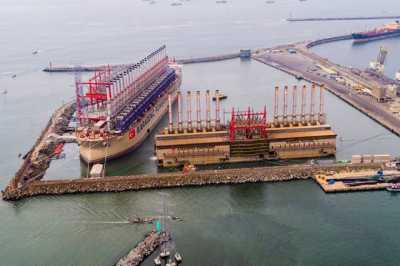
Karpowership, a Turkish provider of electricity from ship-mounted power plants, had grid access extended from 31 July 2023 until the end of the year, it said to Bloomberg Monday. The access is for its three projects announced in 2021 that collectively could produce 1,220 megawatts.
Mulilo, which is part of two groups that in 2021 won bids to provide a total of 395 megawatts, has also preserved its right to grid access.
Eskom didn’t respond to a request for comment.
Both companies submitted bids in a so-called emergency power round that South Africa concluded in March 2021 as it struggled to ease power outages that have worsened since.
Of the 2,000 megawatts of projects that were successful, only Scatec ASA – which is providing 150 megawatts of solar power – has achieved financial close. The rest of the projects were earlier given until the end of December to do so.
Delays have beset the emergency-power program. Karpowership has seen its plans frustrated by lawsuits and environmental challenges. A surge in construction costs globally has also complicated attempts by the bid winners to make financial arrangements.
Grid access is in short supply in South Africa. The amount of transmission capacity is insufficient, and in the wrong part of the country, for the swath of renewable energy projects being erected in a race to alleviate the country’s worst blackouts yet.
In December, a government award for 3,200 megawatts of wind energy failed because there was no grid connection available. Acwa Power, TotalEnergies, and Electricite de France SA also have stakes in winning bids.
Meanwhile Eskom has welcomed the National Energy Regulator of South Africa’s (NERSA’s) decision to issue an operating licence to its new Transmission company – the National Transmission Company South Africa (NTCSA)
Eskom said that the NERSA’s conditions and reasons for issuing the licence will be issued in due course.
South Africa’s embattled power utility will be split up into three entities – Generation, Distribution and Transmission – which forms a key part of Eskom’s Turnaround Plan as outlined in the Department of Public Enterprises’ “Roadmap for Eskom in a reformed electricity supply industry.
Eskom said that the transmission license decision is a significant milestone in the legal separation of the Transmission Division.
The power utility added that the NTCSA is also applying for a trading licence and an import/export license, which NERSA will still have to consider.
“The granting of the requisite operating licences to NTCSA is one of the key dependencies required to enable the operationalisation of the NTCSA,” Eskom said.
Eskom’s grid infrastructure has often been cited as one of the biggest inhibitors to alleviating South Africa’s power crisis.
Insufficient grid capacity means that many major renewable projects have not been able to connect to the grid in areas that could thousands of megawatts of energy – particularly the Northern, Western and Eastern Cape provinces.
However, Electricity Minister Kgosientsho Ramokgopa said that several projects are underway to improve Eskom’s transmission infrastructure, which should help alleviate load shedding.
“We are talking about 25 projects that can unleash about 13 gigawatts of electricity into the grid. The work starts now to be connected by 2026 to ensure there is additional capacity. We need to ensure we expedite the projects and bring them online quicker so we can expand the grid capacity,” the minister said.