
By Lehlohonolo Lehana.
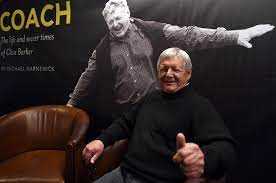
The late former Bafana Bafana coach Clive “The Dog” Barker has been granted a special provincial official category 2 funeral.
KZN Premier Nomusa Dube-Ncube welcomed the decision by President Cyril Ramaphosa to grant Barker, a provincial funeral.
Dube-Ncube said the decision was a “befitting honour” for the 78-year-old sporting legend, who died on June 10.
Barker will laid to rest in Durban on June 15.
“The Special Provincial Official Funeral Category 2, includes elements of police ceremonial honours, is reserved for distinguished persons specifically designated by the president of South Africa on request by the premier of a province,” said Dube-Ncube.
The premier described Barker as “a pioneer” in post-apartheid South African football whose coaching achievements will be remembered for generations to come”.
She said Barker distinguished himself as a true South African sporting legend after his appointment as coach of the South African national team in 1994 and subsequently led the team to victory in the African Cup of Nations (Afcon) in 1996.
Barker was appointed South Africa coach about two months before Nelson Mandela was elected president in South Africa’s first all-race elections in 1994, which marked the official end of apartheid.
And while South Africa’s rugby team also provided an inspirational moment for the newly-democratic country by winning the 1995 Rugby World Cup, that Springboks rugby team was all-white for most of that tournament.
South Africa soccer team captured the nation’s multiracial makeup much better, with white players like Tovey, Mark Fish and Eric Tinkler combining with Black stars Lucas Radebe, Doctor Khumalo, John Moshoeu and Phil Masinga.
South Africa’s 2-0 win over Tunisia in the 1996 African Cup final, a game attended by Mandela wearing a Bafana Bafana team shirt, brought South Africa its first and still only Cup of Nations title.
Barker was a promising player himself, only for his career to be cut short by injury.
Coaching was not an automatic career choice for him, though. He said in an interview on the FIFA website in 1997 that he fell into coaching after he struggled to make ends meet after his playing career ended with a serious knee injury.
“I worked during the day and drove taxis at night and I thought to myself, there has got to be something that is a little easier and less demanding than working day and night,” Barker said. “So I decided the only other thing that I had some talent at — besides singing — was to become a football coach. So I started out with that in 1974.”
It was the right choice. Barker had a 42-year coaching career in South Africa, starting in the days of apartheid and leading him to break the regime’s racist laws by traveling for games to Black townships where whites weren’t meant to go.
Barker’s history of disregarding those apartheid laws endeared him to the majority of South Africans.