
By Lehlohonolo Lehana.
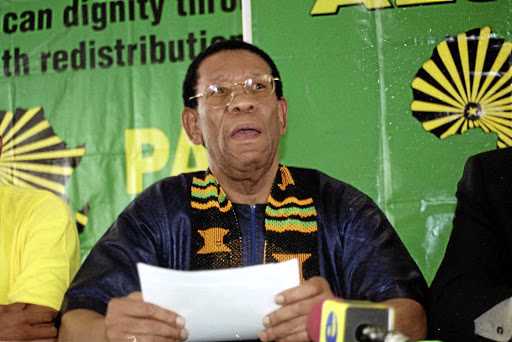
Former Pan Africanist Congress (PAC) leader and anti-apartheid activist Motsoko Pheko has passed away, his family confirmed on Saturday.
Pheko was 93 at the time of his passing.
“We are grateful to God for the time spent with him, the love he so selflessly imparted, including his knowledge as a renowned Africanist, lawyer, author, historian, academic and politician.
“We hope you stand in solidarity with us as we seek peace and quiet to reflect on this momentous occasion.”
Pheko led the PAC between 2003 and 2006, the period before factionalism festered in the party.
Motsoko was born in neighbouring Lesotho in 1933. Following the death of his parents, him and his brother moved to South Africa to live with a relative.
In 1960, Pheko joined the PAC, founded by Robert Mangaliso Sobukwe in 1958.
He joined political activism against the apartheid regime and was soon arrested and handed a hefty jail sentence.
Upon his release from prison, the anti-apartheid stalwart went into exile, where he stayed for 30 years. He worked in New York, USA, the United Kingdom, Zambia and Tanzania, according to online history site SA History Online.
Following the dawn of democracy in 1994 and his return back home, Pheko, as PAC president, was elected to serve in Parliament in 2003.
The 93-year-old butted heads with the PAC and was subsequently expelled over missing party funds in 2007.
Although he successfully challenged his expulsion in the high court, the PAC expelled him again in 2008.
His seat in Parliament was taken by Letlapa Mphahlele, who replaced him as party president at the PAC elective conference in Qwa Qwa, Free State in 2006.
He served as a PAC MP for 10 years, working in various portfolio committees including the safety and security and foreign affairs committee.
Former Pan Africanist Congress of Azania (PAC) president Narius Moloto paid tribute to the author and theologian and sent condolences to his loved ones.
“He has made his contribution, he has lived his life. We appreciate his contribution and our interaction with him. We learnt a lot from him. He was a highly principled person. Politically, of course, he was a character of his own.”