
By Lehlohonolo Lehana.
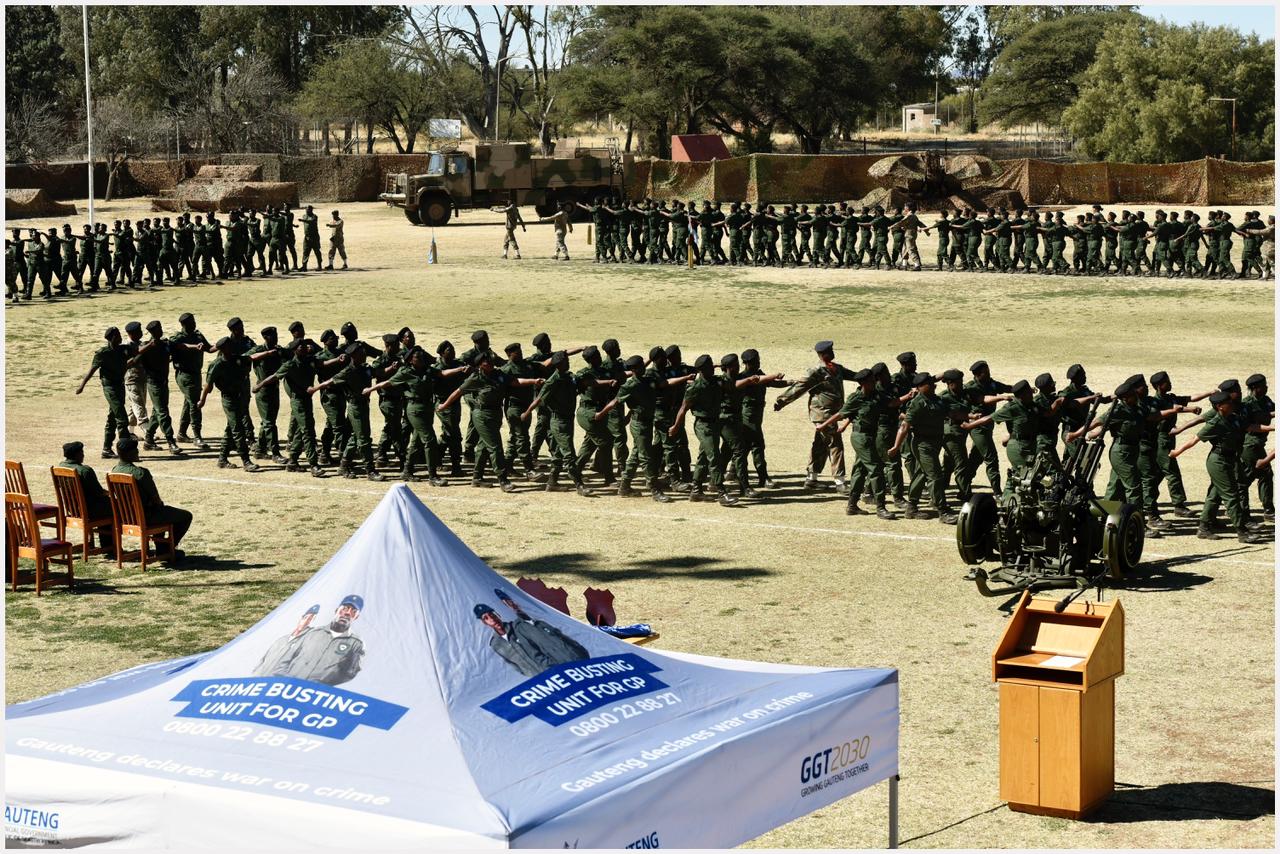
Caption: Crime prevention/traffic warden passing out parade at 10 Anti-Aircraft Regiment.
Minister of Justice and Development, Mmamoloko Kubayi announced that over 9000 Gauteng wardens were declared as peace officers in terms of Section 334 of the Criminal Procedure Act.
Kubayi led media briefing alongside Police Minister Professor Firoz Cachalia and Gauteng Premier Panyaza Lesufi.
The announcement comes after the Public Protector flagged legal deficiencies surrounding the existence and operations of the wardens.
Kubayi confirmed that a revised request from the Premier’s Office sought the declaration of wardens as Peace Officers “in order to assist in enforcing safety and security for the residents of Gauteng Province.”
“Section 334 of the Criminal Procedure Act vests the Minister of Justice and Constitutional Development with the authority to declare categories of persons as Peace Officers, define their powers, prescribe certification conditions, and regulate accountability,” Kubayi said.
She added that wardens are undergoing a second phase of training to qualify for their designated functions.
“This process is being undertaken alongside engagements with the relevant stakeholders to ensure full compliance with all legal and statutory requirements,” Kubayi said.
Cachalia welcomed the development. He said the formal recognition of the wardens would have a positive impact.
“This will make a difference to the communities in Gauteng,” said Cachalia.
He praised the Gauteng Provincial Government for creating innovative ways to fight crime.
“The rule of law is a core value of our constitutional order. But it’s not a straight jacket. It allows for innovative responses to public needs, including what is a core interest of our people, public order and safety.”
“We are now in a position to implement this brainchild of Premier Lesufi in a way that is lawful and constitutionally compliant. It’s going to make a difference to the communities in Gauteng, “he said.
Lesufi, who established the programme in 2023, described the announcement as victory that will help push back criminals.
“This is a victory for the rule of law and for integrated crime fighting that helps align our efforts and strengthen the hand of the state against criminality.
“We’ve indicated that our decision to support the SAPS was nothing else but to ensure that we push back crime in our province.”
“Every time statistics were released, we knew that Gauteng was the epicentre of crime in our country.
“As the economic hub of our country, there was no way we could fold our arms when children are killed, women are attacked [and] people are mugged. We felt we must go beyond words… to push back crime in our province,” Lesufi asserted.
The Peace Officers may only exercise powers within a “specified jurisdiction, in relation to defined offences, and strictly within the scope set out in the declaration published in the Government Gazette”.
The 2011 Gazette (see here and below) makes it clear that the GCPWs will have “all the powers conferred on a peace officer in terms of the Criminal Procedure Act”, as well as “all the powers conferred on a police official in terms of the CPA”.
This gamut of powers is extensive and includes the power of arrest and to carry a firearm.
According to the 2011 Gazette, a peace officer must have a certificate of appointment with their name, photograph, ID and the capacity in which they are appointed. But the Gazette says nothing about how peace officers must identify themselves publicly.