
By Lehlohonolo Lehana.
A risk management report has revealed that officials of the National Home Builders Registration Council (NHBRC) cut corners and manipulated their system in the late enrollment of the George building that collapsed in May 2024.
The report was concluded earlier this year and submitted to the department of human settlements (DHS) on 26 March.
A multi-story development under construction collapsed on 6 May 2024 on Victoria Street in the suburb of Dormehls Drift in George, killing 34 workers.
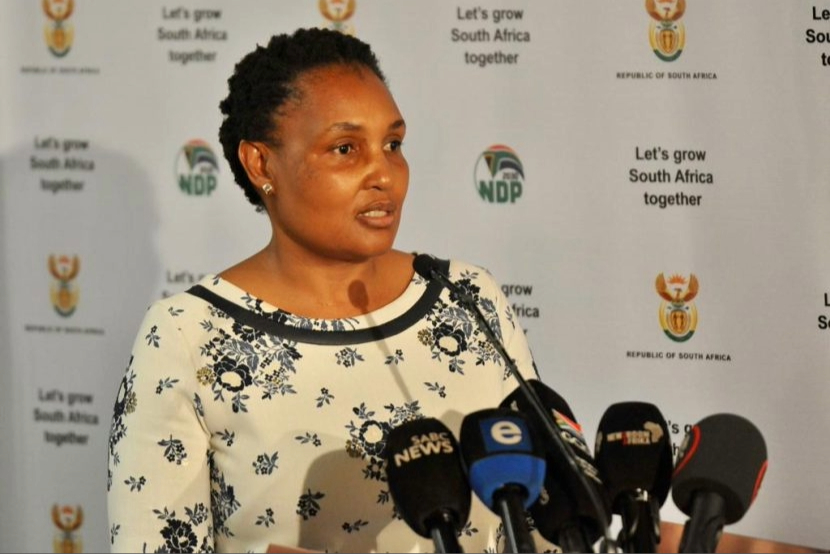
Minister of Human Settlements Thembi Simelane presented a report by the NHBRC to the Portfolio Committee on Human Settlements on Friday, 4 April. She described it as a “very sad report” that showed glaring internal regulatory lapses at the council.
“It’s a report which indicates the failure of our systems at the NHBRC. […] There was a lapse of enrolment requirements which were overlooked by our internal staff at the council. […] There was a lapse […] with regard to the structural engineering and drawings and the details which were not fully disclosed as they should have been. […] We also had missing detailed material information with regard to the construction,” Simelane said.
“The contractor cut corners. Our system enabled him to cut corners by not following our standard operating procedures, and even approving without the fulfilment of all the necessary attachments that needed to be done.”
The NHBRC is a regulatory body of the home building industry, with a mandate to protect the interests of housing consumers and to ensure that builders comply with the prescribed building industry standards.
The contractor for the development was Liatel Developments, under director Theuns Kruger.
The NHBRC report indicates that when the building was originally registered with the council, the plans were for a single-storey development, according to Simelane. However, at the stage of enrolling the building with the NHBRC, the building project was changed to a multi-storey development.
According to Simelane, officials at the NHBRC failed to undertake a proper technical assessment to ensure the contractor could manage the expanded scope of the project.
“At the municipal level and at NHBRC, the building was only listed on paper as a single-storey building, not a complex project, which is a multi-storey building. […] Ordinarily, to approve a one-storey building and a multi-storey building […] the intricacies are different, and the financials which need to be attached to a multi-storey are different,” she said.
Simelane said the report didn’t make any adverse findings when it came to the materials that were used in the construction of 75 Victoria, with indications that the materials used were “of quality”.
“The real cause of the collapse is articulated in the report as processes that were not followed in terms of the proper registration of the building, and to ensure that the structure of a single-storey to multiple storey […] desirably had the strength of carrying that building […]. That’s what literally would have then led into the collapse,” she said.
The NHBRC report recommended an improvement of the technical system used to approve buildings.
At least three officials are facing disciplinary action, while at least two of them could also be criminally charged.
NHBRC CEO Songezo Booi is also in hot water for not following the board’s instructions to place implicated officials on precautionary suspension during the investigation, instead placing them on special leave.
The contractor Liatel Developments, as well as certain implicated NHBRC officials, have been referred to the South African Police Service for criminal investigation, she said.
Meanwhile Simelane has rubbished claims that she earned R700,000 from Eskom contractor Vitrovian, her former employer, through overbilling power utility, Eskom.
According to News24, she joined Vitrovian as a project director in October 2011 until March 2012.
Simelane expressed dismay, calling them a desperate attempt to involve her in sensationalised controversies.
Simelane clarified that, as a project director, she would not have had intimate knowledge of the company’s financial transactions with Eskom or any other clients.
“Once again, I hasten to correct the misconception that the position of project director would have in any way allowed me to enjoy intimate knowledge of the company’s financial transactions with Eskom or any client of the company; this assertion is simply false and is bordering on gutter journalism,” Simelane added.
Last year, Simelane made national headlines after reports revealed that she took a R575,600 loan in 2017 from the VBS Mutual Bank to purchase a coffee shop in Sandton, Johannesburg.