
By Lehlohonolo Lehana.
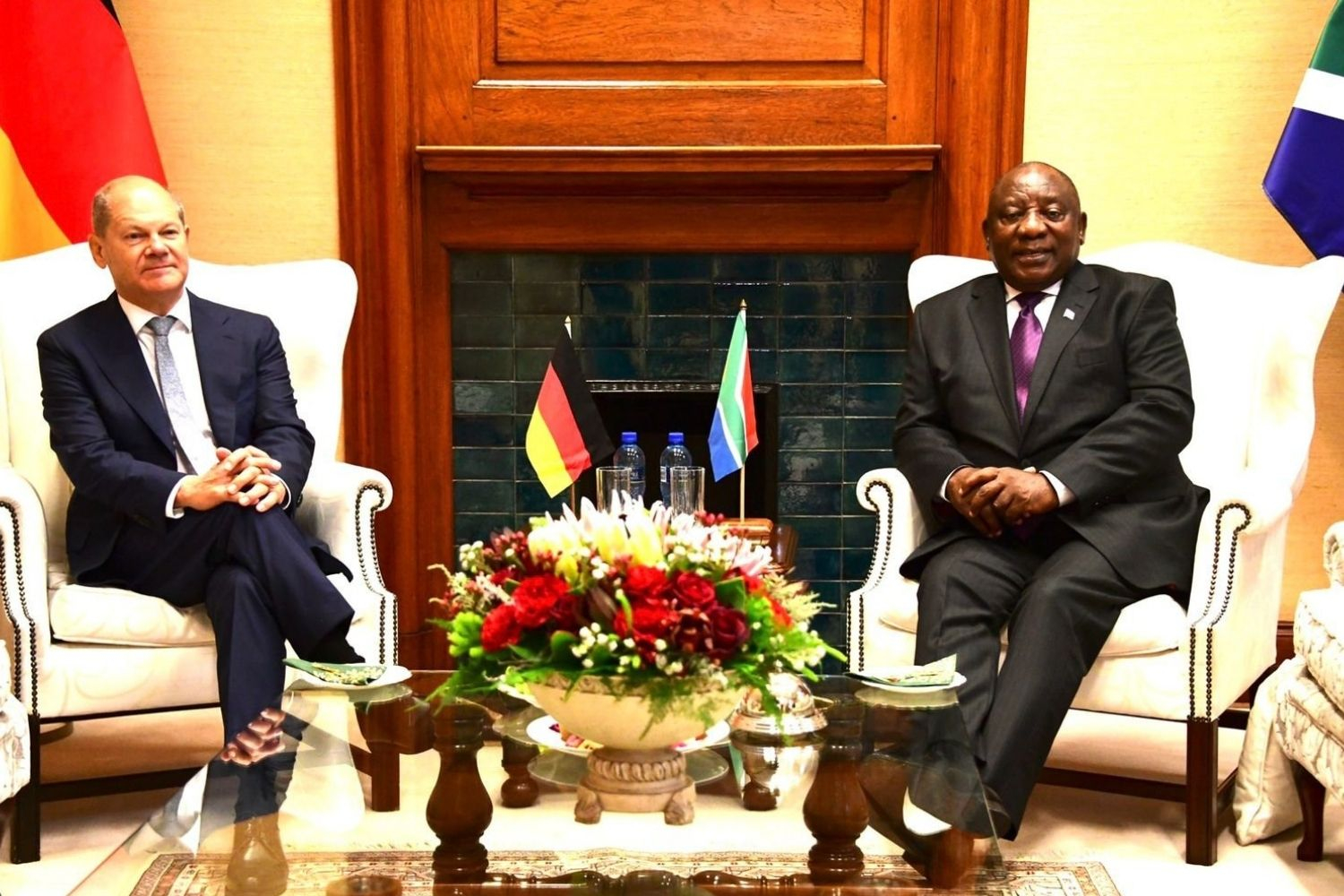
President Cyril Ramaphosa said Germany is committed to supporting South Africa’s efforts towards industrialisation, infrastructure development and job creation.
Ramaphosa was speaking at a media briefing on Tuesday (24 May), where he was hosting German chancellor Olaf Scholz on an official state visit.
He said Scholz’s visit to South Africa comes at a time when the country is recovering from the Covid-19 pandemic.
A number of issues were discussed between the two leaders during their meeting on Tuesday, including increased trade relations, German companies investing in South Africa and Russia’s war in Ukraine.
Germany is South Africa’s second largest trading partner with the country being home to around 600 German companies.
Ramaphosa said South Africa is rebuilding itself after the Covid-19 pandemic.
“We are rebuilding in the wake of the devastating impact of the global Covid-19 pandemic, which has deepened poverty, inequality and unemployment.”
“We look forward to deepening trade and investment ties with Germany. We anticipate constructive discussions around the green economy, clean energy and building climate resilience as we embark on new technologies such as hydrogen & other renewable energy,” Ramaphosa said.
“Another area of our relationship we would like to expand is that of education and skills training. There is much we can learn from the German model of dual education and how German companies integrate the training of young people in the working environment.”
In April 2022, Ramaphosa announced a new programme that will ensure that education and training programmes are directly linked to the jobs needed in South Africa.
He said that a major constraint on growth and employment in the country is the relatively low skills levels in the country and the inadequate outcomes of the education system.
“The resultant skills gap is also a significant contributor to inequality and undermines efforts to end the inter-generational cycle of poverty. The only sustainable way to bridge the skills gap is to dramatically improve the performance of all levels of our education system.
“Among other things, this means ensuring that there is a firm link between the skills and competencies being produced and those required in the economy. We have initiated several programmes to link training to workplace experience and employment.”
Ramaphosa said the jobs shift will see the Department of Higher Education and Training placing 10,000 unemployed TVET graduates in workplaces from April 2022.
A number of other countries are also looking at copying the country’s dual education system where more than half of German students enter dual vocational and educational training programs (VET) as a route into employment.
Students have the option to choose from 326 professional trades that include diamond cutters, aircraft mechanics and even chimney sweeps.
Apprenticeships are standardised across the country — every product designer must study the same textbooks and be familiar with the same design tools — so employment prospects do not vary greatly by college or company. Most join their training company after three years of low-paid work and study.
Vaccine manufacturing in Africa
Ramaphosa lauded Germany for being a dependable supporter of Africa’s efforts to manage the COVID-19 pandemic.
He expressed the country’s gratitude to Chancellor Scholz for the assistance Germany has given not just to South Africa, but the entire African continent.
“We also discussed the support Germany can lend to our efforts to ensure that vaccines produced in Africa are given greater market share in developed countries, and that vaccines destined for African populations should be procured locally,” Ramaphosa said.
Earlier, Ramaphosa told Chancellor Scholz that efforts to produce vaccines in South Africa have suffered a setback as there are no buyers for vaccines that are produced in Africa.
“This is a matter of great concern for us and this is an area that should also concern you because you have been in the forefront of helping us as the continent to move up the ladder of being able to produce vaccines. We believe that vaccines destined for Africa should be produced in Africa,” he said.
In turn, Chancellor Scholz said he was happy to have helped with the manufacturing of vaccines in Africa and South Africa in particular. “We should increase the investment in your country, making it more easy is one of the aspects we will discuss,” he said.
War in Ukraine
During their discussions, Ramaphosa and Scholz spoke about the war in Ukraine and the need for negotiations to bring about an end to the conflict.
Ramaphosa said that Scholz and himself discussed a broad range of international issues, including the pursuit of peace and security on the African continent.
“We also discussed the conflict in Ukraine and the need for the international community to encourage dialogue and negotiation towards a peaceful resolution,” he said.
Scholz weighed in on the war, saying it is necessary for peace in the world that the war stops as soon as possible.
“We have to convince Russia that they will go out of the war and peace has a chance for Ukraine and the development of all of us,” he said.
Later today, Chancellor Scholz and his delegation will be visiting Sasol place in Sandton for the launch of a South African-German consortium that will advance technology research for the production of sustainable aviation fuels.
Ramaphosa said the launch is a historic partnership for the development of carbon emissions reduction technologies, including green hydrogen.