
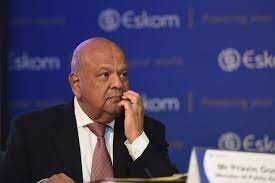
By Lehlohonolo Lehana.
Minister of Public Enterprises Pravin Gordhan and President Cyril Ramaphosa have applied for leave to appeal a recent court judgment that ruled in favour of a motion by opposition parties to exempt hospitals, schools and police stations from load shedding.
The ruling, which was handed down in the Gauteng High Court, Pretoria, last month, ordered Gordhan to take reasonable steps to ensure that public health establishments, state schools and the police stations are not affected by load shedding.
This came after the United Democratic Movement (UDM), Inkatha Freedom Party, Action SA, the National Union of Metalworkers and other organisations launched a legal bid to spare hospitals and clinics, 23 000 public schools and police stations from load shedding.
Gordhan is the second respondent, alongside Eskom, the National Energy Regulator of South Africa and others. Ramaphosa is the fourth respondent and the government of SA is the eighth respondent.
A joint notice of application for leave to appeal was filed on behalf of Ramaphosa and the government on Thursday. Gordhan filed on Tuesday.
The respondents wish to appeal to the Supreme Court of Appeal is on four grounds: that the order was vague; that it is impossible to implement; that the order “violates the rule of law”; and that it infringes on the principle of separation of powers.
Among other things, they believe “the Court erred in finding that the respondents had not budgeted for measures required to ensure a sustainable supply of electricity”.
The papers argue, however, that to find the financial resources to comply with the “far-reaching order” will require “drastically rearrang[ing]” the state’s budget, and doing so within 60 days is not feasible. Moreover, it would require completion of certain processes and coordination with other ministers.
Gordhan contends that the order was unclear in that it did not prescribe what steps he should take or what defines a “reasonable” step – adding that the order “wrongly assumes that the minister has the power and ability” to ensure a sufficient supply of electricity to the listed facilities.
The respondents take issue with the judgment’s criticism of generators as a solution, arguing that preferred alternatives such as solar PV panels will take longer than 60 days to install.
Furthermore, the filed papers argue, there are “multiple causes of the energy crisis”, which means multiple organs of state are required to work together. This means it is impossible for Gordhan – even working with other organs of state – to meet the demands of the order within 60 days.