
By Lehlohonolo Lehana.
Deputy President Shipokosa Paulus says government is consolidating resources to end extortion and ensure that communities conduct business without fear or intimidation.
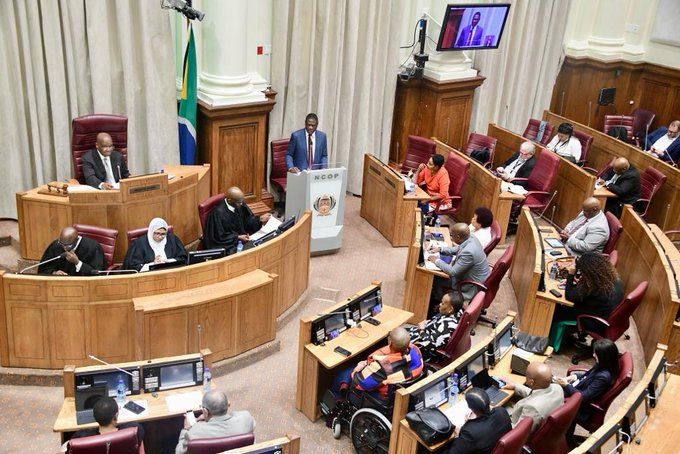
Mashatile delivered a keynote address during the first Three Sphere Planning Session of the National Council of Provinces (NCOP) of the 7th Parliament in Cape Town.
The planning session is convened under the theme: “Towards an Oversight Agenda for the Seventh Parliament: Delineating Key Oversight Priorities for the NCOP in the Seventh Parliament”.
The Eastern Cape town of Mthatha is battling extortion crime by syndicates, which have led to at least one school and several businesses shutting down.
He told the Members of the NCOP that the Government of National Unity (GNU), has adopted three priorities, including inclusive growth and job creation, reducing poverty and tackling the high cost of living, and building a capable, ethical, and developmental state.
“We have adopted the above three priorities because whilst we have made significant progress over the 30 years in reducing poverty and inequality, we remain faced with the challenges of a slow-growing economy, high unemployment and poverty rate, high incidence of crime, corruption and lawlessness, and a highly fractured society.”
Mashatile said the seventh administration has decided to invest in the building of a capable, developmental State.
“A developmental State, in our context, is a State that will redirect resources towards job creation and ensure that people have access to asset ownership, economic opportunity, education, healthcare, and other basic services.”
More importantly, in a quest for a developmental State, the Deputy President mentioned that government will continue to invest in building safer communities.
“Building safer communities is not only a police responsibility, but it is a shared responsibility between the police, communities and all sectors of our society.”
He has since urged citizens to hold hands with law enforcement agencies to combat crime in communities.
Public-private partnership to tackle water crisis
Government is introducing a public-private partnership (PPP) model in water supply, working with National Treasury and the Department of Water and Sanitation.
Mashatile said, this initiative aims to resolve the potential water crisis, similar to how it has successfully addressed the energy and load shedding crisis.
He informed Members of the NCOP that, through the District Development Model (DDM) in Waterberg, Limpopo, and with private sector involvement, government is implementing much-needed interventions to create opportunities for the community.
“In eThekwini, we have been resolving the water crisis to the extent that we are beginning to see much-needed changes in the functioning of the municipality.”
Together with the Minister of Water and Sanitation, Mashatile said they will be visiting Giyani to assess the state of progress in ensuring that people have water in that part of the province.
“This is going to be the modus operandi of the seventh administration because we want to ensure that we do not have a water crisis in the country. We need to go to these communities and resolve the problems.
Govt to launch programme to clean cities
Mashatile has also announced that government will soon initiate a programme to clean cities and recognise those that exceed expectations in making their towns sustainable and safe.
The country’s second-in-command said that cleaner cities contribute towards attracting investors.
“This campaign has the potential of ensuring that the private sector and communities in partnership with the government ensure that our cities are clean and safe.
“Honourable Members, in realising the vision of building a developmental, capable, and ethical State, we will vigorously implement the plan to professionalise the public service, and we will do so by investing in the capacity of the National School of Government.”
Equally, he said, government must continue to invest in the modernisation of the State and government by introducing innovative solutions across government particularly.
“The whole world is going digital in many respects and as South Africa, we must not be left behind.”
Over the last 30 years, government has adopted progressive policies that the seventh administration is going to pay special attention to the speed of execution.