
By Lehlohonolo Lehana.
South Africa will spend an additional R37.4 billion to fund public sector salary increases this year, surpassing a level targeted to be reached in 2025, says Finance Minister Enoch Godongwana.
“The recent wage agreement has placed upward pressure on the wage bill. This means that in the current financial year, the National Treasury must identify over R37.4 billion in savings to cushion the blow on the fiscal framework,” Godongwana said
Godongwana tabled the national treasury’s R34.9 billion budget vote for the 2023/24 financial year in parliament on Tuesday.
He said some of the risks to South Africa’s fiscal outlook had materialised since he tabled his February budget when he allocated R701.2 billion for the compensation of government employees.
“Key among these is the outcome of the public sector wage negotiations, which the Budget did not pre-empt,” Godongwana said.
The result is that the macro-fiscal position presented in the budget has changed adversely and significantly. The risks into the future remain high,” he said.
Godongwana said the treasury, which is trying to tighten spending, now has to identify the equivalent amount (R37.4 billion) in savings to cushion the impact of the recent 7.5% wage agreement as well as to try and recover the funds it has to channel towards the increases.
A key challenge for the fiscus is the management of the public sector wage bill,” he said.
At the end of March, the Department of Public Service and Administration (DPSA) tabled a final offer to workers, comprising a 3.3% salary hike and a 4.2% increase relating to a cash gratuity, both pensionable.
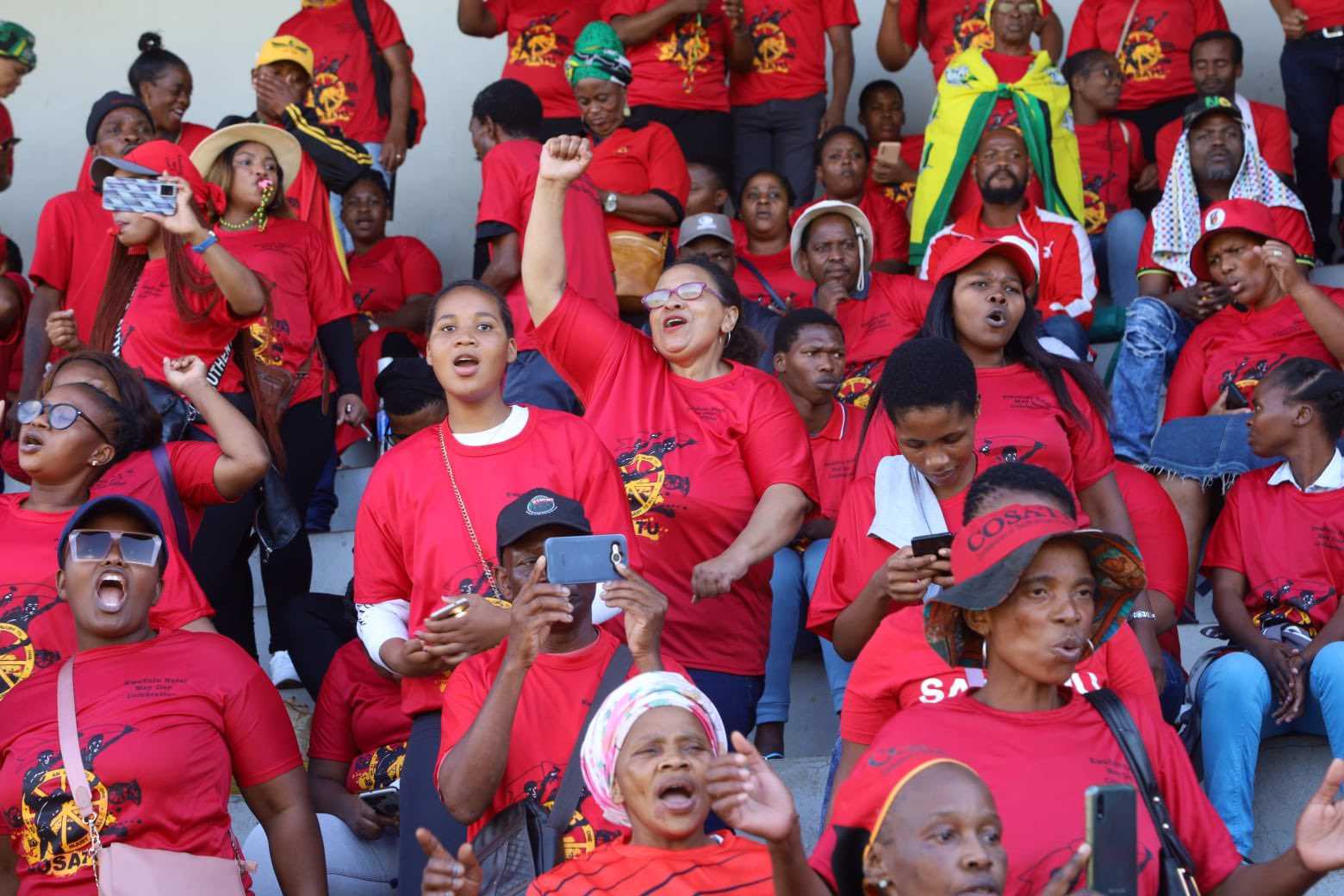
The increases came after public sector unions staged a relentless fight during wage negotiations, leading to a nationwide strike. They rejected the government’s initial increase offer after demanding 10% salary hikes.
The government, which already spends a third of its total budget compensating public sector workers, previously projected the wage bill would hit R728.7 billion during the 2023/2024 financial year, but the increases will not be without significant trade-offs, Godongwana said.
Godongwana also said 85% of the budget will be allocated for transfers and subsidies mainly to South African Revenue Services (SARS), State Security Agency (SSA), conditional grants to municipalities, and funding for civil and military pensions.
“The allocation to SARS is R12.2 billion and it is to support continued efforts to rebuild SARS. I am pleased to report that the efforts are bearing fruits,” he says.
“SARS has seen a net tax revenue growth of 7% per annum since 2019. Public trust in SARS has also increased from 48% in 2018 to 66% this year, whilst public attitude toward tax compliance is at 76,5%,” says Godongwana.
He said over R265 million will be allocated to the Financial Intelligence Centre to implement the Financial Action Task Force’s recommendations.
Earlier this year, the Paris-based anti-money laundering watchdog added South Africa to its list of countries that will be monitored to ensure the implementation of anti-money laundering and terrorism-funding regulations.
The greylisted countries include Nigeria, Turkey, Yemen, Cambodia, South Sudan, Mali, Morocco, Myanmar, Panama, and the Philippines.
Godongwana told MPs that the efforts to get South Africa off the grey list are well underway.
“We have committed to providing periodic updates to Cabinet on progress. Last year, we led an unprecedented process to pass an omnibus of statutory amendments that address the gaps in our anti-money laundering regime.
“The National Treasury, as the lead in the Interdepartmental Committee on Anti-Money Laundering and the Combating of the Financing of Terrorism, continues to coordinate government-wide efforts to comprehensively address the remaining weaknesses in our legal system,” says Godongwana.
He added “We have also updated and strengthened systems for supervising non-financial businesses that are at risk of being used for money laundering or the financing of terrorism.
We have also strengthened the systems needed to identify the beneficial owners of businesses and trusts so that they cannot hide behind the veil of corporate secrecy when engaged in money laundering.
“We have submitted updates to FATF on all of this, and we expect positive re-ratings of our system’s technical compliance with FATF standards in the next six months.”