
By Lehlohonolo Lehana.
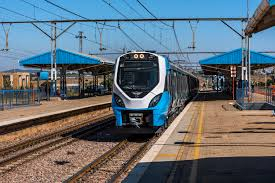
The government has on Monday unveiled 100 electrical trains manufactured by a joint venture between a French company and South Africa’s Gibela consortium in Johannesburg.
Gibela is a Black Economic Empowerment consortium – where French rail company Alstom and Ubambano Rail own 70% and 30% equity respectively.
Transport minister Fikile Mbalula called it a “major milestone” in Africa, and commended the plant for skill training for the youths.
South Africa’s railway system has been crippled by vandalism and lack of maintenance of its ageing infrastructure including old and non-functional Metrorail trains.
The trains run at 120km per hour and have the capacity to carry 1,200 passengers.
The six-cart train only moves when its doors are closed and it is fitted with surveillance cameras and air conditioning.
R124 billion has been budgeted for the entire renewal project over 20 years.
But the parastatal needs over R6 billion just to refurbish its infrastructure and trains to pre-COVID conditions.
Mbalula did not escape scrutiny in state capture report. According to Raymond Zondo, he misled former Public Protector Thuli Madonsela and shielded former president Jacob Zuma, giving her evidence that conflicted with the evidence he gave before the commission.
The Department of Transport – though not yet under Mbalula then – was also not spared from the state capture project during the Zuma years. The report found that Prasa’s R3.5 billion contract with Swifambo Rail Leasing for 70 locomotives was “so flawed” that “any reasonable person” would have seen that it was corrupt from the start.
Mbalula said in addition to state capture, the pandemic had thrown a curve ball at the country’s transport systems. The 100 trains delivered by the Gibela plant were supposed to be delivered in 2020, but disruptions due to the Covid-19 lockdown meant their delivery was put off by two years, he said.
He said since the conclusion of the report of the Commission of Inquiry into State Capture, South Africans would demand to see state-owned companies reform their operations and law enforcement agencies arrest, try and convict those who looted public funds.
Prasa chair Leonard Ramatlakane, meanwhile, said the rail agency was working to modernise infrastructure on its passenger rail network so that it could get the most out of the state-of-the-art trains.
“These trains we see today require modern infrastructure. Part of this is ensuring that we have up-to-date technology at our depots. Where we have the infrastructure in place, we have already installed the train, Istimela Sabantu,” said Ramatlakane.
Ramatlakane said: “The modernisation of the trains and infrastructure support has enabled them to move at a max speed of 120 km per hour. About 50 trains have already passed this test. We want to assure you that Prasa is hard at work.”
Gauteng Premier David Makhura called the event a major milestone in South African industrial production and jobs.
“These trains are built by South Africans. We are re-industrialising. We are supporting the steel industry in our country and on the back of that other industries. We are empowering our people. Black people are at the forefront of building these trains,” said Makhura.