
By Cameron Baker and Greg Ryan, Bloomberg.
The Trump administration’s funding battle with Harvard University is starting to impact projects at affiliated hospitals and has crippled the school’s Center for Aids Research, one of the largest backers in the US for emerging studies on the condition.
Harvard funnels a portion of its federal grants to research partners, including the Mass General Brigham hospital system, and that money has now largely stopped flowing after the government froze more than $2.6 billion in support. Mass General researchers whose work is affected should “stop all activity and spending” unless they have found alternative funding, Paul Anderson, the hospital group’s chief academic officer, said in a message to staff late last week.
A spokesperson for the Education Department had previously said hospitals affiliated with Harvard weren’t affected by the funding freeze.
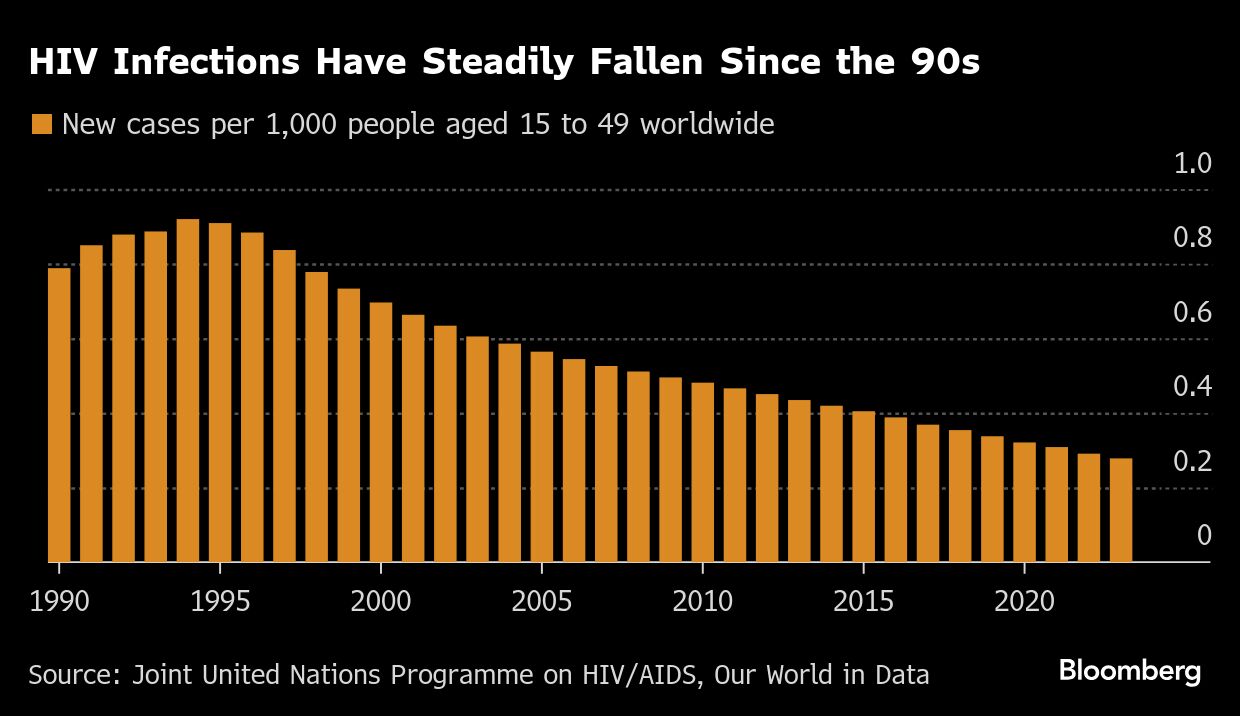
The Harvard Aids research organisation was separately counting on $3.7 million in federal funds to get through the next year, but that award was cancelled after the White House suspended the university’s ability to receive additional grants, according to its leaders. The centre has backed research that led to the development of targeted medications and vaccines and the prevention of mother-to-child transmission, advances that helped turn HIV into a highly treatable disease rather than a death sentence.
The Aids organisation and Mass General partnership projects are among the many research endeavours caught in the middle of the Trump administration’s battle with Harvard and a broader push to rein in National Institutes of Health spending. The White House has also sought to block Harvard from enrolling international students and questioned its tax-exempt status in an increasingly contentious showdown over the handling of antisemitism on campus and government demands for more oversight.
“We’re going to lose a generation of young researchers,” said Roger Shapiro, a professor of immunology and infectious diseases at Harvard’s T.H. Chan School of Public Health and a member of the Aids research centre’s executive committee. “And we’re going to pay the price down the road.”
Harvard has sued the Trump administration over the funding cuts and the restrictions on international students. Representatives for the NIH and the Education Department didn’t respond to requests for comment.
Ripple effects
Unlike many medical schools, Harvard doesn’t have its own teaching hospital and instead relies on a network spread across Massachusetts. While a federal grant may be assigned to Harvard, the money often makes its way to the hospitals through sub-awards. With limited exceptions, Harvard will no longer reimburse research partners for costs under those contracts, Anderson of Mass General said in the memo to employees.
“Harvard hopes to restart funding if the legal challenges are successful, but it’s unclear when that might be or whether an eventual resumption of funding would cover activities during this period,” Anderson said. “We appreciate the contributions each of you are making to science and research and realize this is difficult news.”
More than 570 sub-awards across 32 states are affected in total, according to a Harvard spokesperson.
Other Harvard-backed projects facing funding cuts include research on tuberculosis, early detection of Lou Gehrig’s disease, or ALS, and methods for reducing the side effects of radiation. While Harvard is funnelling $250 million of its own money to help sustain some projects, that won’t be enough to make up for the government pullback.
Ingrid Bassett, an infectious disease physician at Massachusetts General Hospital and co-director of Harvard’s Aids research center, said her current work on community HIV/Aids prevention in South Africa would likely not have been possible without the hub’s financial support earlier in her career.
The researcher pipeline is “how we’re going to get over the finish line in terms of eliminating HIV as a public health problem, “Bassett said in an interview. The research funding pullback is compounded by the dismantling of the US Agency for International Development and doubts over the future of the President’s Emergency Plan for Aids Relief (Pepfar), key providers of HIV testing and antiretroviral therapies.
The leaders of Harvard’s Aids research center are optimistic that government money will eventually start flowing again. Still, they worry the US’s status as an epicentre for scientific innovation may have already been damaged. As nationwide cuts percolate through the industry — suppressing hiring and drying up capital — the risk is that scientists start to look elsewhere.
“The US government got exactly what it paid for, which was the greatest research enterprise on the planet,” Shapiro said. “We’re walking away from a model that has been incredibly successful.”