

By Lehlohonolo Lehana.
The High Court in Pretoria has set aside City of Tshwane’s cleansing levy and ordered the levy to be scrapped and, where already implemented must be reversed.
This comes after Civil Rights Organisation, Afriforum instructed its lawyers to file further opposition to the levy, after two letters to council in this regard were unanswered.
The case was heard in the Gauteng High Court, Pretoria after the organisation approached the court to overturn the metro’s decision to impose this new mandatory monthly levy of R194.37 (excluding VAT) on nearly 260 000 households and businesses in the metro.
AfriForum specifically points to Section 74(2) of the Municipal Systems Act, which stipulates principles on tariff policy and states that tariffs must reflect the costs reasonably associated with the provision of the service. Users must be charged in proportion to their use of that service.
According to AfriForum, the city is targeting property owners who have already renounced the municipal refuse removal service due to poor service delivery.
The metro estimates that there are just under 200 000 residential properties and another 60 000 businesses that do not use the city’s refuse removal service.
The new fee is expected to generate an additional R540 million in revenue for the city.
According to the metro’s original communication, this levy was supposed to have kicked in on July 1. But AfriForum said it has since been informed that no recovery will be made before August 1.
The levy will collect R194.37 per month from affected households, without offering any corresponding service delivery in return.
AfriForum originally requested an urgent interdict in an attempt to stop the implementation before July 1, but following an agreement between it and the metro, the latter had opportunity to supplement their court documents.
The civil rights organisation maintains that the levy amounts to unfair double taxation, particularly in cases where residents do not benefit from the metro’s refuse removal services and are forced to make use of private service providers.
The metro has defended the implementation of the levy and argued that it has its origins in the metro’s 2016 tariff policy. AfriForum said this policy was, however, not filed with the metro’s court documents. This in spite of the metro deeming it a “critical document” for the case.
Acting judge George Avvakoumides in his judgment delivered on Thursday found the municipality’s implementation of the levy unlawful.
“The imposition of a cleansing levy by the [metro] is hereby declared unlawful, invalid and is of no force and effect and is accordingly set aside,” Avvakoumides said.
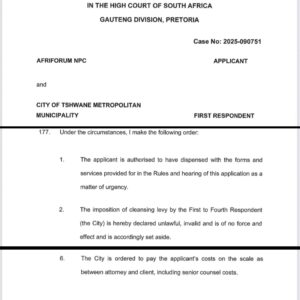
AfriForum also obtained a cost order, which means the municipality must now pay AfriForum’s legal costs.
Fullview attempted to contact the City at the time of publishing and the story will updated once comment is received.
Meanwhile the Democratic Alliance (DA) welcomes the ruling and calls on the City to urgently rework its now un-funded budget to avoid breakdowns in service delivery.