
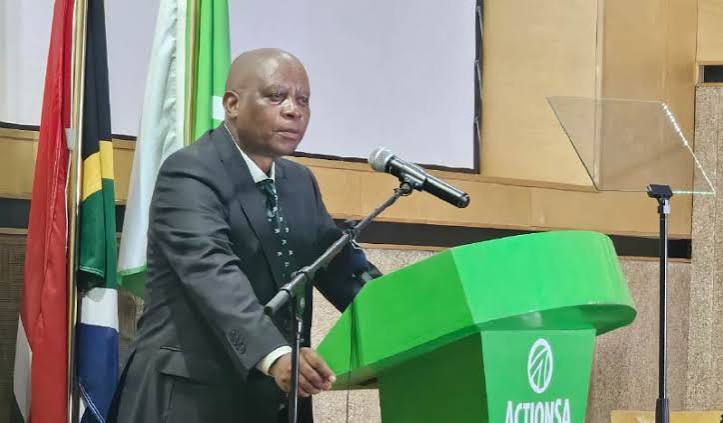
By Herman Mashaba.
There comes a time when political disagreement must be separated from outright disrespect. I have reached a point where I will no longer remain silent while people attempt to bully, undermine and dictate to me and the political organisation I lead.
Let me make this absolutely clear: ActionSA is an independent political party. We are not an extension of the DA, the ANC, the EFF or any other political organisation. We are not a political project that requires permission from other parties to make decisions. We have our own leadership, our own principles, our own supporters and, most importantly, a responsibility to the millions of South Africans who have placed their trust in us.
I am increasingly concerned by the arrogance with which certain commentators, political personalities and even supporters of other political parties believe they can dictate who ActionSA must work with in coalition governments. Some have gone beyond expressing political opinions and have resorted to insults, personal attacks and attempts to undermine my leadership.
I do not take kindly to this behaviour. I have spent years building this political movement. I have made difficult decisions, endured political battles and taken positions that have not always been popular. I have done so because I believe South Africa needs an alternative that puts ordinary people first.
I will not have my leadership undermined by people who have neither the responsibility nor the accountability that comes with leading a political organisation.Where were these voices when the DA turned its back on me in 2019? Let us revisit our political history.
In October 2019, I announced my resignation from the DA and the City of Johannesburg following the election of Helen Zille as the party’s Federal Council Chairperson. My departure was the culmination of fundamental disagreements about the direction of the DA, its approach to inequality and its willingness to prioritise party interests over the people of Johannesburg.
I had fought for an inclusive, pro-poor administration. I had stood up for workers, particularly through our insourcing programme, which benefited more than 7,000 families.
Where were these same people when I was fighting those battles? Where were the voices demanding that the DA respect my leadership, my convictions and the mandate I had been given by the residents of Johannesburg? Where were they when I had to make the difficult decision to walk away from a political organisation because I believed its direction was no longer consistent with the values I had embraced?
Then came the 2021 Local Government Elections. ActionSA made a decision to support the DA in establishing coalition governments in Johannesburg and other metros. We did not do this because we were desperate for positions. We did it because we believed that South Africans had given us a responsibility to prevent the ANC from continuing its disastrous administration of our major cities.
In Johannesburg, we supported the election of DA Mayor Mpho Phalatse. Yet, when the coalition encountered difficulties, the DA’s handling of the negotiations to save the government became a major source of conflict.
In January 2023, ActionSA and other coalition partners worked tirelessly to restore the governing majority. A proposal that had been negotiated and accepted by the Patriotic Alliance, and agreed to by the negotiating teams, was rejected by the DA’s Federal Executive.
On 26 January 2023, the coalition lost the motion of no confidence and Mpho Phalatse was removed as Mayor. The ANC and EFF subsequently returned to power in Johannesburg. ActionSA had voted against the motion to remove Phalatse. We had tried to save that coalition.
In May 2023, we made another attempt to find a way forward, even proposing two of our MMCs as a possible alternative to restore a non-ANC government. Those discussions also collapsed over the DA’s sudden refusal to work with the PA, putting the ANC into power instead of their own mayor.
Where were these self-appointed guardians of coalition politics when all this was happening? Where were the demands that the DA respect its coalition partners and acknowledge that no party has an automatic entitlement to lead?
And then came 2024. The Multiparty Charter was established on an understanding that its signatories would work together to remove the ANC from national government and would not enter into separate coalition discussions with the ANC ahead of the elections.
Yet, in May 2024, the DA entered into discussions with the ANC following the national elections. The DA subsequently joined the ANC-led Government of National Unity. ActionSA raised serious concerns about this conduct and the breach of trust within the Multiparty Charter. We ultimately walked away from that arrangement.
Once again, where were the people now lecturing us about political consistency? Where were they when the DA was engaging the very party we had collectively committed ourselves to replacing?
Why is political pragmatism acceptable when the DA exercises it, but suddenly unacceptable when ActionSA makes an independent decision? Why must ActionSA be held to standards that other political parties are apparently free to disregard? I refuse to accept this double standard.
ActionSA will make decisions in the interests of voters. Does anyone seriously believe that we are incapable of examining political circumstances, assessing available options and making decisions that we believe will deliver the best outcomes for our voters? Must we consult political commentators before deciding how to protect the interests of our supporters? Must we seek approval from the DA before entering a coalition with another political organisation? Are people suggesting that the DA is the only possible coalition partner through which ActionSA can contribute to fixing South Africa?
I do not believe that the interests of South Africa’s poor can be reduced to the electoral interests or ideological preferences of one political party. Coalitions are about governance, accountability, service delivery and the ability to improve people’s lives. They are not permanent marriages between political parties. They are arrangements that must be assessed against their ability to deliver.
We have a practical example in the City of Tshwane. In October 2024, ActionSA’s Dr Nasiphi Moya was elected Executive Mayor through a multiparty coalition that included ActionSA, the ANC and the EFF, alongside other parties. This was not a decision made to satisfy political egos. It was a decision made in the context of the political reality in Tshwane and the need to establish a government capable of addressing the city’s challenges.
Under Dr Moya’s leadership, the administration has made measurable progress in stabilising municipal finances. In April 2025, Parliament’s Cooperative Governance and Traditional Affairs Portfolio Committee welcomed the city’s financial turnaround. The administration also presented its first fully funded budget in three years, while reducing its Eskom debt by approximately R1 billion in its first 175 days.
These are meaningful developments in a city that had inherited serious financial and governance challenges. Does this mean everything is perfect in Tshwane? Absolutely not. There is still substantial work to be done. But it demonstrates that a coalition involving parties with different political ideologies can produce practical results when there is a shared commitment to governance.
Why should this possibility be dismissed simply because some people cannot imagine ActionSA working with anyone other than the DA?
Let us talk about the people we claim to represent. I find it particularly disturbing that so much energy is being invested in telling ActionSA who it must work with, while comparatively little attention is paid to the desperate circumstances confronting ordinary black South Africans.
Where is the same outrage about families living below the breadline? Where are the loud voices demanding urgent intervention for communities without reliable water, electricity, proper sanitation, decent housing and economic opportunities?
Where is the concern for the young black South African who has qualifications but no employment?
These are the people whose interests must inform our political decisions.
Look at Cape Town, often presented as the shining example of DA governance. The city’s own 2024/25 Integrated Annual Report records that 18.2% of its population lives below the poverty line, amounting to approximately 231,030 indigent households. The city’s own long-term planning documents acknowledge that apartheid-era spatial divisions continue to place poorer communities far from economic opportunities, with inadequate public transport and costly daily commutes reinforcing inequality.
Cape Town has achievements worth acknowledging, but no honest assessment of its governance can ignore the persistent poverty, housing pressures and spatial inequality experienced by poorer communities, many of them black and coloured.
We cannot pretend that a particular political party has all the answers while millions of people remain trapped in circumstances that deny them economic freedom and dignity.
Our responsibility is to the people, not to protecting the political image of another party.
My leadership is not up for auction. I understand that political leadership attracts criticism. I have never demanded that people agree with every decision I make. I welcome robust debate, scrutiny and accountability. That is the essence of democracy.
But there is a fundamental difference between disagreeing with a political leader and treating that leader as someone who can be bullied, insulted or instructed to follow someone else’s political agenda.
I have built businesses from nothing. I have served in public office. I have led the City of Johannesburg. I have established a political organisation that contested national elections and secured representation in Parliament and provincial legislatures. I have not arrived at this point in my political journey without understanding the consequences of difficult decisions.
I also understand that the people who vote for ActionSA are not voting for the DA. They are voting for ActionSA because they believe in the alternative we offer. Those voters deserve a leadership that exercises independent judgement and does not surrender its decision-making authority to external pressure.
I will not apologise for insisting that our political decisions must be evaluated on their merits. If a coalition arrangement advances our principles, protects the interests of our voters and creates an opportunity to improve the lives of ordinary South Africans, we have a responsibility to consider it. If an arrangement undermines those objectives, we have an equally important responsibility to reject it.
That is what political independence means.
We must be allowed the space to protect the poor, to stand up for the marginalised and to defend the dignity and constitutional rights of those whose voices are too often ignored in political negotiations.
We cannot continue allowing the interests of the politically powerful to take precedence over the desperate circumstances of ordinary South Africans.
To those who believe that they can bully ActionSA into submission, I have a message: you have misunderstood both this organisation and the person leading it. I have never been afraid to walk away from political arrangements that compromise my convictions. I walked away from the DA in 2019. ActionSA has demonstrated that it will walk away from arrangements that compromise its independence and principles.
We will not be intimidated into making decisions to satisfy political egos. We will not allow outsiders to determine our political future. And we will not sacrifice the interests of our voters to make other political parties comfortable.
Let me conclude by making something abundantly clear. I’m not asking for respect. I’m demanding it.
Not because I am Herman Mashaba. Not because I hold the position of ActionSA President. But because I lead a legitimate political organisation with a democratic mandate, a constituency and a responsibility to millions of South Africans.
Respect our independence. Respect our voters. Respect the democratic choices we make as a political organisation. We will determine our own political future. ActionSA belongs to its members and its voters. It does not belong to the DA, the ANC, the EFF or the political commentators who have appointed themselves guardians of our decisions.
Our loyalty is to the people of South Africa, particularly those who have been left behind by decades of political failure. And that responsibility will always come before anyone else’s political expectations.
Herman Mashaba is ActionSA President.