
By Lehlohonolo Lehana.
The Independent Electoral Commission (IEC) has been making its arguments in the Constitutional Court for the postponement of the local government elections scheduled to be held on 27 October.
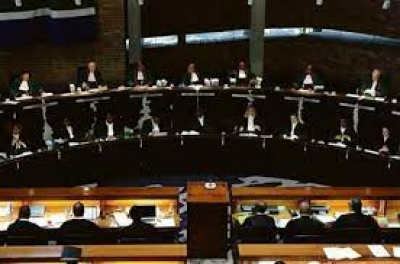
Counsel for the IEC, advocate Wim Trengove, made his arguments before the ConCourt’s full bench on Friday, where he said a free and fair election before 27 October would be impossible.
“We submit that the most appropriate balance is to hold free and fair elections as soon as possible. Even if we can’t do so by the 1st of November,” the advocate said during the proceedings.
Trengove said the IEC was seeking a remedy or relief by approaching the ConCourt rather than a constitutional amendment.
However, Justice Steven Majiedt questioned why the IEC did not approach Parliament to obtain the relief that the commission seeks from apex court.
Majiedt also pointed out that South Africa would be the first country to postpone elections due to the Covid-19 pandemic.
“It seems to me that the primary relief that you seek would require of this court to exceed the bounds of separation of powers to do Parliament’s work, where a supermajority of 75% is required to amend the Constitution as far as elections are concerned first.
“But secondly, it seems to me that in any event that your alternative relief would have the same result, be it indirectly, we would still be postponing the elections in the face of a pre-emptory provision where the Constitution makes provision for Parliament alone to amend that entrenched provision with the super majority.
“As far as I could see we would be the only country in the world in the face of a global pandemic, faced with similar elections, where the judiciary would postpone the election as opposed to instances in France and elsewhere, where Parliament passed the legislation and the UK, too, in the face of this coronavirus pandemic to make provision for this challenge,” he said.
Trengove, however, argued that the IEC was avoiding the action of taking the law into its hands.
“We do not suggest that the judiciary should postpone anything. If we are correct on our submissions about the impossibility doctrine then it would have up to the commission to take matters into its own hands and to organise the elections free and fair as soon as it was able to do so.
“That would have been lawful to do so, but because [the IEC] is a responsible citizen and it appreciates that, that will be a controversial route to take. It came to this court for the clarity order that is a lawful route,” he said.
The commission filed its urgent application with the ConCourt after former deputy chief justice Dikgang Moseneke’s inquiry into the feasibility of holding elections this year found that scheduled elections would likely not be free and fair due to Covid-19.
In his report, Moseneke also found that between now and scheduled elections of 27 October, there would not be enough time for either the IEC or political parties to prepare for elections and campaign fairly and freely, in the midst of a lockdown.
The report suggested that elections be postponed to no later than February 2022, as the Constitution requires an election to be held within 90 days of the expiry of the term of municipal councils.
Meanwhile Counsel for the African National Congress (ANC), Anthony Stein, appeared before the ConCourt’s full bench to argue that the IEC should’ve woken up earlier to the importance of seeking the postponement of the local government elections.
“The IEC is to blame. They should’ve woken up earlier. That is the essential course of the challenge. But the issue is not a question of blame. It’s a question of the possibility of the fairness of the election at this state,” he said.
The Democratic Alliance argued that the ConCourt granting any order would, however, strip the Constitution of its supremacy.
“We are a constitutional democracy. But once the court separates that it can grant this type of relief that’s effectively contrary to unambiguous constitutional text, we will have become something else. We will have become a jurist office,” DA counsel Max Du Plessis told the court.
The counsel for the Economic Freedom Fighters (EFF), Mfesaneka Siboto, said the party was still in support of the postponement.
The Constitutional Court has reserved judgment in the application in which the IEC, and a number of political parties and civil society organisations presented arguments on Friday.