
By Lehlohonolo Lehana.
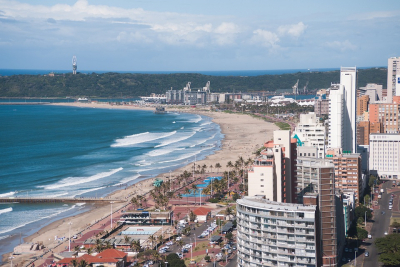
With the festive season fast approaching, the coastline of Durban and other parts of KwaZulu-Natal is filled with sewage and other harmful toxins leading to the tourism industry on the brink of losing millions a day.
The Sunday Times reported that all indications are that tourists are likely to steer clear from Durban, with businesses across the Kwazulu-Natal province noting that bookings are slow.
Tourism in Durban has become a major cash cow over the years, especially for Johannesburg tourists who wish to spend some time in the sun by the sea. However, severe flooding earlier this year has set the province back economically and led to the beaches becoming soiled.
Independent tests conducted by the Sunday Times, in collaboration with Talbot, show that holidaymakers and tourist operators are likely to face high levels of E.coli, which could cause sickness.
Umhlanga, north of Durban, has kept its beaches closed. Duncan Heafield, the chair for the areas tourism association, said that it is currently losing R10 million a day due to the closure of its most popular beach, and it is likely to increase to R25 million a day when the peak holiday season hits from 28 November, reported the publication.
Political parties ActionSA and Democratic Alliance have also raised deep concerns regarding water quality in the area, saying that the eThekwini Municipality has no regard for the health of beachgoers.
Water test results from 3 November showed that the Country Club beach, for example, had an E-coli level of 1,267/CFU/100ml. The critical level is 500CFU/100ml; despite this – beachgoers remain, said ActionSA. The eThekwini municipality has not responded to findings of high E-coli levels.
KwaZulu-Natal has faced a string of bad luck and economic headwinds. The July riots of 2021 redirected business away from the province over fears of a repeat, while the April floods damaged critical infrastructure.
After the flooding, the government appointed an independent agency to manage the billions of earmarked rands for disaster relief to try and avoid corruption and looting of funds. Under the National Treasury’s Solidarity Fund, over R2 billion was raised as relief, but this has only trickled down to those who were affected.
Many crucial parts of the infrastructure, such as sewage pipes, electricity supply and roads, have not all been repaired back to their pre-flooding condition. The South African Roads Agency (Sanral) is yet to begin work on fixing roads in the area.
Roads in the area are crucial to trade across South Africa, with the national freight and logistics company Transnet operating at South Africa’s most lucrative port in Durban.
Data from the Department of Water and Sanitation’s Integrated Regulated Information System (IRIS) reveals that of the 14 municipalities in KwaZulu-Natal, 10 of them (71%) regularly fail to comply with minimum wastewater treatment standards. The Department of Water and Sanitation (DWS) system rates them as “bad” (achieving compliance less than 50% of the time) or “poor” (complying with minimum effluent standards between 50% and 70% of the time). This untreated and partially treated sewage is released directly into KwaZulu-Natal’s rivers, and in some cases, directly into the ocean.
According to the DWS system, in eThekwini, 75% of the 27 sewage treatment plants it operates are failing to treat effluent to minimum standards. They have the capacity to release 761 million litres of untreated or partially treated sewage into the rivers and ocean, per day.
The DWS system shows two sewage treatment works, central and southern, together have the capacity to release 461 million litres of effluent directly into the ocean per day. Both of them have a 0% compliance for microbiological treatment, which is the indicator for E. coli and other faecal bacteria.
University of the Free State Centre for Environmental Management professor, Anthony Turton, said the floods could not be solely blamed as a lack of maintenance and of skilled technicians over time has allowed sewage treatment plants to deteriorate.
This is confirmed by historical data on the DWS system, which shows that during 2021, eThekwini sewage treatment works had an overall compliance rate of 54.5% for microbiological indicators and 68.5% for chemical compliance, which relates to the presence of nitrates and phosphates in the treated effluent. The DWS rates both these compliance levels as “poor”.