
By Lehlohonolo Lehana.
With less than two months to go until the 2026 local government elections, African National Congress (ANC) retains a narrow lead in voter support in the City of Johannesburg.
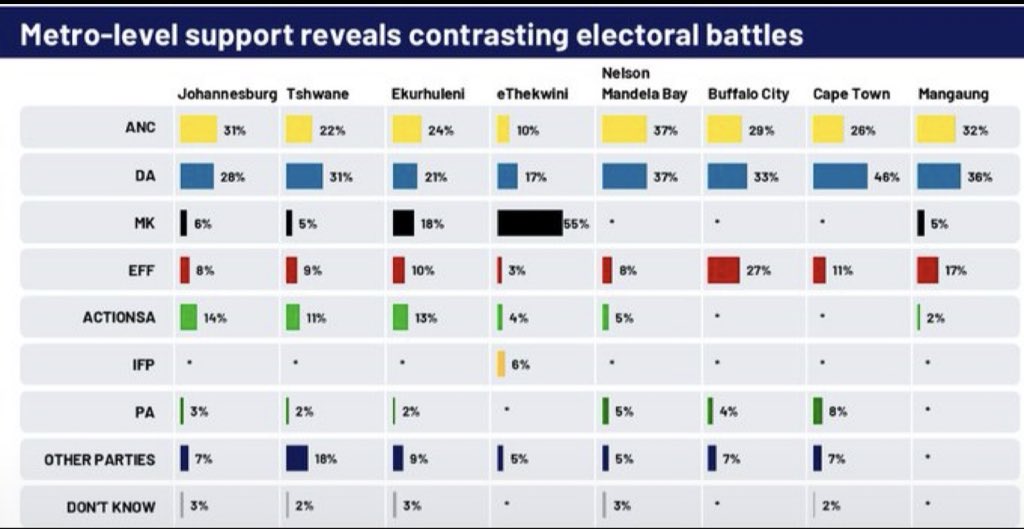
According to an Ipsos survey, ANC has 31% backing in the city, compared with 28% for its main rival, the Democratic Alliance (DA). In the last municipal vote five years ago, the two parties obtained 33.6% and 26.5% respectively.
The survey was conducted between June and July 2026, with 3600 people interviewed in various metros.
Ipsos said their findings suggested that turnout could play a significant role in determining election outcomes in several provinces.
“This is encouraging,” said the party’s regional secretary, Sasa Manganye.
Manganye said that while these results are encouraging, the party should not become complacent.
“Our task now is to consolidate this momentum and work even harder to improve our electoral performance beyond the last elections. We must turn renewed confidence into organisational strength, stronger community engagement and, ultimately, electoral gains,” he said.
The survey also show that the DA is ahead with 31% of those polled against the ANC’s 22% in Tshwane.
The ANC and DA remain locked in competitive races in Ekurhuleni, Nelson Mandela Bay and Buffalo City, with neither party showing a clear advantage.
ActionSA has recorded double-digit support in Johannesburg, Tshwane and Ekurhuleni, suggesting its strongest electoral presence remains concentrated in Gauteng’s metropolitan areas.
In eThekwini, MK Party is projected for a victory, with 55% of those surveyed saying they would vote for the party of former president Jacob Zuma.
In Cape Town, the DA records 46% support and could potentially exceed 50% as campaigning continues.
The survey found that the ANC was likely to garner 31% votes nationally, followed by the DA with 25%, MK Party 14%, EFF 11%, ActionSA 6%, IFP 3% and Patriotic Alliance 2%.
The ANC retained strong support in Limpopo and the Eastern Cape while the DA was still dominant in the Western Cape. DA is now also emerging as larger than the ANC in a second province: the Free State. The Free State is ravaged by poor service delivery.
MK Party remains largely a KwaZulu-Natal (KZN) phenomenon, while the Economic Freedom Fighters (EFF) is making notable inroads in Mpumalanga and the Eastern Cape and continues to perform well in Limpopo.
“With two months of campaigning still to go, competition is likely to intensify across much of the country as parties seek to consolidate support in their strongholds while making inroads into areas where they currently trail competitors,” said Mari Harris, political analyst at Ipsos.
Harris cautioned that the figures should not be interpreted as predictions of the final election outcome, noting there was still much campaigning to do and many voters to persuade before South Africans cast their ballots.