
By Kevin Rademeyer, Sports Journalist.
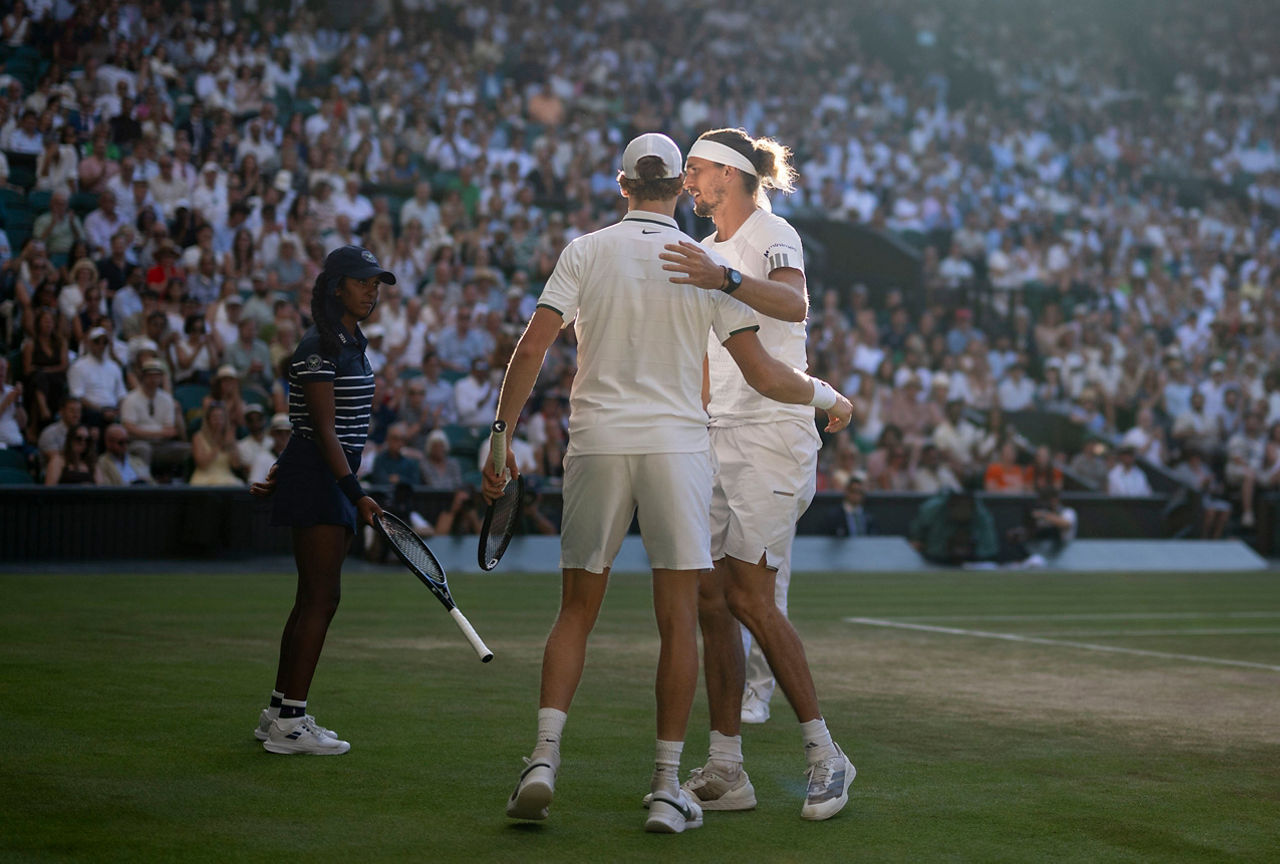
Photo Credit: AELTC/Joel Marklund.
The All England Club, London.
Talent wins matches. Character wins championships.
Jannik Sinner arrived at Wimbledon carrying far more baggage than any defending champion would have wanted. Barely a month earlier he had suffered one of the most devastating defeats of his career at Roland Garros, collapsing physically while leading by two sets and 5 1 in the third against Juan Manuel Cerúndolo. It was a defeat that would have haunted many players for months, perhaps longer.
Instead, Sinner treated it as a lesson rather than a scar.
The world number one made a decision that surprised many. Rather than chase confidence at one of the traditional grass court warm up events, he skipped the entire lead up schedule. His focus shifted from collecting victories to recovering physically, refining his game and ensuring he would peak when it mattered most.
It was hardly the perfect preparation.
His opening match at Wimbledon suggested a player still searching for rhythm. Miomir Kecmanović dragged him into five demanding sets and there were moments when Sinner looked vulnerable. His forehand misfired, his timing deserted him and questions resurfaced about whether Paris had left deeper wounds than anyone realised.
But champions rarely reveal themselves when everything is going well. They reveal themselves by how quickly they solve problems.
Every round brought improvement. The movement became sharper. The serve, already one of the finest weapons in world tennis, became almost untouchable. His confidence grew quietly rather than spectacularly, until by the second week he resembled the player who has spent most of the last two seasons looking untouchable.
The semifinal against Novak Djokovic confirmed it. Facing the seven-time Wimbledon champion should have represented the ultimate examination. Instead, Sinner dismantled one of the greatest players the game has ever known in ruthless straight sets. Djokovic searched for answers that simply did not exist. Sinner was faster, stronger, cleaner from the baseline and almost flawless behind his serve.
It was the performance of a player who had rediscovered complete belief. That belief was tested one final time against Alexander Zverev.
The German arrived carrying the confidence of a first Grand Slam title at Roland Garros and determined to end a nine-match losing streak against Sinner. He served magnificently and edged a superb first set, yet there was never any sense of panic from the defending champion.
That calmness has become Sinner’s defining quality.
He understands that tennis matches are not won by emotion, or by spectacular shots, but by clarity. While others search for miracles, Sinner simply trusts the next point. When the second set reached another tie break, his precision under pressure never wavered. When Zverev attacked, Sinner defended with remarkable intelligence. When the opportunity finally arrived late in the third set, he seized it without hesitation.
His serving throughout the final was extraordinary. Time and again, when danger loomed, he found another unreturnable delivery. Trailing 15 30 early in the fourth set with the match delicately balanced, Sinner produced three consecutive service winners to extinguish the threat. It was not luck. It was the product of countless hours of preparation and absolute conviction.
That is what separates the very best.
Winning Wimbledon for a second successive year was not simply another Grand Slam title. It was a statement about resilience. Sinner turned the most painful defeat of his career into the foundation for another triumph. He accepted responsibility for what happened in Paris, adjusted his preparation, trusted the process and emerged even stronger.
The statistics will record a successful title defence and a fifth Grand Slam crown. History, though, may remember something more important.
It will remember a player who refused to let failure define him, who trusted his preparation over panic, and who showed that greatness is built as much between the ears as it is in the racket hand.