
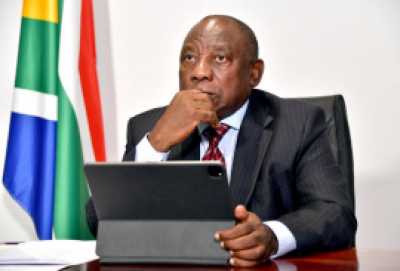
Japan’s government invited the African Union (AU) to the forthcoming G7 summit and excluded the regular attendee South Africa.
Comoros President Azali Assoumani, the current chariman of the continental body, is expected to represent Africa at the talks in Hiroshima, South Africa’s presidency said in a statement on Monday.
“The Japanese government, which is hosting the G7, decided for its version of the summit to invite the African Union instead of individual countries from Africa,” it said. “Therefore, the president of Comoros, who is the current chair, will attend the G7 plus meetings and not South Africa.”
The meeting of global powers is set to take place from May 19-21.
The African Union, made up of 55 member states, has sought to become a permanent member of the Group of 20 wealthy nations, and in December received backing from US President Joe Biden for its bid.
While the G7 heads of state represent only 10% of the global population but almost 40% of global GDP, their decisions can have a lasting impact on the fight against global inequality and hunger, investment in energy transition and climate action, advancing gender equality and ending gender-based violence.
The foundational purpose of the G7 forum — the US, UK, Canada, France, Germany, Italy, and Japan — was an intervention in global financial and economic governance. The forum first met in 1975 to discuss and take pertinent resolutions on the worldwide economy and the global financial architecture, such as responses to the oil crisis in the early 1970s and the exchange rate changes resulting from the US departure from the gold standard in 1971.
Similar to today, these decisions were of great significance and had a lasting impact on the other 188 countries in the global economy, most of which were, at the time, newly independent, some affected by armed conflict, and had little to no industrial capacity, poor economically but rich in raw materials.
There has never been any doubt that these countries, many of which are in Africa, want to develop and move from net receivers of so-called aid to self-reliant net providers of innovations and solutions to the challenges and problems confronting them and the world. Colonialism, underdevelopment, inequalities, poverty have been and continue to be a major global crisis that has dragged on for ages, compounded in Africa by exclusion from global value chains and, sustained illicit finacial otflows, and worsening threats from pandemics and climate change, among other challenges.
Africa has warned that it has a significant infrstructure gap that must be closed to facilitate the AU’s effort at an African renaissance with its 15 flagship projects. The G7 has a present and historical duty to assist by drawing on their financiang commitments for Africa. A reminder that Africa contributed just 3% of global emissions but is already dealing with the unaffordable impacts of a changing climate on infrastructure, communities and livelihoods, driving further inequality.
With inputs from Bloomberg.