
By Ian King.
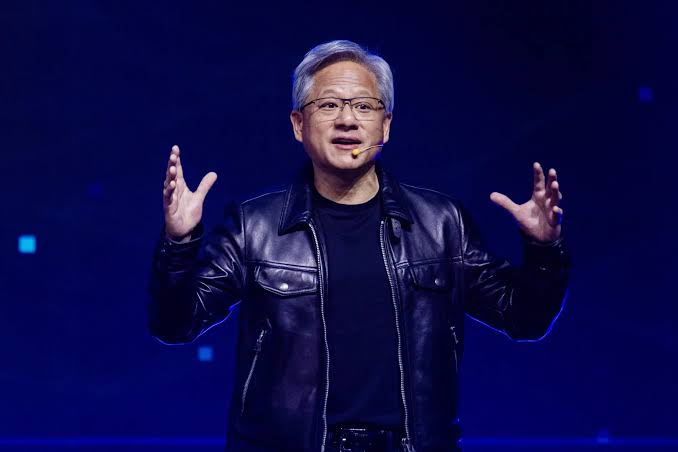
Caption:Jensen Huang, co-founder and chief executive officer of Nvidia Corp., in Taipei on Oct. 18, 2023. Image: Annabelle Chih/Bloomberg.
Nvidia Chief Executive Officer Jensen Huang, the preeminent face of the AI infrastructure boom, was ousted from his post after reports of two affairs, including with one woman who is reportedly suspected of spying for China.
Chief Financial Officer Colette Kress was named interim CEO.
Huang, one of the three engineers who founded the chipmaker in 1993, had been under intense pressure since Sunday when he admitted to a romantic relationship with Alice Huang, a former executive at the Singaporean data centre firm Megaspeed International.
Huang’s resignation deepens a crisis partly of Nvidia’s own making, given that there has been no clear succession plan for the 63-year-old who has been the company’s only CEO. Arguably more than any other founder in the technology world, Huang built Nvidia around himself and his view of what constituted the right way to manage a company.
Kress, who joined Nvidia 13 years ago after stints at Microsoft and Cisco Systems, has spent her career in financial roles. While she has represented the company at Wall Street-related events, her public role has been confined to Nvidia’s numbers and the majority of the communication with the financial community has been handled by her former boss.
Under Huang’s leadership, Nvidia’s shares have soared more than 700 000% since it became a public company in 1999. The firm’s market valuation has at times topped $5 trillion, ranking it among the largest companies in the world. The staggering growth eclipses anything accomplished by Apple’s Steve Jobs, Microsoft’s Bill Gates or Amazon.com’s Jeff Bezos.
Huang’s departure threatens to reverberate far beyond Nvidia. He has used Nvidia’s financial strength to back dozens of major AI players including frontier labs OpenAI and Anthropic PBC. He’s also both invested in and backstopped financing deals for cloud computing firms including CoreWeave, inspiring others to forge similar arrangements with one another to bolster the entire AI ecosystem. Big names on Wall Street including Michael Burry of The Big Short fame have warned that such circular deals are artificially inflating AI demand.
“As a student of economic history, I don’t know if there’s ever been such a key man holding so much of this industry up,” Blue Bear Capital investor Thomas Ferguson said of Huang while speaking at the BNEF Houston Summit on Wednesday ahead of his departure.
Huang has also led high-profile efforts to promote the worldwide expansion of data centres, travelling extensively to speak at conferences, lectures and other events. Wearing his signature leather jackets, he’s drawn crowds of fans swept up in “Jensanity.”
The executive also has become close with US President Donald Trump, appearing at White House meetings on technology, at state dinners and aboard Air Force One. Huang has enjoyed far greater access to the president than most corporate leaders. Trump on Monday backed Huang as “a very honourable man.”
The revelations about the Nvidia CEO’s affair with Alice Huang, an executive at Megaspeed, raised serious questions about his judgment. On Wednesday, the New York Times reported that Huang had also had a relationship with Kimberly Powell, Nvidia’s vice president of healthcare, citing unidentified people who worked at the company.
Megaspeed, which was spun out of a Chinese gaming enterprise, is one of Nvidia’s largest Southeast Asian customers and has been under US investigation for months related to the potential smuggling of Nvidia’s advanced AI chips into China, Bloomberg has reported. Megaspeed and Nvidia have denied wrongdoing.
Nvidia’s board has been working with an outside firm to identify potential replacements for Huang, a person familiar with the matter said Wednesday, asking not to be identified because the information isn’t public. Directors had met remotely on Wednesday to discuss Huang’s fate, people familiar with the situation said.
Some highly prominent tech executives named by those in the industry as people that could be looked at by Nvidia’s board include Lisa Su, CEO of rival Advanced Micro Devices, Rene Haas, chief at Arm Holdings Plc and Micron Technology leader Sanjay Mehrotra.
“The fundamentals of the business (if not the leadership) are clearly still intact with numbers that remain massive (and probably still headed higher),” Stacy Rasgon, an analyst at Bernstein, said in a note late Wednesday. “We don’t think the company should have huge issues operating while engaged in a search for new leadership.”
US lawmakers have called for Huang to appear before congressional committees and threatened a subpoena if he failed to appear. Nvidia’s board said on Tuesday that it had hired Wachtell, Lipton, Rosen & Katz partner Joon H. Kim, a former career federal prosecutor, “to conduct a thorough and independent investigation.”
For the AI supply chain, “we wonder what will happen to the company’s myriad of investments in the space, various backstops and residual guarantees,” Rasgon said.
While Rasgon acknowledged it had been tough to make a call on the stock, he downgraded Nvidia to “market-perform” and lowered the price target to $200. “Our gut tells us that we probably haven’t yet fully probed the depths of what might be found here,” Rasgon said in the note. “We’ve had enough, and prefer to watch from the sidelines.”
As Nvidia’s CEO, Huang was notorious for being a micromanager who had as many as 60 leaders reporting directly to him. Every employee had to write a list of their five most important tasks and publish them internally. Huang would sift through these to make sure that everyone understood what to focus on and personally write to even lower-level employees with advice or redirection.
But within Nvidia, employees had noticed that Huang had been less engaged in recent days, according to a person familiar with the situation. That included not immediately responding to his regular “top five” emails, said the person, who asked not to be identified because the matter is private. Nvidia’s leader is typically so focused on operations that he is known to personally review every employee’s compensation.
“My management style is what made it possible for the company to grow,” he told Bloomberg News’ Emily Chang in a recent interview. “I wanted an organisation that was able to adapt to change, both in inventing change for itself and the rest of the industry, as well as reacting to change that’s coming toward us.”
© 2026 Bloomberg.