
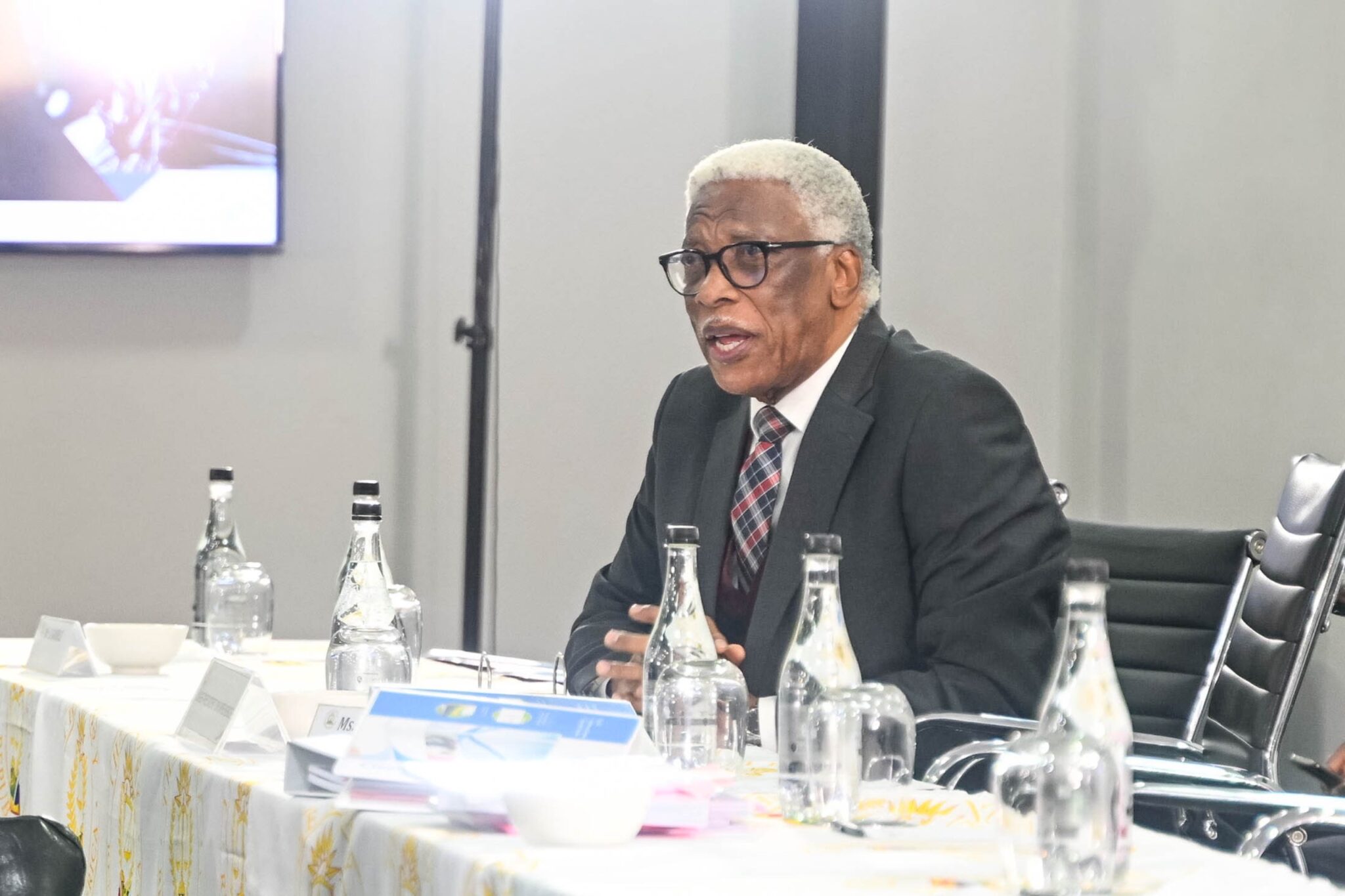
By Lehlohonolo Lehana.
The Judicial Service Commission (JSC) found Eastern Cape Judge President Selby Mbenenge guilty of gross misconduct, criticising both his conduct and the earlier findings by the Judicial Conduct Tribunal (JCT).
A junior secretary Andiswa Mengo accused Mbenenge of making unsolicited sexual advances towards her between 2021 and 2022.
In her testimony, Mengo detailed receiving sexually explicit texts and images from the Judge President.
In his defence, Mbenenge maintained that his relationship with his accuser was consensual.
The complaint, initially lodged with the Office of the Chief Justice (OCJ) and later reviewed by the Judicial Complaint Committee (JCC).
The JCC, on September 14, 2023, recommended a full investigation by a Tribunal, citing a prima facie case that, if substantiated, could lead to a finding of gross misconduct.
The Tribunal, comprising Retired Judge President B.M. Ngoepe, Retired Judge C. Pretorius, and Adv. M.G. Mashaba SC conducted a new hearing, including the testing of parties’ versions through cross-examination and expert evidence.
A tribunal ruled that his actions including a flirtatious relationship with a court secretary, violated the judicial code of conduct, but were not serious enough to justify impeachment.
Mengo has been found to have given false testimony.
While the Tribunal found no evidence of gross misconduct, gross incompetence, or gross incapacity, it did determine that Mbenenge was guilty of misconduct not amounting to gross misconduct, specifically for contravening Article 5.1 of the Code of Judicial Conduct.
Article 5.1 of the Code of Judicial Conduct, states: “A judge must always, and not only in the discharge of official duties, act honourably and in a manner befitting judicial office.”
The Tribunal found that Mbenenge’s conduct amounted to misconduct because he initiated and subsequently conducted a flirtatious relationship with Mengo at a place of work and during working hours.
This was deemed “prejudicial to the effective and expeditious administration of business of the court,” contravening Article 5.1 read with Note 5(iii) thereto. The report will be submitted to the judicial services commission for a final decision on a sanction.
In a statement, published on Thursday afternoon, the JSC said in its deliberations, the tribunal had “excluded from its consideration” several pieces of evidence. It had also criticised Mengo for giving false evidence in some parts of her testimony.
The JSC said it had deliberated on two questions: the first was whether to uphold the finding of misconduct, and the second was whether this conduct amounted to gross misconduct.
In consideration of these questions, the JSC disagreed with the tribunal in several key respects.
Firstly, the tribunal had limited its assessment of Mbenenge’s conduct to what happened at the workplace.
“On the admitted facts, the communications were not confined to working hours or the workplace but extended beyond both and included exchanges which, by their nature, bore directly on the standard of conduct expected of a judge and, more particularly, a Judge President engaging with a junior staff member.
“By characterising the matter principally as a flirtatious relationship at work and during working hours, the tribunal understated the significance of the admitted conduct.”
The JSC said that bearing in mind the nature and content of the communication, it was of the view that this was grossly inappropriate for a judge, let alone a Judge President, especially in relation to a person in the position of Mengo.
“It is conduct incompatible with the standard of honourable behaviour and proprietary required of judicial office.”
The JSC also said it did not endorse the finding that there was no sexual harassment.
The tribunal had not applied the appropriate standard of assessing a “balanced amalgamation of an objective and subjective standard” taking into account Mengo’s position and Mbenenge’s conduct in context.
It had failed to consider whether Mbenenge ought to have known that his conduct was unacceptable, “focussing almost exclusively on the conduct of the complainant [Mengo]”.
It had also failed to consider the power dynamic, instead approaching the matter on the basis that the parties were “consenting adults on equal footing”.
In concluding that Mbenenge was guilty of gross misconduct, the JSC took into account the sexual nature of the communications which were initiated by Mbenenge, his pursuit of Mengo, and his stated intention to pursue a sexual relationship with her.
It said it would now submit its findings to the Speaker of the National Assembly.
It had also invited the parties to make submissions regarding whether or not it should advise the President to suspend Mbenenge pending a decision on his impeachment by the National Assembly.
Meanwhile Thabo Kwinana, Mbenenge’s legal representative, has confirmed plans to file a review application. He maintains that the process was fundamentally flawed.