
By Lehlohonolo Lehana.
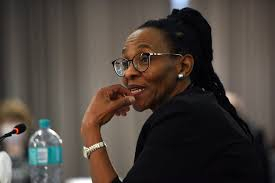
The Judicial Service Commission (JSC) has nominated President of the Supreme Court of Appeal, Justice Mandisa Maya as Chief Justice.
The Chief Justice position became vacant when Mogoeng Mogoeng’s term came to an end in October last year.
The JSC interviewed four shortlisted candidates for the top post throughout the week following a thorough selection process which, for the first time, involved public nominations.
Justice Maya was the only woman among candidates for the Chief Justice position.
Born in 1964, 60-year-old Judge Maya started out as an attorney’s clerk and worked as a court interpreter and prosecutor in Mthatha in the late 1980s. After getting a B Proc from the University of the Transkei and later her LLB from Natal University in Durban. Maya holds a master’s in law from Duke University in the United States.
She was admitted to the Transkei bar in 1994 after doing her pupillage in Johannesburg.
Maya was appointed a High Court judge in Mthatha, in the Eastern Cape, in 2000. She acted as a Constitutional Court judge in 2011 and in 2017, she became the first woman president of the Supreme Court of Appeal, where she’s said to run a tight ship.
She is the first South African woman jurist who served as President of the Supreme Court of Appeal of South Africa (SCA). She also wrote the first appeal court judgement in isiXhosa.
Maya was appointed as Deputy President of the SCA in 2015, and as President of the SCA in May 2017, after being appointed as acting president in 2016.
This is the first time in South African history that the JSC has interviewed four candidates for the Chief Justice vacancy.
From a legal perspective, the Judicial Service Commission (JSC) interviews this week are of minor importance as any endorsement or recommendation it might make will not be binding on President Cyril Ramaphosa. In terms of section 174(3) of the Constitution, the president is required to consult the JSC and the leaders of parties represented in the National Assembly before making an appointment, but he is not bound by their advice.