
By Lehlohonolo Lehana.
@TM Foundation.
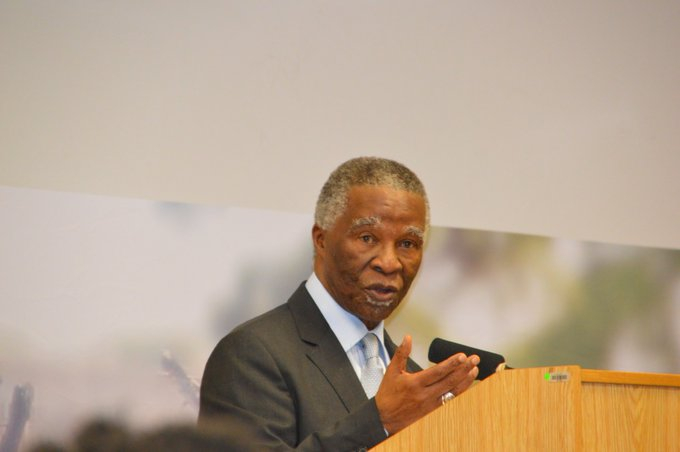
Former President Thabo Mbeki is delivering an Inaugural Lecture on the late former Zambian President Zambian President Kenneth Kaunda. Kaunda contributed immensely to South Africa’s transition to democracy in 1994.
Mbeki, a fierce champion of Africa’s Renaissance, is expected to focus his remarks on the state of the continent and what can be done by Africans themselves using lessons from Kaunda.
Mbeki says Kaunda played a pivotal role in the liberation of Africa from colonialism and apartheid.
“I would like to believe that all of us will have heard the voice of the young Kenneth David Kaunda as we listened to what the Fifth Pan-African Congress said in 1945 in its challenge to the colonial powers.”
Mbeki said, “I am talking about Kenneth Kaunda, as he played a leading role in the historic organisations of the Zambian struggle for liberation from colonial rule – the Northern Rhodesia African National Congress, the Zambian African National Congress, and the United National Independence Party, UNIP – and led the Cha-Cha-Cha civil disobedience campaign.
He added that Kaunda had been opposed to settler colonialism in particular.
South Africa had struggled against “colonialism of a special type”, where settlers within the country ensured the indigenous African population was stripped entirely of rights and productive property, including land.
This ensured settlers could suppress any rebellion by the majority – the black oppressed.
Mbeki said independent Zambia was born in 1964 under circumstances in which the liberation movements in southern Africa were launching strategic offensives to remove the colonial and apartheid regimes.
He said Kaunda was not just concerned with Zambia’s independence, but also that of Angola, Mozambique, Namibia, Zimbabwe and South Africa, and had opened the country’s doors to their liberation movements.
Kaunda had felt that apartheid, which formed institutions where no blacks could go, did not just happen in South Africa, but these other countries too.
Mbeki quoted from Kaunda’s writings, saying that Tanzania’s Julius Nyerere had helped the Zambian liberation movement, so he [Kaunda] had felt that Zambia had to do the same for other liberation movements, even if it meant being bombed.
Known as “KK”, Kaunda had left an indelible imprint on the successful struggle for the total liberation of Africa from colonialism and apartheid, Mbeki said.
Watch Live in the Video Below:”
Video Courtesy of SABC.