
By Lehlohonolo Lehana.
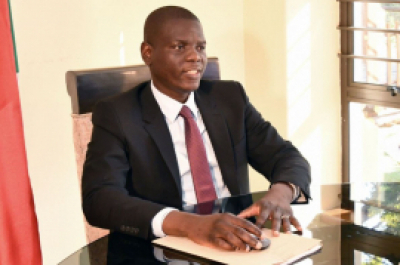
The Department of Justice and Constitutional Development minister Ronald Lamola says it is working hard to ensure that South Africa avoids becoming grey listed by the Financial Action Task Force (FATF).
The FATF is an international initiative designed by G7 countries in order to combat money laundering.
A greylisting by the FATF would hamper South Africa’s ability to attract foreign investment and would knock investor confidence in the country.
Speaking at the RMB Morgan Stanley Big Five Investor Conference, Lamola said any greylisting would have “dire consequences for the country”.
“Chief amongst the consequences is the risk of reducing investor confidence and a negative impact on the financial wellbeing of South Africans. Although our economy is reaping the benefits of commodities upturn, the effects of the upturn are yet to manifest themselves structurally.
“As such, one is concerned that a greylisting by the [FATF] would certainly deepen if not enhance our well-documented structural inequalities. This will affect the costs of borrowing and of raising capital for our country,” he said.
The FATF’s report highlighted concern over fraud, corruption and other crimes in South Africa and also made adverse findings on South Africa’s ability to effectively deal with money laundering and terrorist funding. Recommendations were also put forward.
The minister said the department is hard at work responding to the findings and recommendations.
He said the actions taken by the department include:
- The creation of the Anti-Money Laundering (AML) Desk within the National Prosecuting Authority (NPA). The desk has formulated an Anti-Money Laundering Desk Strategy, which covers the investigation and prosecution of money laundering and terrorist financing.
- The NPA’s International Cooperation Unit’s processes have been improved in respect of referrals relating to foreign predicate offences. Staff capacity has been increased at head office.
- Mutual legal assistance (MLA) requests on State capture investigations were made to several countries in 2018. These countries include the USA, the UAE, India, Canada, the Netherlands, and China.
- The NPA is pursuing seven foreign bribery matters wherein MLAs were sent to foreign authorities, which shows its willingness to pursue such matters through ongoing communication with foreign jurisdictions.
- The Asset Forfeiture Unit has, since 19 November 2019, pursued cases of foreign predicate offending relating to charges of fraud, which is one of the focus areas in terms of SA’s risk assessment.
- The AFU has obtained eight Preservations in seven matters to the value of R40.3 million and eleven forfeitures in ten cases to the value of R31.8 million.
“Cabinet has approved the General Laws (Anti-Money Laundering and Combating Terrorism Financing) Amendment Bill [B18-2022] in Parliament…the Bill has been submitted to the Standing Committee on Finance and the Select Committee on Finance.
“The Amendment Bill seeks to address deficiencies in at least fourteen of the twenty recommendations, including an appropriate enhancement of powers and procedures for regulatory authorities.
“A separate Bill, the Protection of Constitutional Democracy against Terrorist and Related Activities Amendment Bill, 2022, deals with two further (and core) recommendations. The outstanding four deficient recommendations will be dealt with via policy processes and mechanisms to be developed by October/November 2022,” he said.
The minister said these “interventions will provide a material response” to the FATF.
Lamola, meanwhile said that work on a multi-disciplinary anti-corruption agency is progressing in order to ensure that the looting and corruption that took place during the execution of the State Capture project is not ever repeated.
“The…critical work…is ensuring that the current investigative framework evolves into a multi-disciplinary anti-corruption law enforcement agency. By multi-disciplinary agency, we are referring to an agency which has the intelligence capacity, forensic depth, digital forensic capabilities and highly skilled prosecutors.
“A number of these skills sit in the private sector, especially forensic accountants, digital forensic skills, etc. At this point in time, the state cannot compete with the financial incentives that private sector provides for such skills,” he said.
Lamola added that the National Prosecuting Authority (NPA) is also being strengthened to deal specifically with matters of ethics.
“We are establishing an Office for Ethics and Accountability for the NPA to detect and address any future unethical behaviour. After considering the necessary draft legislation, we should be able to establish this office by the end of this financial year.
“We are also in the process of putting in place all the necessary measures to ensure that the [NPA’s] investigative directorate becomes a permanent feature of our anti-corruption law enforcement framework,” he said.
The Minister said it is critical that accountability and justice become the norm and not the exception.