
By Estea Rademeyer, Sports Journalist.
Photo Credit: LIV GOLF.
LIV Golf’s plans for a 2027 season remain clouded by financial uncertainty, questions over player commitments and growing concern among tournament hosts, with South Australia’s Premier warning that Adelaide will not proceed unless the competition delivers the same standard of golf that has made it one of the league’s flagship events.
The uncertainty could also have implications for South Africa, where LIV Golf is scheduled to return to The Club at Steyn City in Midrand, Johannesburg, from April 22 to 25, 2027.
South Australian Premier Peter Malinauskas has made it clear that retaining leading players, including Bryson DeChambeau and Cameron Smith, will be central to Adelaide’s decision to continue hosting the tournament.
Malinauskas said LIV Golf officials had provided positive assurances about the 2027 event, but his government was monitoring developments closely. “What’s happening with the players is going to be the most instructive outcome here,” he said. “It’s very important to us they keep the likes of Cam Smith and Bryson DeChambeau in that playing roster; that underpins the success of the event.”
He added that Adelaide would not accept a reduced standard of competition. “We’re not going to go through with LIV unless they put on the standard of event they have put on in the past, which has been truly exceptional.”
The warning comes as LIV Golf attempts to secure enough players to sustain a restructured competition after Saudi Arabia’s Public Investment Fund decided to end its financial support following the 2026 season.
According to a Financial Times report, 15 players had expressed interest in committing to the proposed LIV Golf 2.0 by the league’s initial deadline of October 25. That figure falls well short of the 30 to 40 players reportedly considered necessary by BC Partners, the private equity firm that has pledged financing of up to $300 million to help keep the league operating.
The deadline was extended to October 30, aligning with the date on which the PIF is reportedly due to begin winding down its role as LIV Golf’s sole lender.
The league has received more than $5 billion in investment from the PIF since its launch in 2022. It filed for Chapter 11 bankruptcy protection in the United States in September as it sought to restructure its finances and establish a more sustainable operating model.
Despite the reported shortage of commitments, a source familiar with LIV Golf’s position told The Golfing Gazette that there was “continued optimism” at the organisation and that plans for the new version of the league remained “on schedule”.
The source described aspects of the Financial Times report as containing “several inaccuracies and mischaracterizations”, while declining to provide further details. The number of players who have committed or remain involved in serious discussions, the source said, “is dynamic and continues to evolve”.
The proposed new competition is reportedly expected to feature a reduced schedule of 10 tournaments, split between five events in the United States and five international tournaments.
However, several established players have already indicated they will not continue. Jon Rahm, Louis Oosthuizen, Ian Poulter, Tyrrell Hatton and Tom McKibbin are among those reported to have decided to leave or signalled their intention to do so. Australian Lucas Herbert is also pursuing a return to the DP World Tour, while Graeme McDowell has announced that he will not take part in the new competition.
Only five players, Richard Bland, Cameron Tringale, Brendan Steele, Victor Perez and Ben Campbell, have publicly stated that they would like to remain involved in LIV Golf 2.0. It is not clear whether all five are included in the 15 players cited by the Financial Times.
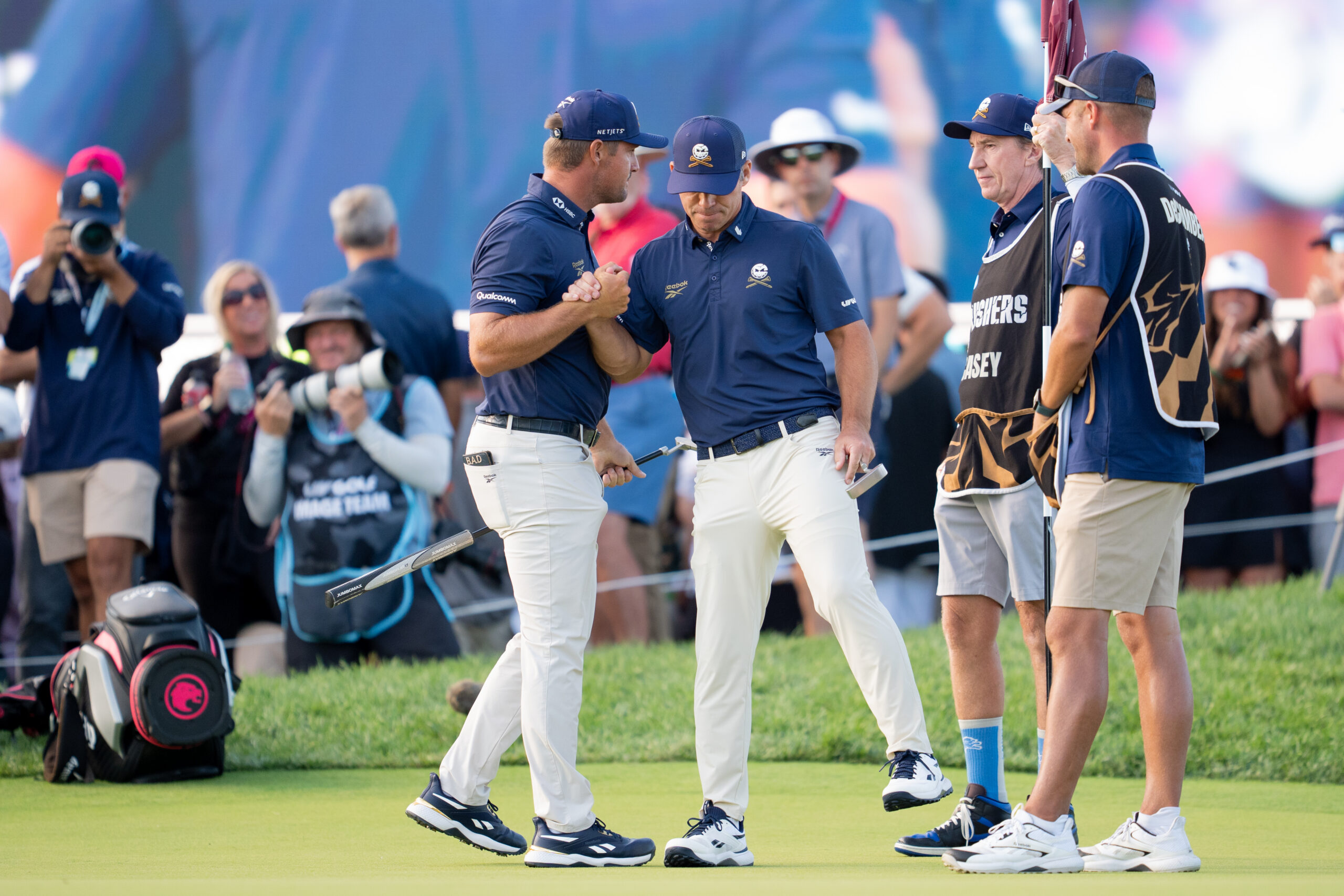
DeChambeau remains one of the most significant unresolved names. The two time US Open champion has not publicly confirmed a final agreement for 2027, despite reports that he wants to remain involved in LIV Golf’s future.
Bryson will return to South Africa shores for the Nedbank Golf Challenge in December, alongside other global superstars like Wyndam Clark, Ben Griffin and Justin Rose.
DeChambeau popularity, strengthened by his social media presence and YouTube content, makes his participation particularly valuable to the league and its host venues.
Smith’s position is also uncertain. The 2022 Open champion, who captains Australia’s Ripper GC, has reportedly sought a release from his existing LIV contract, although he has not publicly confirmed his plans.
LIV Golf Adelaide has been part of the circuit since 2023 and has developed a strong following among spectators and players. The 2026 edition produced a notable moment when Anthony Kim claimed his first professional victory in 16 years.
The tournament’s popularity, however, does not guarantee its future if the league cannot retain enough high profile players.
Kooyonga Golf Club, selected to host the 2027 Adelaide event, has asked a US bankruptcy court to require LIV Golf to confirm by November 6 whether it intends to proceed. The club is also seeking protection against potential financial losses associated with reserving its course for the tournament.
The uncertainty has wider implications for international host venues, including South Africa. LIV Golf is scheduled to return to Steyn City in April 2027, but the league’s financial position and the number of players who ultimately commit could influence the quality and commercial appeal of the event.
For host countries, major golf tournaments offer opportunities to attract visitors, generate hospitality spending and support tourism, while providing exposure through international broadcast coverage and sponsorship. Those benefits depend in part on the strength of the field and the event’s ability to draw spectators.
If LIV Golf enters 2027 with a reduced roster of recognised players, tournaments could face challenges in maintaining ticket demand, sponsor confidence and broadcast interest. A weaker field could also affect the return on investment for local organisers and businesses that commit resources to staging an international event.
These are potential risks rather than confirmed outcomes for the South African tournament. The available information does not establish that the Steyn City event will be cancelled or that its player field will fall below expectations. Its prospects will depend on LIV Golf’s restructuring, its final tournament calendar and the players who agree to participate.
The questions surrounding player commitments are compounded by legal and contractual disputes. The Financial Times report indicated that 23 players remained involved in legal discussions with LIV Golf and the PIF over outstanding money.
Rahm, who reportedly signed a deal worth $450 million when he joined ahead of the 2023 season, is said to have left a substantial amount of potential earnings behind to secure his departure.
Dustin Johnson is also leading a group of players, including Bubba Watson, seeking severance payments from the PIF. The group argues that career decisions were made in reliance on promises that have not been fulfilled.
For prospective players, uncertainty over governance, revenue generation and financial risk is reportedly a key concern. According to the Financial Times, players interested in the restructured league have sought clarification from BC Partners about its authority and governance rights, as well as how LIV Golf intends to generate income.
The outcome of those discussions could determine whether the league can assemble a sufficiently strong field for 2027.
For Malinauskas, the priority is straightforward: Adelaide will only continue if LIV Golf can deliver the quality of competition that has established its reputation. South Africa’s scheduled return to the circuit now sits against the same unsettled backdrop, with the league’s financial recovery and player retention likely to shape the outlook for its international events.
LIV Golf has maintained that its plans remain on schedule, but until more players commit and the future structure becomes clearer, questions will remain over whether the league can deliver the competition its host venues expect.