
By Lehlohonolo Lehana.
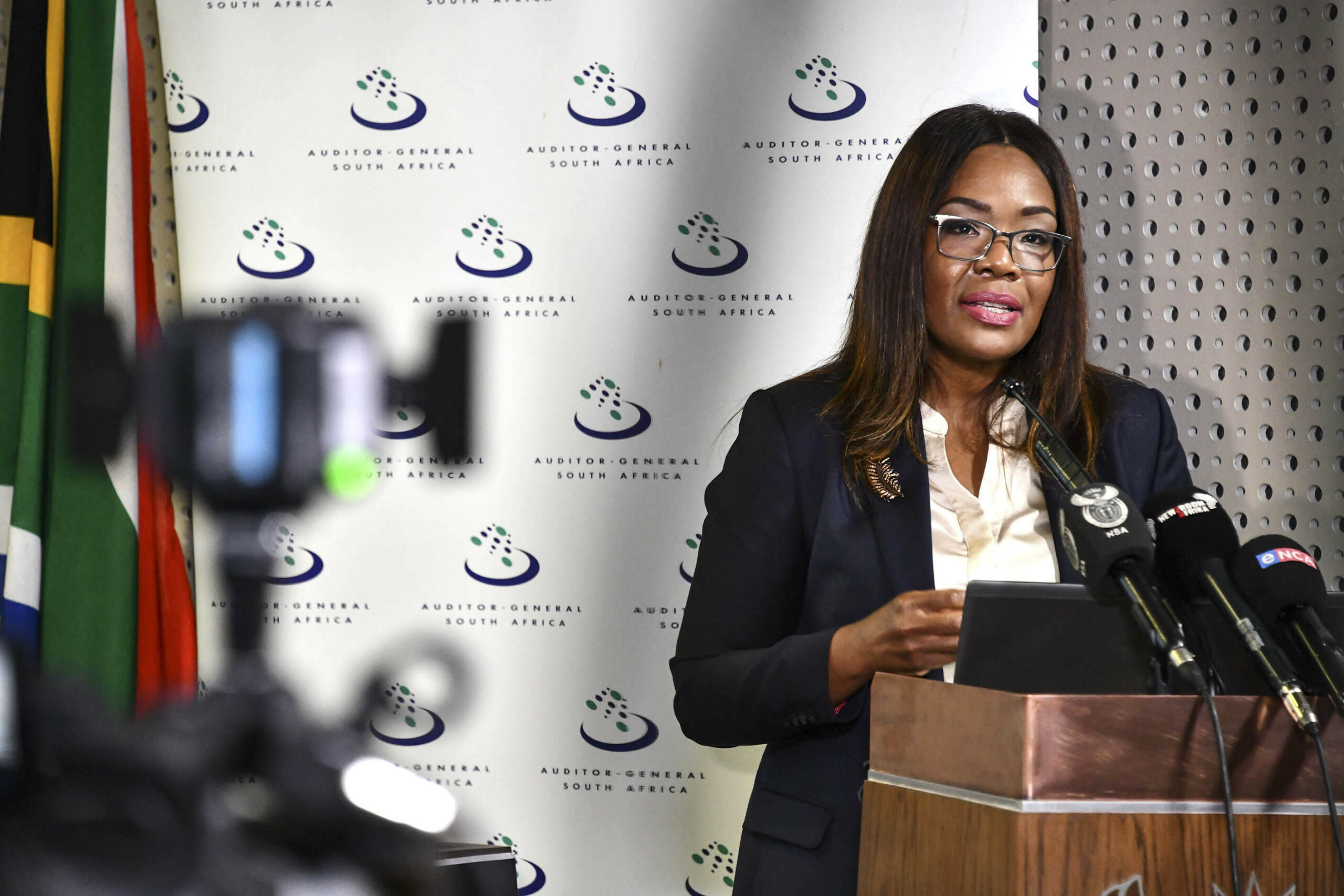
The Auditor General (AG) Tsakani Maluleke on Thursday, 26 March, released 2024-25 consolidated general report on the national and provincial audit outcomes.
Maluleke noted a marginal increase in the number of clean audits, but cautioned that the progress remains slow and uneven. While some institutions have improved their audit outcomes, many continue to struggle with basic financial controls and accountability measures.
She says the gains are limited in impact, as several of the institutions that improved manage relatively small budgets.
“Regressions should worry us because as a nation, we should be striving towards progress. And when you see regressions of this significance, you know that controls are not stable. The rules were stable, so the rules didn’t change. It’s just that the management disciplines and controls went backwards.”
The report also highlights ongoing challenges with late or outstanding audits, which continue to undermine transparency. At the end of the audit cycle, dozens of audits were delayed due to late submission or non-submission of financial statements, although some have since been finalised.
“The reason they would have been outstanding is either because financial statements were submitted late, or financial statements were not submitted at all, or there were particular delays encountered in the audit process,” she explained.
Maluleke raised particular concern about Sector Education and Training Authorities (SETAs), where a significant number received qualified audit opinions. She says this is troubling given the relatively simple nature of their operations.
“The business model of a SETA is actually quite simple. It really isn’t difficult to compile a set of financial statements that are credible within a SETA. And so we have to keep worrying about these auditees that sit in these categories.”
The Auditor-General further warned that broader financial pressures — including rising debt, instability in state-owned entities, and continued irregular and wasteful expenditure — are placing increasing strain on public finances.
“There are significant threats to our fiscal health as a country, and some of those would be the guarantees that are given to state-owned entities. Some of those would be the fact that a number of public entities have got balance sheets that are not quite stable… We’ve seen that fruitless and wasteful expenditure is something that we can easily avoid. However, it does continue to happen.”
AG report has also revealed a pattern of failed infrastructure projects, which have laid bare deep-rooted weaknesses in government procurement, raising concerns about the state’s ability to deliver basic services.
The 152 infrastructure projects, implemented across South Africa by provincial and national departments and five public entities, had a combined estimated cost of R47.39-billion. They covered critical infrastructure such as schools, health facilities, housing, roads, water infrastructure and government buildings.
In his 2026 State of the Nation Address, President Cyril Ramaphosa repeated his promise to turn the country into a giant construction site. He linked the infrastructure roll-out to addressing a wide range of challenges, from the water crisis to unemployment, economic growth and energy.
“Infrastructure is much more than an investment in brick, mortar, concrete and steel. It’s an investment in jobs, productivity and growth. For many years, fixed investment has been declining. We are now changing that.
“Government has committed more than R1-trillion in public investment over three years to build and maintain infrastructure. This is the largest allocation of its kind in our country’s history. It will be transformative,” said Ramaphosa.
Maluleke cautioned against trying to get the job done too quickly.
“Somehow we have to accept that if we are going to give ourselves the best chance of rolling out infrastructure on time, at the right quality, at the right price, we might have to slow down the spending so that it is commensurate with our capabilities,” she said.
She added that many departments and entities across different sectors did not have the capabilities needed to match the scale of infrastructure development.
“We might have to be selective on what we do, when, so that it is matched by adequate capability to ensure that the money goes where it’s supposed to go. One of my anxieties is that money will continue to be sent to different entities and departments, and we’ll wonder why there’s still no cranes across South Africa,” she said.
According to the 2024-25 report, the human settlements sector experienced the longest infrastructure project delays, with some projects delayed for almost 20 years.
“These delays highlight deep-rooted weaknesses in project planning, execution and oversight, “said Maluleke.
The average delay in this sector, the report found, was 71 months — almost six years. (South Africa’s ailing water sector was not too far behind, with an average delay of 69 months.)
Maluleke’s office audited 24 housing projects across all nine provinces with a combined value of R5.67-billion. Of those 24 projects, the AG made findings on 23, while 20 (83%) experienced project delays.
Watch Live in the video below:
Video Courtesy of AG.