
By Lehlohonolo Lehana.
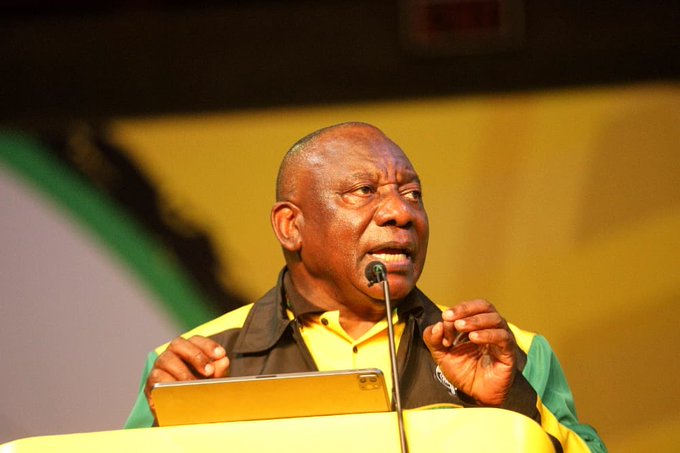
The African National Congress (ANC) President Cyril Ramaphosa unveiled the party’s Action Plan to make local government work better for the people ahead of the municipal elections.
This comes as the ANC’s National Executive Committee (NEC) met over two days in Boksburg to assess the state of local government, with a key focus of the gathering being to find solutions to widespread service delivery failures in municipalities across the country.
Ramaphosa urged municipalities to take decisive action against corruption, adding that even though corruption is most prevalent within municipalities, there is often a lack of political will to hold officials accountable for maladministration.
The President addressed over 4,000 councilors and mayors at the FNB stadium, who are set to account to the ANC NEC on the work they have done since taking office after the 2021 local polls.
The proposed action plan outlines specific roles and responsibilities for ANC councillors, introduces critical intervention mechanisms, and mandates monthly performance reporting.
Ramaphosa emphasised that the plan would be shared with all ANC deployees, accompanied by clear and measurable tasks that must be fulfilled both in government and within the party structures.
This strategic initiative comes at a time when the ANC is facing mounting internal divisions and weakening public trust.
The new action plan is expected to form the backbone of the ANC’s campaign to rebuild its credibility at the local government level — a critical battleground as the 2026 elections loom on the horizon.
Ramaphosa said the ANC would soon establish dedicated teams to pursue and expose criminal networks operating within the state.
“We are going to set up teams that will go after those syndicates. We know them, and we are going to nab them… Free yourself now before it is too late,” he said.
In a desperate bid to restore public trust, the ANC has committed to a process of renewal. This initiative aims to revitalise the party, restore its credibility and address the root causes of its declining support.
He stressed the urgent need to dismantle networks that manipulate appointments and municipal contracts, warning against councillors hiring allies or unqualified individuals simply to “do their bidding.”
“Let us allow those who can do the work to do the work. I know it is tempting for us to hold on. Now, this must end,” he said.
Ramaphosa called on ANC structures to ensure accountability and professionalism at the municipal level, saying communities deserve competent officials and efficient service delivery.
“Citizens are here. They want those who do not serve them well to be moved out. We must not obstruct that.”
He further urged councillors to lead with humility, transparency, and a commitment to public service, warning against arrogance and complacency.
“There is no place for laziness or arrogance. Let us serve our people with the respect they expect.”
Ramaphosa said that improving audit outcomes and the municipality’s finances had to be a priority for every ANC councillor.
Auditor-General report found that only 41 out of 257 councils received a clean audit in the 2023/24 financial year.
“Comrades, it cannot and must not be acceptable that in our country we have, we control a number of municipalities. It is usually painful each time when the auditor-general comes to report to Cabinet and they put up their report and those municipalities that do best are not ANC-controlled municipalities and I can name it here because there is nothing wrong with competition, they are often DA-controlled municipalities.”
Overall, metros have continued to regress from 2021, despite their greater capacity and large budgets.
Of the eight metros, only Cape Town received a clean audit.
Three (Ekurhuleni, Johannesburg and eThekwini) received unqualified with findings audits, and three (Buffalo City, Tshwane and Nelson Mandela Bay) earned qualified with findings audits.
SA’s eight metros are responsible for delivering services to 8.9 million people, or 46% of all households in the country. The financial health of metros remains concerning as they struggle to collect revenue, despite implementing recovery and turnaround plans.
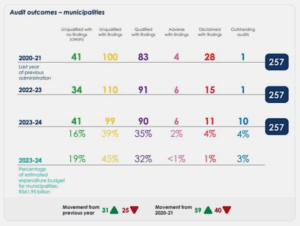
Source: Auditor General.
Another problem is the ongoing non-compliance with procurement legislation, leading to financial losses and contractors not delivering.
Some 214 municipalities had findings on non-compliance with procurement and contract management legislation.
The lack of consequences in local government continuously slows any progress towards improved service delivery and financial performance. This is most evident in poor and slow responses to investigating allegations of financial and supply chain management misconduct and fraud indicators.Also evident is a lack of enthusiasm for dealing with unauthorised, irregular, and fruitless and wasteful expenditure.