
By Lehlohonolo Lehana.
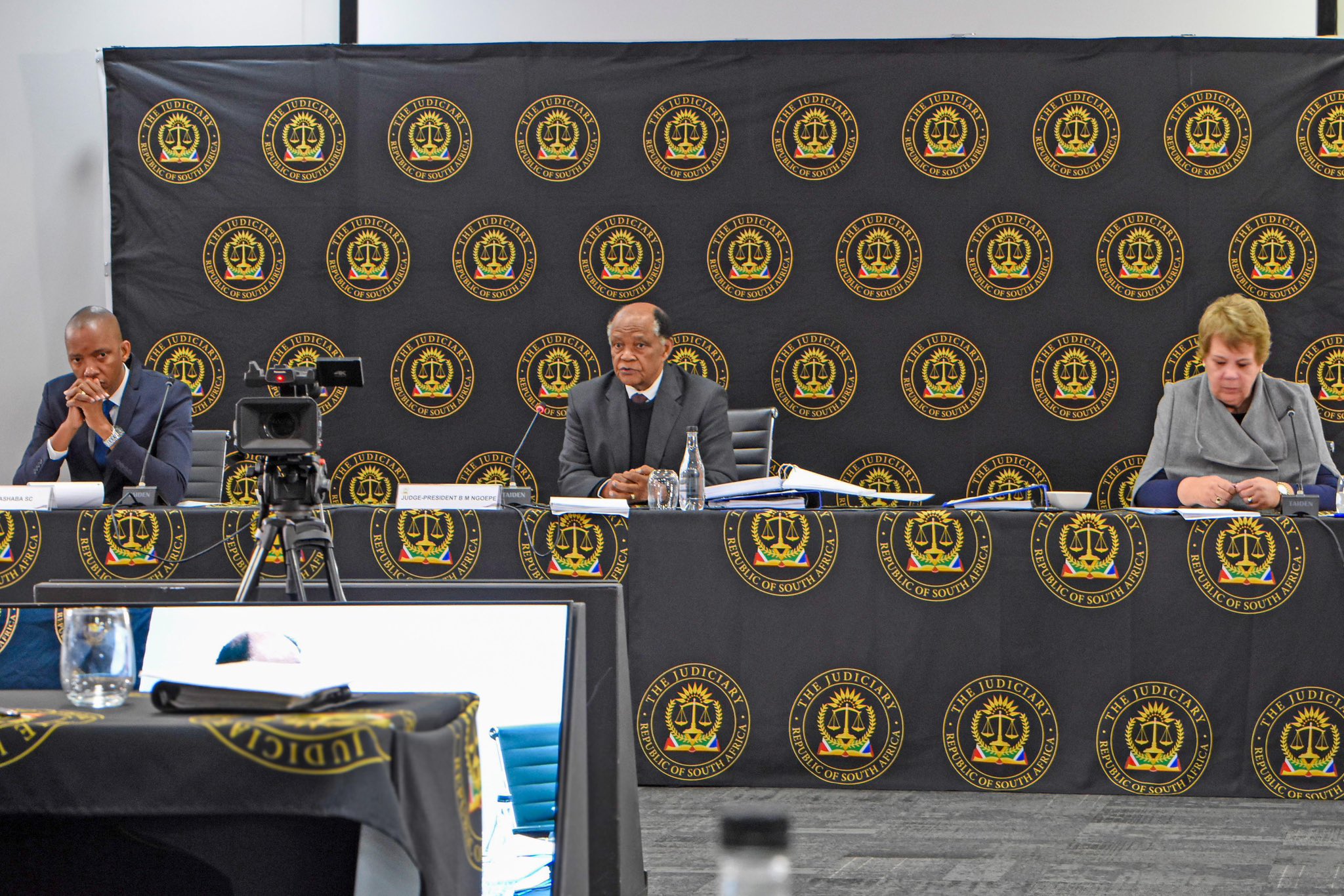
The Judicial Conduct Tribunal heard the closing arguments in the sexual harassment case involving Eastern Cape Judge President Selby Mbenenge.
The tribunal has been probing allegations that Mbenenge sexually harassed court secretary Andiswa Mengo.
Mengo alleges that Mbenenge sent her a picture of his penis and asked her for oral sex in his Mthatha chambers on either 4 or 15 November 2022. Mengo claims he called her into his chambers, pointed to a bulge in his trousers, said “look what you do to me”, and began unzipping his pants. She said she turned and ran out of the office.
In response, Mbenenge claimed that this had been fabricated to embellish Mengo’s complaint.
He provided a detailed account of his movements on those days, backed up by tracking records of his vehicle. He also pointed to the fact that CCTV footage of the passageway outside his chambers did not show Mengo entering or leaving his chambers.
In her submissions, during the proceedings, Mengo’s counsel, Advocate Nasreen Rajab-Budlender SC,said sexual harassment is prevalent in society and in the South African legal profession, “it is more prevalent than the global average and that 43% of women in the profession reported experiencing sexual harassment while 25% have considered leaving or have left the profession” as a result of sexual harassment.
“We submit that in JP Mbenenge’s case, there is no circumstance under which it was appropriate conduct for him as a leader and judge to engage in the manner that he did with Ms Mengo.”
Advocate Muzi Sikhakhane for Mbenenge said that while the Judge President pursued a romantic, flirtatious relationship with Mengo, he cannot be punished for it.
He denied that his advances were unwanted, but conceded they “simply lacked elegance”.
Sikhakhane has accused Mengo of fabricating the facts.
In her closing argument evidence leader Advocate Salome Scheepers said Mbenenge’s version of events was not credible, insisting that Mengo’s testimony had remained consistent throughout the proceedings.
According to Scheepers, Mengo did not sensationalise the conduct; she reported exactly what happened.
“She was specific, crude and uncomfortable yet contained,” Scheepers told the tribunal. “Her reaction, her evident distress and her communication with colleagues supported her version of events.”
Scheepers said Mengo had used humour, including laughing emojis as a way to deflect from Mbenenge’s sexually charged comments, rather than encourage them.
“The laughing emojis displayed discomfort on Mengo’s side,” Scheepers said.
She further referred to testimony by Abongile Tshete, who said they became aware of the alleged harassment through Mengo’s WhatsApp statuses.
Scheepers also criticised the credibility of Dr Vincent Mello, an expert witness called by Mbenenge’s legal team, arguing that he was not qualified to analyse emojis.
“He conceded that based on the information before him, he was unable to track where the messages were from,” she said.
She dismissed Mbenenge’s claim that his messages reflected flirtatious behaviour and that he intended to pursue a consensual relationship.
While the respondent [Mbenenge] alleged that he was showing flirtatious behaviour and wanted a relationship with the complainant, based on what he was saying on WhatsApp, that is far from the truth.
“He asked for his messages to be deleted because he was worried about his family finding out. Those are not the actions of a good man; it’s just a man who wants to cover his tracks,” she said.
She described Mbenenge’s communications as persistent sexualised communication and urged the tribunal to find him guilty of gross sexual misconduct.
While the matter is precedent-setting in that it is the first case in which a judge president is made to answer to allegations of sexual harassment before a Judicial Conduct Tribunal chairperson, retired Gauteng High Court judge president Bernard Ngoepe said that the outcome of this Tribunal hearing will not determine how other cases of sexual harassment in the judiciary will be handled.
“Each case is adjudicated accordingly to its own facts. We are going to determine this case according to the law and facts before us. As for what the outcome will be, we don’t know, “said Ngoepe.