
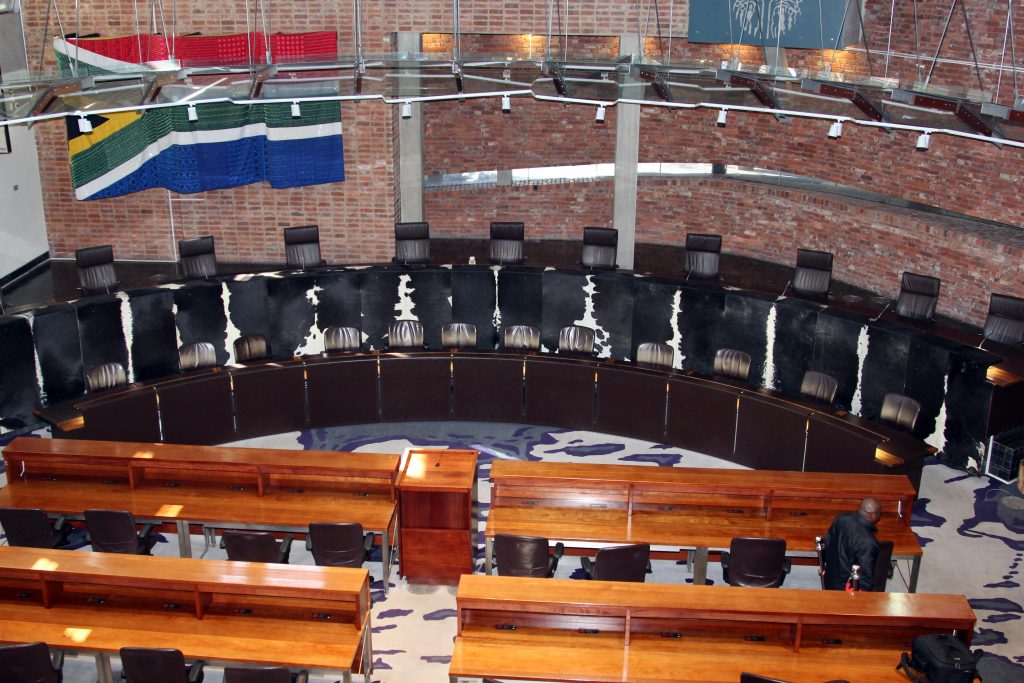
By Lehlohonolo Lehana.
The Constitutional Court ruled that only the National Executive (Minister of Justice), has the authority to file extradition applications for accused individuals in foreign states.
For decades, the National Prosecuting Authority (NPA) has applied to foreign countries to extradite alleged criminals to face trial in South Africa. According to the ConCourt, that power rests with the Justice Minister.
Johnathan Richard Schultz, who now resides in the US, initially brought the case challenging his extradition, which raised the loophole.
When his co-accused appeared in court, the NPA sought a postponement to allow time for the prosecution team to request Schultz’s extradition from the US, which has not happened to date.
Schultz believes that only the Minister of Justice, and not the NPA, can legally make such a request under South African law. In 2022, the Gauteng Division of the High Court in Pretoria disagreed and found in favour of the NPA, which argued it had the power to initiate the requests, as it had done so in good faith for decades.
In December 2024, however, the Supreme Court of Appeal (SCA) overturned the Pretoria high court decision and agreed with Schultz when it ruled that the NPA had, in fact, overstepped because the Extradition Act of 1962 never explicitly gives the NPA the authority to make outgoing requests.
Another person who has benefited from loophole is former ANC secretary-general Ace Magashule’s former personal assistant, Moroadi Cholota, who was extradited to South Africa in August 2024 in connection with the R255-million asbestos scandal, which included charges of fraud, corruption, theft and racketeering.
When the Free State High Court set Cholota free in 2025, it relied heavily on a 2024 Supreme Court judgement which found in favour of Schultz.
At the heart of both matters is whether the NPA has the power to make an extradition request or if that power lies with the minister of justice.
In a judgment handed down on Friday, the apex court delivered a split outcome that affirmed both Cholota’s complaint about how she was brought back to the country and the National Prosecuting Authoritys’ argument that an irregular extradition alone does not deprive a court of jurisdiction
ConCourt has upheld a ruling of the Free State High Court in Bloemfontein that Cholota’s extradition from the United States was unlawful.
However, the Apex court found that this does not deprive South African courts of jurisdiction to prosecute her.
The accused are alleged to have failed to replace hazardous asbestos roofs at more than 300,000 homes in Free State townships.
Delivering judgment, Deputy Chief Justice, Dunstan Mlambo, addressed the issue of jurisdiction after the High Court declined to prosecute Cholota, citing that her extradition had been requested by an incorrect state functionary.
Mlambo warned that such an approach would undermine efforts to combat impunity.
“Such reasoning is not supported by the facts and would not strike an appropriate balance between the concern for lawful process and the imperative to combat impunity.”
National Prosecuting Authority spokesperson, Mthunzi Mhaga, says the ruling vindicates the State.
“The interpretation is that the SCA judgment or pronouncement that the national executive makes or has the power to make the execution requests is affirmed. However, in so far as the judge refusing to hear or have jurisdiction to hear the matter, we obviously vindicated in the sense that the matter is now remitted to the High Court so that the other grounds of special plea can be adjudicated. Already, the Constitutional Court has said that her extradition was unlawful,” Mhaga said.
The matter will now return to the High Court.
The Constitutional Court also refused to allow a late leave of appeal application on the Schultz matter, criticising the NPA’s reasons for late filing, saying it “left much to be desired”.
The NPA said part of the delay happened because it thought the Department of Justice would appeal, and because it was hard to get counsel owing to the State Attorney’s slow processes.
“The court found that neither of these reasons was satisfactory. A litigant cannot escape the obligation to comply with the court’s rules on the mere allegation that it thought another cited party would lodge an appeal,” reads the judgment.
The court found the risks, as argued by the NPA, were largely overstated and that the legal system could handle it.
“Even without the relief sought by the applicants to limit the retrospectivity of the Supreme Court of Appeal’s judgment, the harm they feared to the administration of justice is largely, if not completely, ameliorated,” the court found.
The National Prosecuting Authority (NPA) has been ordered to pay Schultz’s costs, including the costs of two counsel.