
By Lehlohonolo Lehana.
Congress of South African Trade Unions (COSATU) is holding its rescheduled 15th national elective congress from Monday to Wednesday at Emperors Palace in Kempton Park.
The initial congress collapsed in September 2026 and failed to reach a quorum within the constitutionally required 30-day window due to deep-seated leadership disputes.
Over 1,800 delegates from 16 affiliated trade unions are participating in the rerun to elect new leadership and adopt policy resolutions.
The congress’s premature collapse was attributed to Nehawu’s decision to suspend its president Mike Shingange just prior to the event, raising questions about his eligibility to run for the presidency.
Despite this setback, as deputy president of Cosatu, he retains the right to be elected under the federation’s constitution.
The Cosatu presidency carries considerable historical significance.
Established in 1985 as the successor to the struggle-era South African Congress of Trade Unions, the federation has played a pivotal role in championing labour rights and shaping South Africa’s political landscape, particularly under the ANC.
Support for Shingange is split among the unions. He enjoys backing from the National Union of Mineworkers and several others, while significant opposition stems from his own union, Nehawu, and other affiliates.
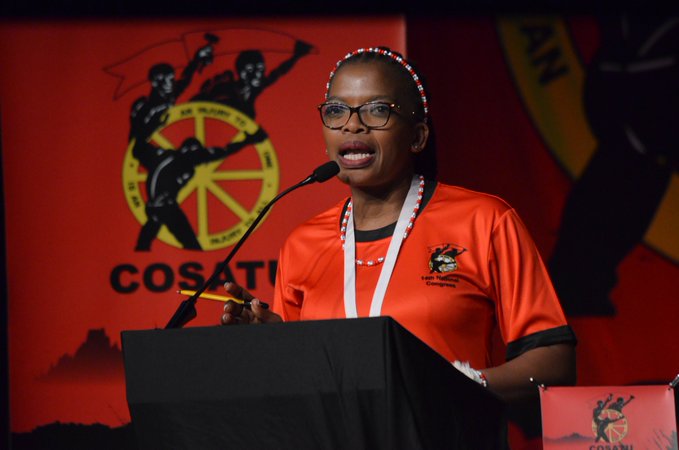
Delivering the opening address Cosatu president Zingisa Losi said the federation needed to prioritise the working class over individual leaders and organisational interests.
“There is no enemy amongst us. Our enemy is unemployment. Our enemy is exploitation. Our enemy is poverty and inequality. Our enemy is crime and corruption. It is racism and sexism. It is homophobia and gender discrimination,” she said.
Losi described the weeks following the premature adjournment of the congress in September as difficult for the federation, its affiliates and leadership, as well as workers who depended on Cosatu for representation and protection.
She said the dispute had tested the federation’s unity and warned against allowing internal disagreements to derail its broader mandate.
She urged delegates to choose unity over division, arguing that the federation’s strength depended on its ability to act collectively.
Losi also defended Cosatu’s alliance with the African National Congress (ANC) and the South African Communist Party (SACP), describing it as a vehicle for advancing transformation and working-class interests.
“The alliance remains the most effective and progressive political vehicle to advance transformation,” she said.
After a smooth start, the ANC chairperson Gwede Mantashe staged a walkout after refusing to address the congress before the SACP.
Mantashe led the ANC delegation at the gathering but objected to the speaker lineup, citing historical precedence regarding the order of addresses.
He rejected suggestions that his decision to leave was driven by pride, saying he would not abandon his principles for convenience.
“You do the right thing, whether it is painful or not. You don’t change it as you like, and one of the things I will never do is to give up a principle for convenience,” he said.
The walkout drew criticism from several Cosatu affiliates, which said the ANC delegation should have respected the congress programme.
SACP secretary general Solly Mapaila used the message of support by calling for full implementation of the Freedom Charter, particularly its provisions on the right to work and the transfer of monopoly industries into public ownership.
“The right of all to work has not been put into practise precisely because we have followed a capitalist path of development. We have deviated from the central core of the Freedom Charter,” he said.
Mapaila renewed the SACP’s call for the reconfiguration of the alliance, saying the aim was to strengthen collective decision-making and accountability rather than allow any partner to micromanage the state.
He said the alliance needed to work collectively to implement its shared programme and address disagreements over economic policy, austerity and public-sector job cuts.