
By Lehlohonolo Lehana.
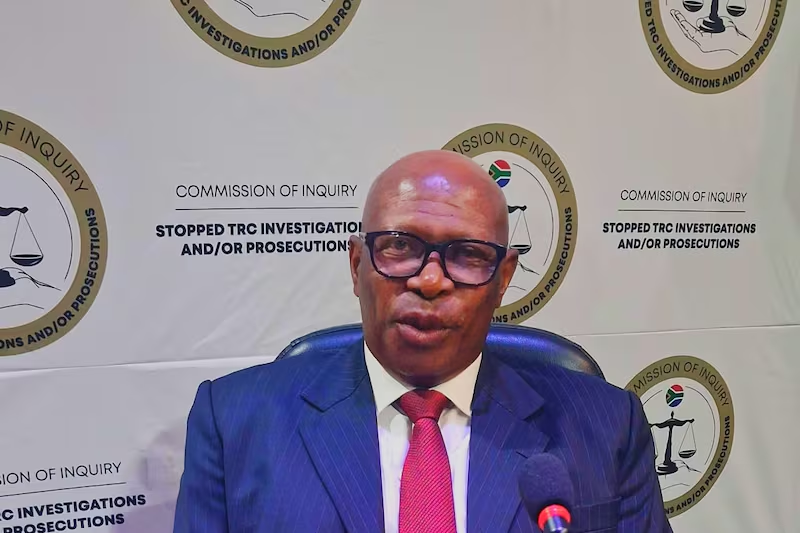
The Truth and Reconciliation Commission (TRC) Cases Inquiry resumed on Wednesday with the cross-examination of former National Director of Public Prosecutions (NDPP) Bulelani Ngcuka.
The inquiry, chaired by Justice Sisi Khampepe, is probing allegations of political interference in the prosecution of apartheid-era crimes that were not pursued after the work of the Truth and Reconciliation Commission.
Ngcuka told the inquiry he appeared voluntarily to account for decisions taken when TRC-related cases were referred to his office. He said he was determined that apartheid-era crimes revealed through the TRC process would not collapse due to weak prosecution.
He testified that when he took office in August 1998, the NPA was newly established and faced significant resource constraints, low morale within the prosecution service and high levels of violent crime nationally.
Ngcuka was a central figure in the state’s handling of thousands of TRC cases after the commission’s final 2003 report.
Concerning the cases which were never pursued after his exit from the position, Ngcuka said “I was very sore about those cases, the TRC cases. Given my relationship with the victims.
“Mrs [Victoria] Mxenge was killed on 1 August [1985], a week before she was the main speaker at the [Mathew] Goniwe and [Fort] Calata funerals in Cradock. And she was killed.”
Mxenge was assassinated in her driveway in front of her three children by four men after returning from a political meeting. Marvin Sefako confessed to her murder. The other suspects have never been found.
Ngcuka completed his articles with the Durban law firm of Griffiths Mxenge after obtaining his B.Proc at the University of Fort Hare in 1977. He completed his articles in 1981, the year Mxenge was brutally assassinated.
The details of the atrocity that was the extra-judicial killing of Griffiths Mxenge are important to recount, to once again place on record the depravity of his state-sponsored murderers.
Mxenge was abducted in Umlazi by a Vlakplaas apartheid death squad led by Dirk Coetzee that included askaris (turned liberation movement operatives) Almond Nofomela, Joe Mamasela, Brian Ngqulungu and David Tshikalanga. Mxenge was stabbed more than 40 times, his throat was slit, his body mutilated, his ears cut off and his stomach ripped open.
Solving these killings, said Ngcuka, “were the things I wanted to do”. He said the building that housed the NDPP at the time had been named the “Victoria and Professor Mxenge Building” in honour of the murdered activists.
Ngcuka cited the challenges and difficulties of prosecuting cases where there was insufficient evidence. He referred particularly to the haunting September 1977 murder by security police of Black Consciousness leader Steve Biko.
While it was common knowledge that the police had murdered Biko, Ngcuka and his team realised they lacked the “evidential sufficiency” to guarantee a conviction in a court of law.
Ngcuka agreed with advocate Kgomotso Moroka, representing the Department of Justice and Social Development, that under Section 179 (5) of the Constitution, the NDPP “must determine prosecution policy in concurrence with the Cabinet minister responsible for the administration of justice”.
This meant that the authority had to “work closely” with the department, Ngcuka told the inquiry and that requests by former Justice Minister Bridgette Mabandla to discuss policy matters did not constitute political interference, but were rather “a necessary part” of the legal relationship.
“It never happened during my time,” Ngcuka categorically told the panel, adding, “You know this thing about political influence, if you allow it as a national director, of course there will be. The decision is yours and yours alone. And you tell people this is how it is going to work.”
Testifying earlier at the inquiry, Dr Silas Ramaite, former special director of prosecutions, said that Mabandla had informed him in 2004 that an “outside mechanism”, the “Amnesty Task Team”, had been established “to investigate TRC prosecutions” and that all cases should be placed on hold.
Ngcuka maintained that prosecutions should have proceeded only where there was a reasonable prospect of success, a policy rooted in constitutional mandates rather than political preference.
He said he had not personally attended a meeting in 2003 convened by the Department of Justice to discuss amending prosecutorial policy for TRC matters.
Two colleagues who did, reported back that there was “no need for the NPA to participate or change its guidelines”. The matter, according to Ngcuka, ended there.
By the time he left office, the NPA had undergone a “significant institutional reform”, said Ngcuka.
While only six of the 21 priority TRC cases had reached court during his tenure, Ngcuka defended the track record as “good work”, given the limited resources and the “complex and constantly evolving” terrain they navigated.
He told the commission he did not perceive former president Thabo Mbeki’s April 2003 speech to Parliament as seeking to put in place special arrangements to replace the TRC Amnesty process.
Mbeki has been accused by some, such as former NPA head Advocate Anton Ackerman, of signalling an attempt to re-run the TRC Amnesty process.
He had said that the door would be opened to those who had not applied for amnesty to enter into special arrangements with the NPA.
He was also asked to reflect on a secret memorandum from Vusi Pikoli, who succeeded him to the Mabandla, where the former complained of political interference by a forum of directors general.
The memorandum wanted him to wait for its recommendations before proceeding with prosecutions.
Ngcuka said, he is hesitant to judge those who succeeded him at the NPA.
“You don’t know the circumstances under which they were operating. One does not have all facts. And I don’t want to be seen as critical of my successors. But let me say this, I cannot find any reason why the national director can say he does not know what to do.”
“The law is clear. You make the decision. You prosecute. You don’t ask for advice from other people. That would have been my view. So I don’t know what caused my colleague to make that decision. But at the end of the day, he should have been the one to say no,” explained Ngcuka.
Ngcuka said he too was frustrated by lack of progress.
To centralise this effort, he established the Priority Crimes Litigation Unit (PCLU) and issued a directive that all TRC-related dockets — many of which were collecting dust in forgotten offices — be brought to his headquarters.
Many cases were decades old, evidence had been destroyed, and witnesses’ memories had faded.
Despite his personal drive, Ngcuka frequently clashed with other state organs. There was palpable tension between his elite “Scorpions” (the Directorate of Special Operations) and the South African Police Service (SAPS), he told the inquiry.
The police felt the Scorpions received better resources and more media attention. At one point, SAPS leadership even refused to provide investigators to Ackermann, suggesting instead that Ngcuka approach Mbeki to resolve the matter—a suggestion Ngcuka dismissed as “nonsensical”.
Throughout his tenure, the spectre of political interference loomed large in public discourse, but Ngcuka was adamant that he never tolerated it.