
By Lehlohonolo Lehana.
President Cyril Ramaphosa has formally received a collective declaration representing the voices of workers, civil society, youth, women, persons with disabilities, and vulnerable communities across the globe.
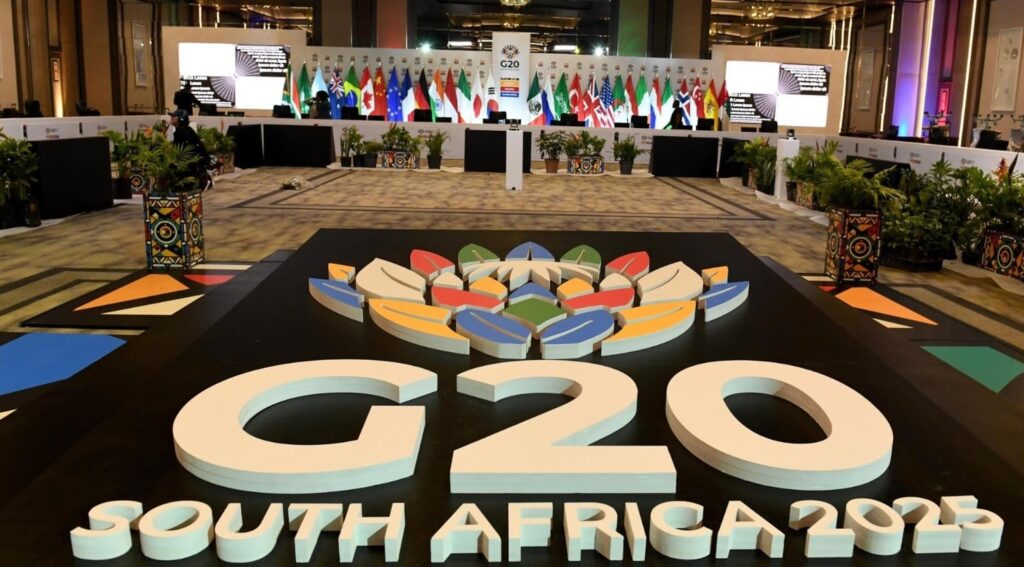
The declaration was delivered on stage by South Africa’s young leaders at the G20 Social Summit that was held at the Birchwood Hotel and OR Tambo Conference Centre on Thursday.
The three-day summit, which began on Tuesday, saw thousands of delegates from all walks of life, to air their views ahead of the long-awaited G20 Leaders’ Summit, taking place over the weekend.
The three-day G20 Social Summit is designed as an inclusive platform to amplify the voices of civil society, grassroots organisations and communities.
In a groundbreaking moment for international diplomacy, the G20 Summit has landed on African soil for the first time, marking a pivotal chapter in global governance.
The summit, hosted in South Africa, is emerging as a powerful platform for challenging existing global power structures and demanding meaningful African representation.
Dr William Carew, representing the African Union’s Economic, Social and Cultural Council, delivered a passionate address that cut to the heart of the continent’s long-standing marginalisation.
“We are no longer content to be observers of our own destiny, but we are builders of a new global war, “he said, stressing Africa’s determination to author its own narrative.
Professor Narnia Bohler-Muller, representing the G20 engagement groups, further amplified the call for systemic change.
“We meet at a time of compounding crisis… climate collapse, democratic erosion, backsliding on human rights, economic precarity and deepening inequalities.”
The G20 Social Summit stands as a landmark moment, signalling a potential shift from a world order built on historical inequities to one founded on genuine solidarity, equality, and shared prosperity.
After receiving the declaration, Ramaphosa embraced the children and took photographs with them, calling the moment a powerful expression of what he has repeatedly emphasised throughout the summit; inclusiveness, shared leadership, and people-centred participation.
The declaration, representing outcomes of over 230 community dialogues held nationwide as part of South Africa’s “People’s G20,” outlines the collective global priorities for a fairer, more inclusive multilateral order.
Guided by the African philosophy of Ubuntu “I am because we are” the declaration calls for digital inclusion for all.
In the declaration, delegates demand affordable and equitable access to digital infrastructure, universal digital literacy, and human-centred governance of artificial intelligence. The declaration stresses stronger online safety measures and the protection of children, women, and vulnerable groups from digital harm.
The declaration also calls for a fair and inclusive trade, resilience, and inclusive value chains.
“The rise of protectionism and increased volatility in global markets threaten the stability of multilateral trade, placing additional pressure on economies that are least equipped to absorb such disruptions.
“We affirm that diversification of products, markets, and supply sources strengthens resilience; however, resilience alone is insufficient to ensure that trade works for all. We underscore the importance of transparent, predictable, and responsive trade governance systems that enable swift adaptation to shocks and structural changes, “the declaration read.
The declaration also emphasised that the G20 has a critical role in restoring confidence in global trade and ensuring that the benefits of production networks and supply chains are shared equitably.
It also called for climate justice, and a people centred Just Transition. With global warming threatening to exceed 2.5°C, delegates emphasised the need for climate action that balances ambition with justice.
The declaration calls for:
• A people centred Just Transition.
• A Just Transition Facility providing grants and concessional finance.
• Debt relief mechanisms linked to climate action.
• Universal access to affordable, clean energy by 2030; and
• Urgent action to eliminate pollution damaging ecosystems and human health.
The delegates also called for the reformation of the global financial architecture. The declaration highlights the inequities embedded in current global financial rules that disproportionately burden developing countries. It calls for reforms to credit rating systems, International Monetary Fund (IMF) frameworks, and Special Drawing Rights (SDR) allocation models, alongside innovative tools such as century loans, strengthened sovereign wealth collaboration and expanded access to long-term, inclusive development finance.
The acceleration of the Sustainable Development Goals (SDG) also formed part of declaration. Noting that only 18% of SDG targets are on track, delegates call for transparent national reporting, ethical governance, and innovative financing models to close the SDG investment gap.
The declaration emphasises that development must be judged not only by growth, but by dignity, equality, opportunity, and the well-being of people and the planet.
The declaration concludes with the announcement of G20 Social Summit Legacy Projects, designed to institutionalise people-centred participation and ensure that the voices amplified under South Africa’s Presidency remain embedded in future global decision-making.
Ramaphosa also used his G20 Social Summit closing address to urge urgent global action against gender-based violence, calling it a national disaster.
He said no nation can thrive while its vulnerable citizens, including children and women, are abused by those who should be protecting them.
Ramaphosa stated that in South Africa, this process will be sped up as the government is at the centre of protecting its most vulnerable citizens.
“In South Africa, women need support and protection from the government and men. We are now going to classify GBVF as a global crisis to be addressed. We have agreed, among all our social partners, to take concerted efforts to end this crisis,” he stated.