
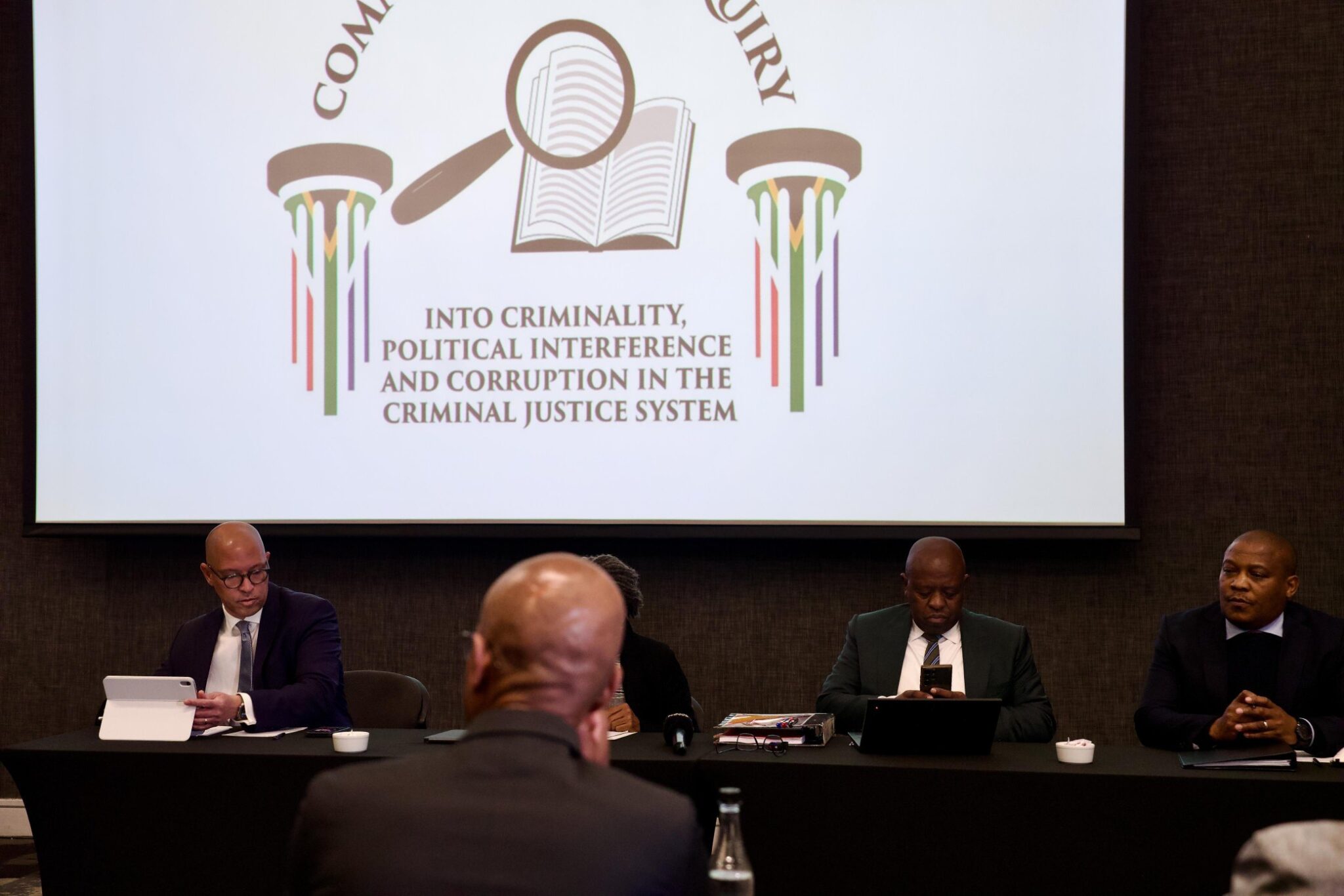
By Lehlohonolo Lehana.
The Madlanga Commission of Inquiry is still focusing on the hit squads operating in KwaZulu-Natal (KZN) and consisting of members of the South African Police Service (SAPS) who commit extra-judicial killings.
The ‘hit squads’ target suspects in Cash-In-Transit (CIT) robberies, as well as taxi operators and drug syndicates under the guise of a Task Team.
These were under the command of South African Police Service (SAPS) officers Lieutenant Colonel Deendayalan (Deena) Govender, Colonel Mbongeni Khalishwayo and Captain Pedro Rodrigues.
The Independent Police Investigative Directorate (IPID) investigator Len Barnabas John was the first witness to testify on the hit squads.
On Thursday, 13 August 2026, the commission heard an explosive phone call between slain drug lord and tow-truck operator, Bevin Loftus, and his rival, panel-beating and tow-truck businessman, Clive Naicker.
Loftus, affiliated with a drug gang in KwaZulu-Natal, was killed on April 1 2023 with four other people ― Ryan Santos, Chase Fynn, Michigan Hippolet and Sihle Zondi.
The recording was played during testimony by Loftus’s father, Gregory, who believes his son was killed by a Hawks task team acting on Naicker’s instructions.
In the recording, Bevin is heard accusing Naicker of putting up R2.5 million for his assassination, while Naicker accuses Loftus of killing his uncle.
Before ending the call, Loftus is heard telling Naicker: “The fastest lives the longest,” suggesting that time would tell who would be killed first.
Gregory told the Commission he witnessed the call, which his son made on speakerphone.
He said Bevin was enraged by rumours of an impending attempt on his life and had been staying indoors for months out of fear for his safety.
The retired South African Police Service (SAPS) Captain, Ashley Houston, testified that Bevin was associated with a drug-dealing gang known as “Hollywood”.
Houston said Loftus was often seen at the gang’s alleged drug den with its leaders.
He told the Commission that he once arrested Loftus after a complaint was lodged against him for allegedly threatening to shoot a warrant officer.
Houston said no other police officer was willing to arrest Loftus, fearing they could be harmed by him or his alleged associates.
He further testified that one of the leaders of the Hollywood drug cartel, whom Loftus was often seen with, is a convicted fugitive.
Houston said the Hollywood gang was involved in turf wars with other gangs in Wentworth, Durban, with members being killed on a weekly basis.
The shooting of Bevan and his friends took place against the backdrop of extraordinary violence in the tow truck industry and in the drug trade, where the assassination of key players has shaken both markets dramatically.
At the scene of Bevin shooting, KZN police commissioner Lieutenant General Nhlanhla Mkhwanazi bemoaned the use of ride-hailing drivers (like Uber and Bolt) to transport drugs. Police and security experts frequently link drug trafficking to transport-related companies, including tow trucks, taxis and logistics.
While Naicker described Bevin as evil, Gregory said his son stood his ground in the tow trucking and taxi business that were frequently characterised by extreme violence.
Meanwhile the commission served Joe “Ferrari” Sibanyoni with a Rule 10.6 Notice seeking answers on matters linked to the taxi industry.
Sibanyoni received the notice last week, according to reports, and could be called to testify before the commission.
A Rule 10.6 notice is a formal legal notification issued by the commission, and it also compels designated persons to respond in writing or make representations regarding specific allegations.