
By Lehlohonolo Lehana.
The inquest into the 1985 murders of the anti-apartheid activists known as the Cradock 4, resumed in the High Court in Gqeberha on Monday.
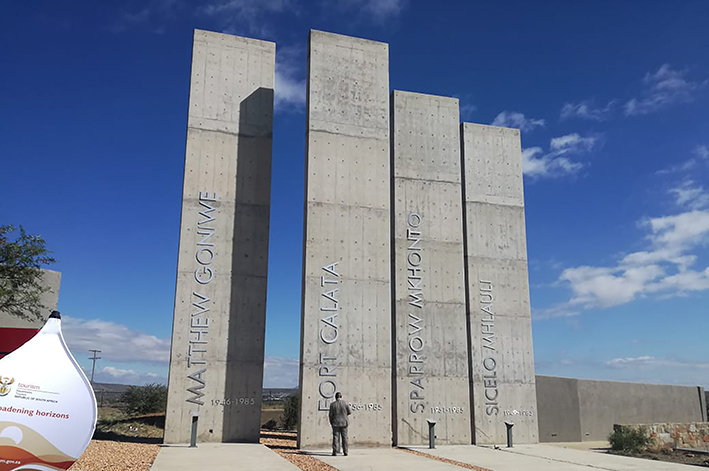
The Cradock Four — Matthew Goniwe, Fort Calata, Sicelo Mhlauli, and Sparrow Mkhonto — were activists from the Eastern Cape who were abducted, tortured and killed near Gqeberha (Port Elizabeth).
Their charred remains were discovered outside the city.
Two earlier inquests were held — the first, which ran from 1987 to 1989, concluded that unknown assailants killed the men, while a second inquiry in 1993 found unidentified police officers had murdered them.
Advocate Howard Varney, acting for the families of the Cradock Four, said in his opening address, when the inquest started a few months ago, that the men were murdered as part of a calculated and premeditated decision taken at the highest level of the apartheid government’s state security system.
He said that despite trying everything in their “security toolbox”, the apartheid state was unable to break the defiance campaign led by the Cradock Four.
Mbulelo Goniwe, the nephew of Matthew Goniwe, took to the stand on Monday to provide contextual” evidence about his ties to the Cradock Four and the role that he played in the formation of the Cradock Residents Association and the Cradock Youth Association.
“Matthew was like my father, not just my uncle,” he said. “It was a role he embraced fully. He was my role model.”
He said that as the defiance campaign continued, Cradock became a priority for the Security Branch, and they were subjected to constant surveillance.
He said that under the leadership of the Cradock Four they created structures that had credibility within the community. He said the success of the United Democratic Front and civic structures set up by these community leaders led to a successful defiance campaign in the area.
On Tuesday, United Democratic Movement leader and head of the former Transkei military ruler, Bantu Holomisa testified at length about a military signal that emanated from the Eastern Cape to military headquarters and that called for the permanent removal of Goniwe, Mhlauli, Mkhonto and Calata.
Holomisa, was asked what he thought the phrase meant. “The understanding I have, was that these people must be killed.”
He was also asked about a letter that he had written to the late former president, F W de Klerk, regarding extra-judicial killings that activists blamed on a so-called third force.
Holomisa said, he did nothing once the evidence came to light.
He said the apartheid government kept denying these claims, saying it was propaganda against them.
“The evidence led at the Truth and Reconciliation Commission proved beyond reasonable doubt that this violence was sponsored by the apartheid state,” he testified.
Holomisa said he came across a secret military communication known as “the signal” and subsequently leaked it to the press in 1992.
In 1999, eight former police officers applied for amnesty before the TRC for their role in the abduction and murder of the four activists.
They included Hermanus du Plessis, who drafted the death order; Eric Taylor, who confessed to the killings; Harold Snyman, Nicolaas Janse van Rensburg, Gerhardus Lotz, Sakkie van Zyl, Jaap van Jaarsveld and Eugene “Prime Evil” De Kock. Only De Kock and Van Jaarsveld were granted amnesty.
Meanwhile former Vlakplaas commander, De Kock will not testify tomorrow due to ill health.
His lawyer Advocate Juan Schoeman told the court that his client is being treated for heart failure and would be unavailable to testify before the inquest for at least two to four weeks.
“I can’t take it further than that because I don’t know if his condition will worsen or get better, within a month.”
Legal counsel for some of the former security officers scheduled to testify objected to the application for the hearing to continue, saying their clients would be prejudiced if they gave evidence without knowing if De Kock will implicate them in any matters.
Advocate Schoeman in turn, told Judge Thami Beshe, that his client would confine his direct testimony to what he had told the Truth and Reconciliation Commission (TRC) in the past.
Advocate Varney, asked Judge Beshe consider what the impact of yet another delay would have on the families of the victims.
In considering all the arguments, Judge Beshe, ruled that “it will be in the interest of justice that this court continues to hear the evidence of witnesses other than De Kock in his absence or unavailability.”
Judge Beshe said the persons of interest will have an opportunity to respond to De Kock’s testimony at a later stage, if advised so by lawyers.
It is unclear when De Kock will be given a clean bill of health by his doctors, allowing him to appear before the inquest.
De Kock was the police colonel in command of a notorious unit known as Vlakplaas during the apartheid era. Vlakplaas itself is a farm west of Pretoria that was the headquarters of the South African Police counterinsurgency unit, known as C10 and then later C1. Vlakplaas and was established and then run by firstly Dirk Coetzee and then De Kock himself.