
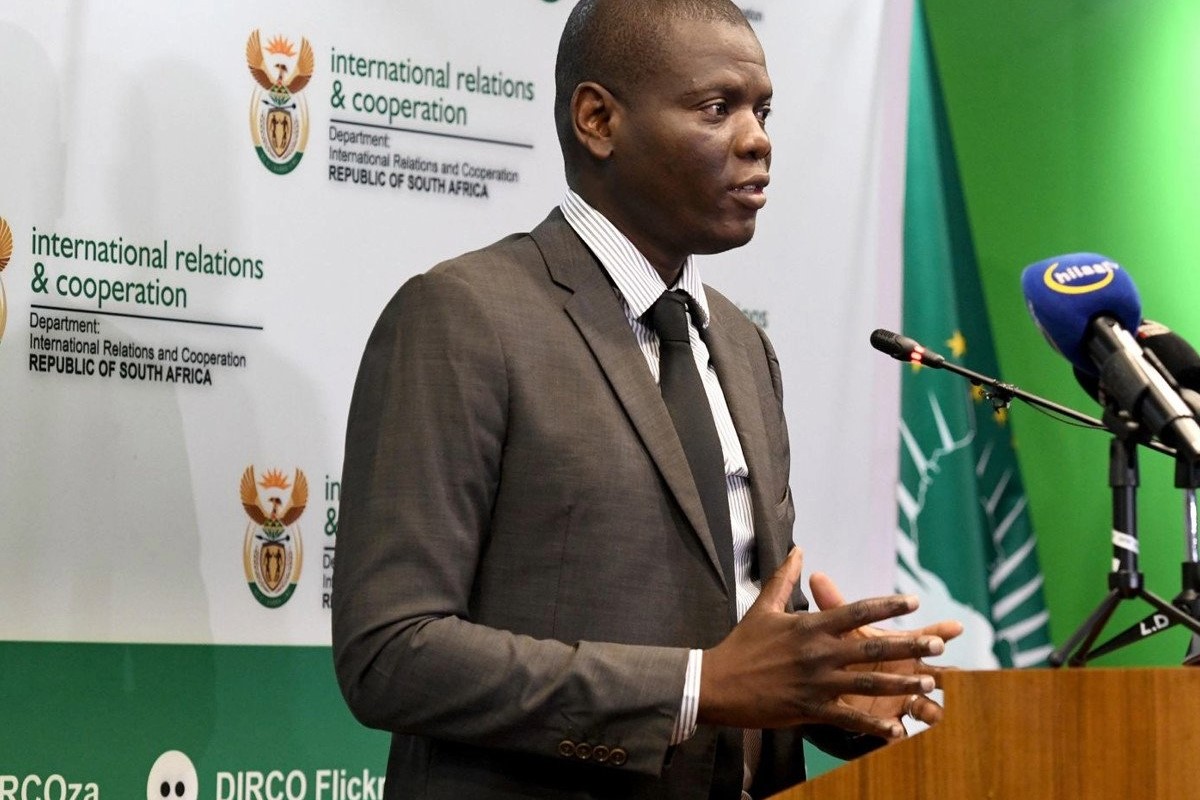
By Lehlohonolo Lehana.
“We have signed a non-disclosure agreement to continue engaging with the process of the tariff to reduce the 30% that has been imposed on SA,” he said.
He noted that the challenges related to tariffs are not unique to South Africa, with many countries, including India, Brazil, and Switzerland, facing similar issues.
“We have to continue to engage and put effort into diversifying our markets in the East and other countries that remain open to trade in South Africa,” he said.
Lamola said a delegation of congressional staff from the U.S. House Foreign Affairs Committee would visit South Africa later this week, though no names were released.
When asked about media reports suggesting that South Africa could be cut off from the SWIFT payment system if certain U.S. sanctions were imposed, Lamola said the government had received no such notification.
“On our side, there has been nothing formal, not verbal or anything formal, indicating that South Africa would be removed from the SWIFT system,” said the minister.
The committee recently passed the “US-South Africa Bilateral Relations Review Act of 2025” by a vote of 34-16, with 28 Republicans and six Democrats supporting it and only Democrats opposing.
It envisages SA government and ANC leaders being sanctioned under America’s Global Magnitsky Act, which imposes financial and visa restrictions on individuals deemed guilty of human rights abuses or corruption.
The Bill would also require the US Administration to determine if South Africa has undermined US national security or foreign policy interests.
The Bill cites a long list of actions by the ANC government which it says have offended the US, centred on its good relations with Russia, China and Iran, and its hostility to Israel and Taiwan.
The minister also said, Washington’s preferential treatment of white Afrikaners for resettlement into the United States is “apartheid 2.0”.
US in May offered refugee status to the minority white Afrikaner community, claiming they were victims of discrimination, which the Pretoria government strongly denies.
The “refugee programme is preferential treatment of Afrikaners in South Africa to enter the US”.
“And you know, with our history… preferential treatment of a particular privileged group, the Afrikaners, who are not running away from any genocide in this country, is definitely apartheid 2.0,” he said.
A first group of around 50 Afrikaners – descendants of the first European settlers of South Africa – were flown to the United States on a chartered plane in May.
Lamola expressed uncertainty about Donald Trump’s decision to attend G20, stating that the South African government is still awaiting confirmation.
“It is an unpredictable situation. We will hear the final word from the US as and when they decide. Whatever they decide, the G20 will proceed. We will work with all leaders that will be present to decide the outcome,” he said.
As part of the G20 preparations, Lamola highlighted that negotiations for the working group ministerial meetings are underway, which will set the tone for the forthcoming discussions on the G20 Johannesburg Leaders’ Declaration.
Other scheduled key meetings still to be hosted, include the G20 Compact with Africa in early October, food security meeting taking place in Cairo in September and meeting on industrialisation and agriculture in Abuja in October 2025.