
By Lehlohonolo Lehana.
Public Works and Infrastructure Minister Dean Macpherson revealed preliminary findings into the collapse of the four-storey building in Verulam, north of Durban, on Tuesday, based on an early report compiled by the Council for the Built Environment (CBE).
The report points to serious construction failures, including friable concrete, poor workmanship, and indications that no approved building plans or permits were submitted to authorities.
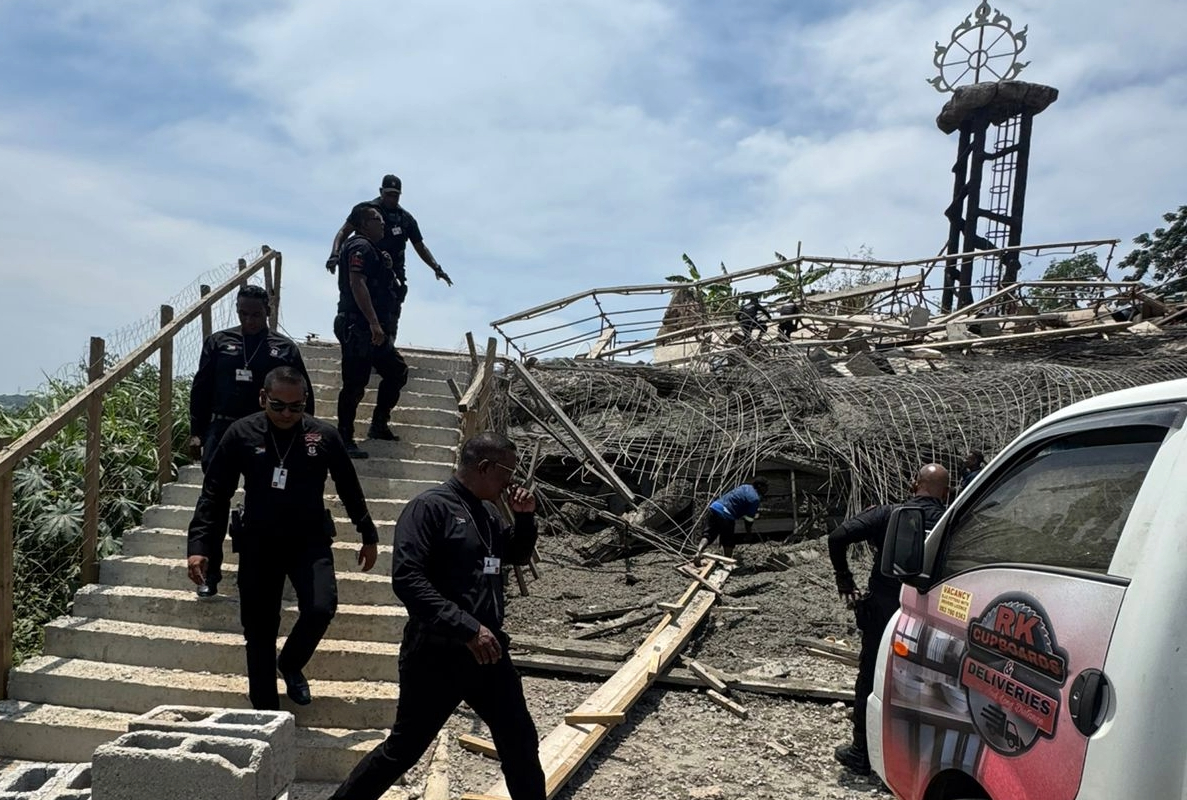
The multistory building was being constructed on top of the temple in the eastern town of Verulam, about 25 kilometers (15 miles) north of Durban, when it collapsed Friday, and authorities confirmed one person dead at the time.
Search teams pulled four more bodies from the rubble over the weekend, bringing the death toll to five.
The temple complex, on a steep slope overlooking a ranch, had been undergoing expansion work when it abruptly fell just before noon on Friday. Images of the aftermath released by the municipality showed twisted metal, collapsed pillars and mounds of rubble.
Macpherson said that the supplier had not yet been identified, but that the site of the collapse had been declared a crime scene.
He said that the findings were preliminary and that a full forensic and criminal investigation would be undertaken.
Macpherson explained that the structure was a reinforced concrete, multi-storey building with columns, flat slabs, and masonry walls that was under construction.
The collapse occurred while concrete was being poured, with reports indicating that work was underway on the upper levels of the building at the time of the incident.
The minister said the evidence, including video footage, showed a sudden structural failure, “most likely triggered” by the pouring of wet concrete.
“It has also been observed that substandard concrete material and substandard reinforced columns were used,” confirmed Macpherson.
The minister added that visual assessments showed “misaligned structural elements” and relayed expert opinion on the decision to pour wet concrete on the upper layers of an incomplete multi-storey building.
“[This] poses a significant, abnormal and dynamic load on the floors below, loads that no building is structurally designed to withstand, resulting in a rapid and progressive collapse.”
The minister also acknowledged the work of emergency services and disaster management teams. “I want to formally acknowledge and thank our disaster management teams, emergency services, and first responders who worked tirelessly under extremely difficult and dangerous conditions.”
President Cyril Ramaphosa has been briefed on the tragedy and has endorsed the steps taken so far, including strengthening the criminal investigation and technical oversight.
Macpherson warned that the collapse highlights systemic failures in South Africa’s building regulation and enforcement.
The CBE report notes a troubling pattern of serious structural collapses in the eThekwini metro over the past decade. It recommends intensified detection of illegal building activity, mandatory notification to municipalities of large deliveries of ready-mix concrete, and a national awareness campaign on building approvals and safety requirements.
eThekwini Mayor Cyril Xaba welcomed the report, describing it as a crucial step in clarifying the possible causes of the tragedy. “The report has effectively put an end to speculation. We will continue to support the technical team investigating this matter to ensure the process is expedited and that the final report is released without delay,” he said.
Xaba confirmed that government responded immediately after the building collapsed, deploying police, search and rescue teams, disaster management, and emergency services.
South Africa’s Commission for the Promotion and Protection of the Rights of Cultural, Religious and Linguistic Communities, a constitutional body that protects and promotes the rights of diverse communities, said the collapse has traumatized worshippers, relatives, and the larger community.
Hinduism is practiced by less than 2% of South Africans nationwide, but it is most common in KwaZulu-Natal. The largest Hindu temple and cultural complex in the Southern Hemisphere opened in Johannesburg.