
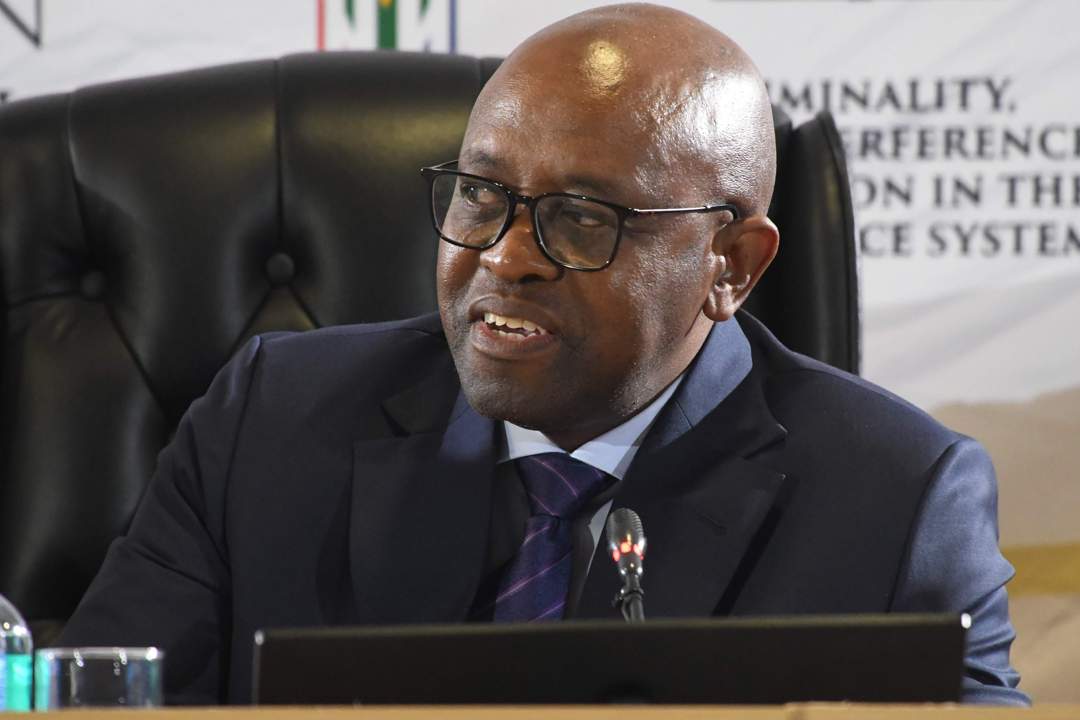
By Lehlohonolo Lehana.
The Madlanga Commission of Inquiry heard evidence from an anticorruption, anti-money laundering and asset recovery expert, Laura Pop, who is employed by the World Bank and works in partnership the United Nations Office on Drugs and Crime (UNODC).
Pop has 17 years’ experience in anti-corruption work across more than 20 countries, including South Africa, focusing on illicit asset recovery, financial disclosure, money laundering and strengthening institutions that investigate economic crime.
Her appearance followed testimony by Johannesburg Metropolitan Police Department (JMPD) Head of Internal Affairs Superintendent Elmarie de Beer, who told the commission the previous day that investigators had uncovered alleged links between some officers and criminal syndicates.
Pop testified how criminal syndicates could exploit weaknesses in state institutions, and how illicit money could move through systems designed to prevent it.
She told the Commission that South Africa’s problem was not unique. Globally, the capture or infiltration of criminal justice institutions by corrupt individuals and organised crime was “unfortunately not an isolated phenomenon”.
“To clean up a compromised institution quickly and at scale through ordinary processes is simply unrealistic for many countries,” Pop told the commission.
Pop’s proposal for an extraordinary evaluation addresses a critical question: must the state wait for a criminal prosecution or civil recovery process to conclude before deciding whether an official should remain in a position of trust?
The purpose of deep cleaning exercise would be to avoid that lengthy wait, while evidence gathered in criminal investigations could be considered where it pointed to misconduct or an integrity breach.
She also proposed that previous vetting should not provide a safe harbour. An earlier financial disclosure review or security clearance would not prevent fresh scrutiny. In the context of the Commission, this addresses a broader question raised by the inquiry: whether existing safeguards are sufficient to detect or prevent the alleged infiltration now being investigated.
Pop said the once-off exercise would not be a permanent substitute for ordinary accountability systems. The longer-term challenge, she said, would be preventing re-infiltration through stronger financial verification, appointment processes and independent oversight.
Pop also outlined at least four decision-making models used across justice systems in countries including Albania, Ukraine and Kenya.
These include assessment bodies that vet candidates through competitive selection processes, as well as systems where judges and independent experts are carefully selected to serve on commissions or oversee specific areas such as financial integrity.
However, Pop said institutional reform must also consider what happens to officials facing allegations.
She said implicated public officials should not necessarily be allowed to continue operating in industries where their conduct is under scrutiny, but should still have a fair opportunity to earn a living elsewhere.
Pop said she was aware of cases where officials facing disciplinary proceedings had moved into different professional fields following investigations.
She said institutions need to be able to address alleged wrongdoing without creating a system that leaves individuals permanently unable to work.