
By Lehlohonolo Lehana.
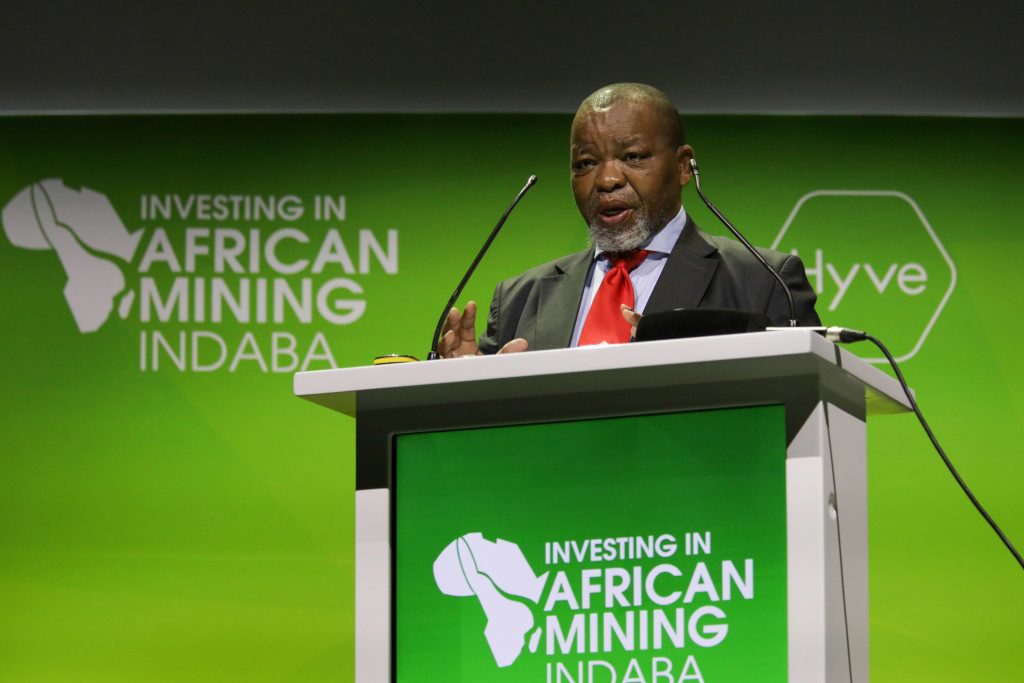
Minister of Mineral and Petroleum Resources Gwede Mantashe has urged Africa to take control of its vast mineral resources and push back against developed nations, particularly the United States.
Mantashe was speaking at the 31st Investing in African Mining conference (Mining Indaba) in Cape Town on Monday.
The 31st Investing in African Mining Indaba is underway, with over 115 countries represented.
The theme of this year’s conference is “Future-proofing African Mining, Today.” However, some participants are concerned that tariffs imposed by Donald Trump — most notably the 10% tariff on Chinese goods announced Saturday — will make this mission much harder.
Denys Denya, senior executive vice president of Afreximbank, which is involved in funding trade expansion projects, said tariffs are dominating their talks, but answers are few so far.
“Because China sources lots of its minerals from Africa that go into its manufacturing which then gets exported, there’s a potential negative knock-on effect on African mining, if the demand is not there as a result of the tariff,” Denya said. “But we are waiting to see what the impact will be. At the moment we can speculate, but we don’t really have the evidence.”
Mantashe criticised Western countries for defining “critical minerals” to serve their own interests, sidelining Africa’s broader economic needs. He said South Africa and other African nations should not cower in fear of US threats.
“Let us withhold minerals to the US,” he said.
“If they don’t give us money, let’s not give them minerals … we are not just beggars. Let us use that endowment for our benefit. If, as a continent, we are [paralysed] with fear, we are going to collapse, but with minerals at our doorstep.
“We cannot continue to debate these minerals based on the dictates of some developed nations as if we have no aspirations to accelerate Africa’s industrialisation and close the development deficit. We must avoid the race to the bottom.”
Mantashe’s remarks come amid a global scramble for minerals essential to the energy transition, including lithium, cobalt and rare earths. The US has prioritised securing supply chains for these minerals, often looking to Africa as a key source.
“Despite having these abundant mineral resources, Africa remains poor, and this must change,” Mantashe said.
“Africa needs to accept its advantage and take charge of the growing demand. I have ministers in my cabinet who always worry about geopolitics, with this imminent threat that because we passed an Expropriation Act, [US President Donald Trump will withhold funding to South Africa.
“I said let’s not immobilise Africa. Let’s withhold minerals from the US. That is it. If they don’t give us money, let us not give them minerals. But the reality is that they take our minerals but say they are withholding funding. No, we have minerals in the continent and therefore we have something. We are not just beggars.”
Mantashe spoke after President Cyril Ramaphosa’s office said on Monday he hoped to discuss South Africa’s land policy with the US administration after Trump said it was a good reason to suspend all aid to the country.
The US president claimed at the weekend that, with its land expropriation policy, “South Africa is confiscating land and treating certain classes of people very badly” and warned that the US would “cut off all future funding to South Africa until a full investigation of this situation has been completed”.
The presidency suggested Trump’s words were based on a misreading of the recently adopted Expropriation Act, which it said was not aimed at the confiscation of private land.
“South Africa is a constitutional democracy that is deeply rooted in the rule of law, justice and equality. The South African government has not confiscated any land, “it said.
Africa is believed to hold 30% of the world’s minerals, some of them traditional sources of wealth like diamonds and gold, others used in products like batteries and electric vehicles, regarded as critical for the transition to cleaner energy sources.