
By Lehlohonolo Lehana.
The African National Congress (ANC) has agreed on various measures to restore public trust in the party, and tasked the Integrity Commission to achieve this objective.
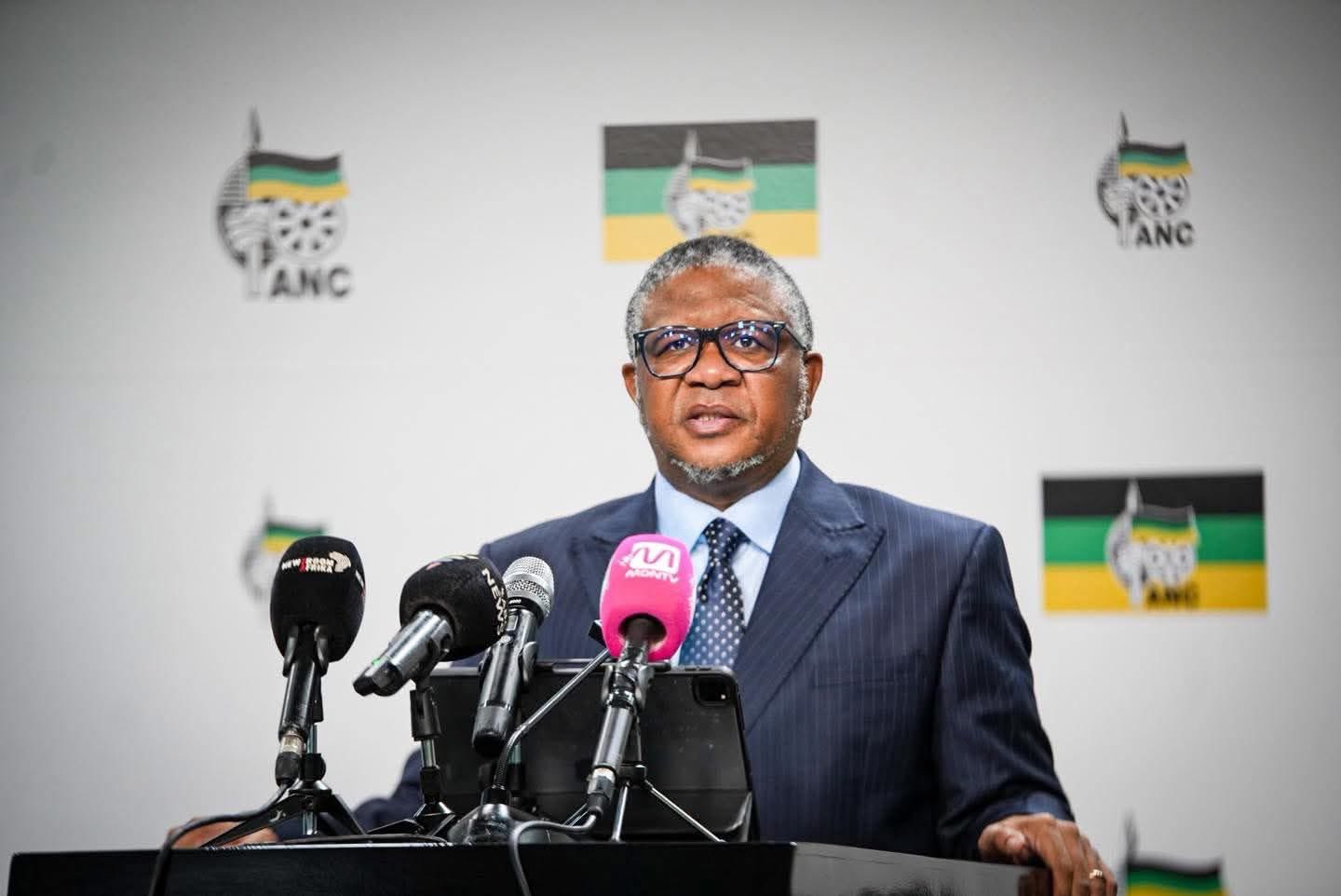
ANC Secretary General Fikile Mbalula briefed the media on the outcomes of the party’s National Executive Committee (NEC) meeting.
ANC held its ordinary NEC meeting from 14–16 November 2025 at the Germiston Council Chambers.
The NEC gathering covered a range of critical issues, including preparations for the G20 Summit hosted by South Africa from 18-19 November 2025, updates on the arrival of Palestinian asylum seekers, and the party’s state of readiness for the National General Council (NGC) in three weeks.
“The NEC reiterated, with absolute clarity, that the Integrity Commission remains central to restoring and safeguarding public confidence in the African National Congress. As a movement that draws its legitimacy from the trust of the people, we recognise that ethical leadership is not optional; it is foundational to who we are and what we represent,” Mbalula said.
Mbalula added that the NEC has also tasked the Integrity Commission to actively monitor the Madlanga Commission of Inquiry and Parliament Ad hoc Committee.
He said this will be done in line with its mandate and terms of reference, which will, in turn, be communicated effectively to demonstrate that the ANC is cleansing and renewing itself.
“The ANC has undertaken serious reflection, as it does on an ongoing basis. Both the Ad Hoc and the Commission have been instituted to investigate the public statements made by Lt. Gen. Nhlanhla Mkhwanazi. The NEC has reiterated its earlier stance that the ANC fully supports the proceedings and awaits the conclusion of both these processes,” he added.
This comes as testimony before the commission links Brown Mogotsi to Police Minister Senzo Mchunu and Vusimuzi Matlala, who have been implicated in corruption, political interference and malfeasance within the South African Police Service (Saps), which the country was originally alerted to when Lieutenant General Nhlanhla Mkhwanazi went public with allegations.
Mbalula said no ANC member implicated in corrupt activities, or appearing in court, would be supported by other party members.
There are calls within the ANC to oust Cyril Ramaphosa, disband the NEC, and replace the leadership with a national task team led by former president Thabo Mbeki.
Mbalula said there were a few party members who believed Ramaphosa should resign and were hoping to use the National General Council (NGC) to advance their agenda.
This would however require a two-thirds majority at the NGC to happen.
He said Ramaphosa told NEC members that those plotting to remove him were wasting their time because if he were to go, he could leave at any time.
“He will not go because he was elected by members of the ANC, not by those who are peddling negativity. There’s nowhere the president is going. He is doing very well and leading a collective,” Mbalula said.
“I explained that there are people who have such intentions and are trying to drive them through our structures, and that has failed. These are tendencies in the party that want to derail the organisation. They don’t want this Ramaphosa because they were defeated at ANC conferences successively.”
Ramaphosa is nearing the end of his tenure as ANC president, with his second and final term set to conclude in December 2027. However, this does not mark the end of his role as President of the Republic, which is expected to continue until the national parliamentary elections in 2029.
Historically, the ANC has sought to avoid a scenario in which the party president and the head of state are two different individuals—a duality that once defined its leadership structure.
This changed dramatically in 2007 when Jacob Zuma was elected president. His newly appointed NEC swiftly moved to consolidate power, pressuring then-President Mbeki to resign in September 2008 so Zuma could assume both roles. Zuma’s leadership effectively ended the era of dual centres of power, establishing a precedent where the ANC president also serves as the country’s president.
Whether the ANC leadership will be tempted to recall Ramaphosa when his party presidency ends in 2027 remains uncertain. However, if the precedent set by the last two transitions holds, it is plausible that Ramaphosa could be removed before his national term concludes in 2029.