
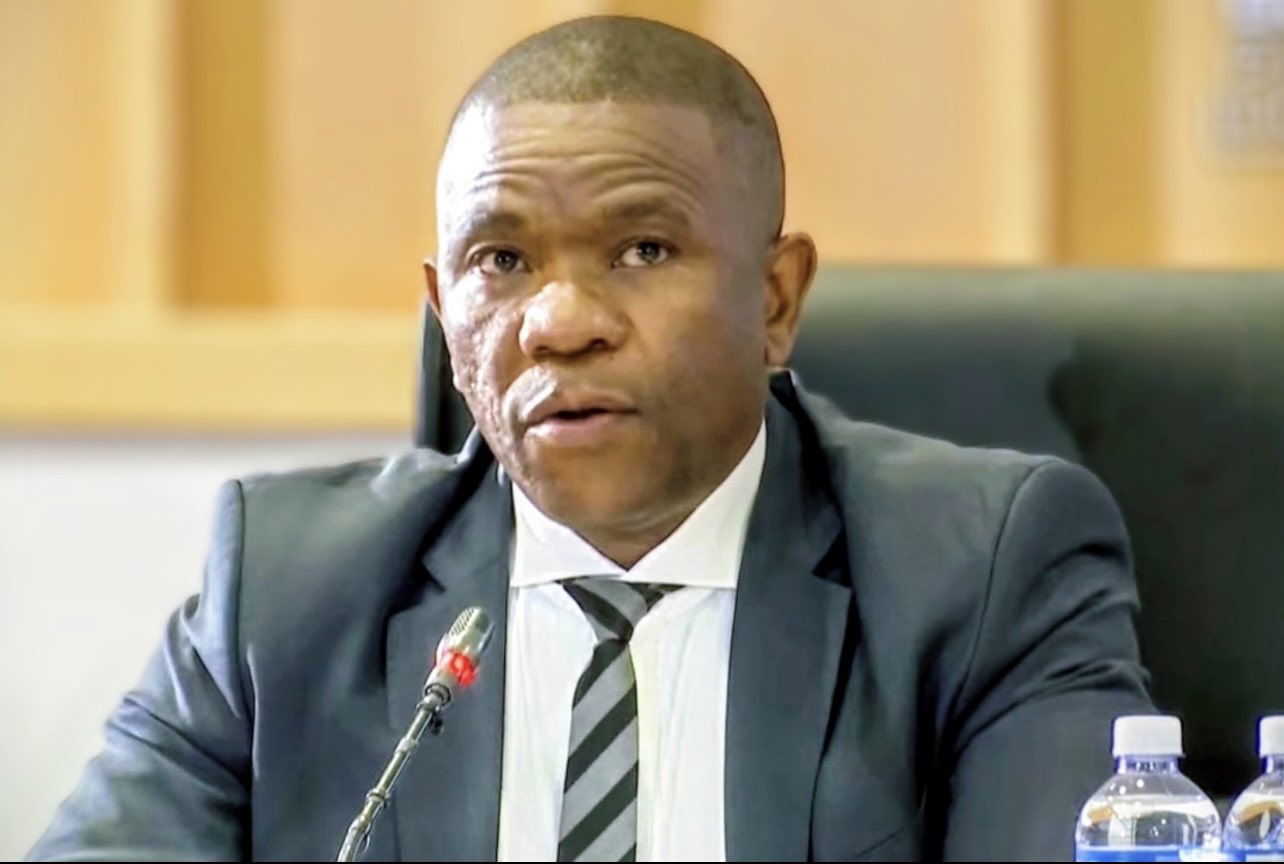
By Lehlohonolo Lehana.
KwaZulu-Natal Provincial Commissioner Nhlanhla Mkhwanazi says he was convinced that Minister of police Senzo Mchunu had been influenced when he issued the directive to disband the Political Killings Task Team (PKTT).
Mkhwanazi was the first witness at the ad hoc committee in October 2025, when public hearings started. On Wednesday, 18 March, he returned as the committee’s last witness.
Mkhwanazi said corrupt politicians within the system had captured the new officials taking part in criminal activity. He noted that Mchunu had been in office for close to a year before he had sent the disbandment letter about the PKTT.
“I believe that Minister Mchunu was captured to end up writing that letter. But he doesn’t accept that he owns [the letter]. He said he wrote the letter on his own iPad,” said Mkhwanazi.
President Cyril Ramaphosa has said he did not approve the disbandment of the PKTT and was dissatisfied that he had not been consulted by Mchunu beforehand.
Ramaphosa said this in written responses to Parliament’s ad hoc committee.
He said the decision was taken by Mchunu and should have fallen under the authority of the national police commissioner General Fannie Masemola.
Ramaphosa said he was informed of the move on or about February 1, 2025 by Masemola, who indicated that Mchunu had instructed that the unit be disbanded.
The committee was established after Mkhwanazi made explosive allegattions raising concerns about political interference and corruption within South Africa’s criminal justice system.
Mkhwanazi also spoke extensively about acting deputy national police commissioner Lieutenant General Hilda Senthumule, who testified last week about how she “regrets” not looking into alleged underworld figure Vusimuzi “Cat” Matlala before asking him to sponsor a policing award in November 2024.
Matlala is accused of having a close relationship with deputy national commissioner Shadrack Sibiya, as well as offering him and other leading police officers gifts or financial payments.
Senthumule denied claims by Sibiya that Matlala paid for her cosmetic enhancement surgery — a “Brazilian butt lift”. She told MPs the money came from a combination of credit cards and a police bonus.
She said she was pursuing civil and criminal charges against Sibiya.
During his testimony, Mkhwanazi produced a recording of a conversation between Senthumule and Sibiya. While not in English, Mkhwanazi alleged the audio proved Senthumule was no bystander in the controversial transfer of 121 dockets away from the Political Killings Task Team (PKTT).
Labelling Senthumule untrustworthy, Mkhwanazi pointed to her as the likely source of the letter that moved the 121 dockets from KZN to SAPS headquarters.
He clarified his meeting with Matlala, which witnesses have alleged indicated his complicity to organised crime.
“Cat Matlala, when he met with me in that meeting, he was afraid of the people he was talking about. And he made it clear that what he’s sharing with me, in the street language, you’d refer it to as snitching. So, he was giving out information that would have compromised his safety,” Mkhwanazi said.
He said subsequent witnesses who had appeared before the ad hoc committee and Madlanga Commission such as KwaZulu-Natal Hawks head Lesetja Senona and Matlala, had been afraid to mention the names of key individuals.
Mkhwanazi told the ad hoc committee that he maintained that Matlala had approached him as an informer and had been used by key individuals in organised crime.
With Mkhwanazi’s testimony concluded, the committee now pivots to the high-pressure task of drafting its final report. These findings, along with a set of critical recommendations, are set to be tabled in the National Assembly.