
By Lehlohonolo Lehana.
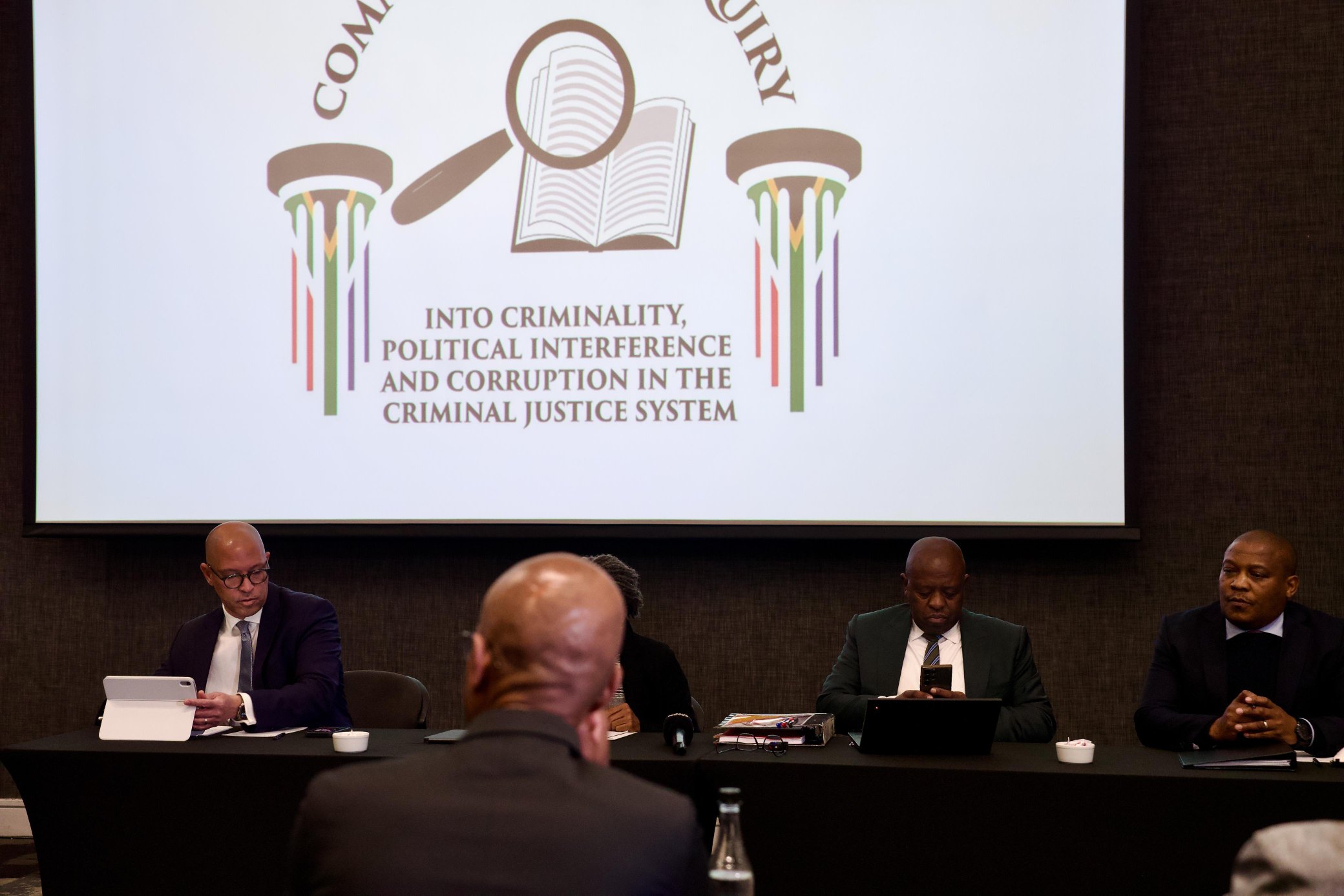
The long-awaited Madlanga Commission of Inquiry officially commenced its public hearings on Wednesday, 17 September 2025, at a secure venue in Pretoria.
Chaired by retired Constitutional Court Justice Mbuyiseli Madlanga, the commission was established by President Cyril Ramaphosa in response to explosive claims made by KwaZulu-Natal (KZN) Police Commissioner Lieutenant General Nhlanhla Mkhwanazi during a bombshell press briefing in July 2025.
Mkhwanazi, who has become a central figure in the nation’s fight against corruption within law enforcement, took the stand as the first witness, with his testimony expected to span up to five consecutive days.
Members of the public were urged to arrive early due to strict security screening procedures, with seating limited to around 300 people to ensure order and safety during the proceedings.
Mkhwanazi’s testimony, which is set to continue on Thursday, exposed finer details of alleged corruption involving senior officers in the South African Police Service (SAPS) and how they may be linked to violent criminals.
A key focus during the commission’s proceedings on Wednesday was the (Political Killings Task Team (PKTT), which started its work in 2018.
The commission heard that at the end of last year police minister Senzo Mchunu ordered it to be “disestablished” because it was not “adding any value to policing in South Africa”.
Mkhwanazi testified that he found out about Mchunu’s decision two days later via a WhatsApp on 2 January.
The WhatsApp, he said, was from a friend — a civilian not linked to policing.
Mkhwanazi felt Mchunu’s stance on the PKTT was “misplaced” and “wrong”.
During Wednesday’s proceedings, he provided details about what allegedly happened in the run-up to the PKTT’s disbandment.
Mkhwanazi referred to the April 2024 murder in Vereeniging of engineer Armand Swart, who was shot after the company he worked for unearthed corruption related to Transnet contracts.
Three suspects were arrested for the murder: Musa Kekana, Tiego Mabusela and a police officer at the time, Michael Pule Tau.
Mkhwanazi said the firearms seized in this case were forensically analysed and linked to “multiple other murders”, which pointed to a much bigger syndicate with “significant access to finance”.
When the three suspects appeared in court, the police officers involved in investigating the case tried to ensure they were kept behind bars.
But Tau was granted bail in August last year, with his health cited as a reason. (He resigned from the SAPS after his release.)
“This sparked great concern amongst investigators as well as the prosecution team because they started fearing [for] their lives, and the threat towards their lives started escalating,” Mkhwanazi testified.
He said the Swart murder investigation team first consisted of five officers, but this was later reduced to two.
A counterintelligence investigation — a covert probe — was launched parallel to the Swart murder investigation to try to determine where exactly the threats to the officers were emanating from.
That’s where the PKTT comes in.
Mkhwanazi said that the then CI head, Dumisani Khumalo, had been worried about the two police officers who were investigating the Swart case and related issues.
“He then felt it was important for a special intervention to be made in order to protect these two investigators.”
Mkhwanazi said Khumalo had asked for law enforcement support from outside of Gauteng.
Khumalo had specifically asked Mkhwanazi to dispatch 10 members of KwaZulu-Natal’s PKTT to join Gauteng’s counterintelligence operation.
Mkhwanazi granted approval for this.
Mkhwanazi said he believed this created the impression that the PKTT itself was running the Gauteng investigations into the Swart murder and related cases, which, in turn, worried those under investigation or individuals linked to those under investigation.
“It was my feeling … someone believed [this], because there were threats against the two detectives in Gauteng.
“Someone thought that the PKTT was the one that was responsible for the investigations in Gauteng towards these criminal syndicates … which involved the participation of senior police officers in the SAPS in head office as well as senior politicians and their associates.”
He believed that because of this, Mchunu was swayed into disbanding the PKTT. Someone influenced the minister to do this,” Mkhwanazi said.