
By Lehlohonolo Lehana.
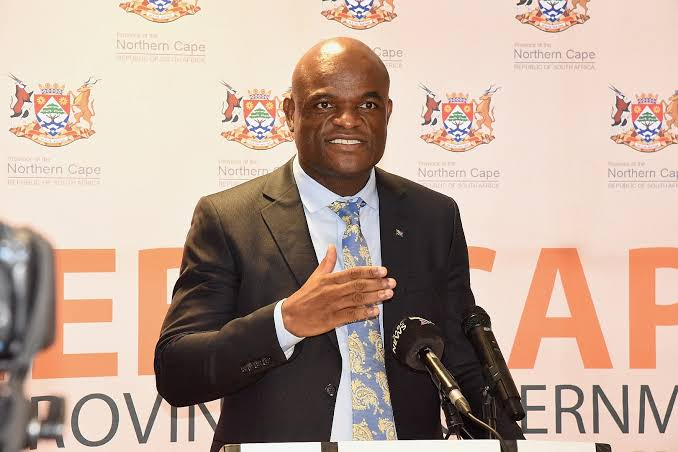
Premier Zamani Saul Saul acknowledged that while the Northern Cape has cemented its position as South Africa’s renewable energy powerhouse, inadequate grid capacity has emerged as the single biggest obstacle to further growth.
Saul delivered the Northern Cape State of the Province Address at the Mittah Seperepere Convention Center on Thursday.
“We are producing clean energy at scale, but our ability to transmit that power to the rest of the country is constrained, “Saul said.
Why the Grid is constrained, Saul said the transmission backlog stems from decades of underinvestment in high-voltage infrastructure, combined with the rapid expansion of renewable projects in recent years. “The grid was not built for the scale of renewable energy we are now attracting,” he said.
Saul confirmed that Eskom has committed to expanding and modernising key transmission corridors across the Northern Cape. “We are working closely with Eskom to accelerate the rollout of new transmission lines and substations.”
The premier also expressed his sadness over the Ekapa mine tragedy in Kimberley, and extended his deepest condolences to the affected families.
“During this painful and uncertain period, the affected families must know that we stand with them in solidarity,” he said.
The mining company announced its closure, citing operational, financial, and safety factors as reasons for the closure. It has been more than a week since five mine workers have been trapped approximately 890m underground in Tunnel 6 following a mudslide. The closure could cost approximately 3 500 jobs.
Saul said access to basic services such as water and sanitation has improved. He announced nearly R1 billion for infrastructure upgrades and boosting the R1 billion housing project.
The premier also announced that R48 million has been earmarked for upgrading the Steinkopf Health Centre in addition to R60 million for an oncology centre.
Eastern Cape SOPA – Reforms
Eastern Cape Premier Lubabalo Oscar Mabuyane focused on reforms, saying improving infrastructure is key to sustaining education outcomes and reducing inequality.
The province plans to eliminate 300 pit toilets in 2026 as part of ongoing infrastructure upgrades, with more than 50 new schools also scheduled for completion this year.
The move follows years of safety concerns linked to unsafe sanitation facilities.
The Premier further announced that 430 schools will receive infrastructure upgrades, maintenance or improvements as part of efforts to stabilise the education system.
Mabuyane also referenced the rapid growth of online shopping and delivery platforms such as Temu and Uber Eats.
He said the government is exploring ways to integrate township entrepreneurs into digital supply chains and last-mile delivery systems, including support for delivery drivers, logistics and digital skills.
While unemployment and poverty remain high, Mabuyane framed these interventions as part of a broader strategy to reduce inequality and improve quality of life.
The provincial government will host a 2026 Post-SOPA Stakeholder Engagement tomorrow at the Eastern London International Convention Centre (ELICC).
North West SOPA – Fixing municipalities
In his address, Premier Lazarus Mokgosi’s address in Mmabatho on Thursday placed the repair of local government at the centre of his speech, arguing that municipal performance remains the single biggest determinant of both service delivery and economic growth in the province.
He drew a direct link between functional municipalities and economic expansion, warning that weak administration undermines service delivery and erodes investor confidence.
According to Mokgosi, stabilising and strengthening municipalities is key to unlocking growth and restoring public trust in government institutions.
The latest report from the Auditor General shows that most of municipalities have poor financial management, with seven receiving the worst possible outcome for several years in a row.
Seven of North West’s 22 municipalities have been put under administration for issues such as failing to supply water to communities; administrative and political instability impacting on service delivery; failure to deal with prior audit outcomes, and non-compliance with supply chain management processes.
The seven crippled municipalities are Dr Ruth S Mompati District, Kagisano-Molopo, Kgetlengrivier, Madibeng, Naledi, Ramotshere Moiloa and Tswaing.
The Auditor-General has been encouraging the province’s political leadership and oversight structures to hold municipal managers and officials accountable for poor audit outcomes and to implement consequences promptly.
DA chief whip Johni Steenkamp said the address focused heavily on the municipal portfolio, particularly plans to fix local government. “Sopa was very focused on the municipal portfolio and how to fix that, you can see it’s an election year we are in, but didn’t give any how, when, or any detail.”
Steenkamp maintained while the Mokgosi struck the correct tone on the importance of functional municipalities, the address fell short of providing clear timelines, measurable targets, and concrete plans to turn struggling municipalities around.