
By Lehlohonolo Lehana.
The chairperson of the Portfolio Committee on Police, Ian Cameron, said that the allegations against minister of police Senzo Mchunu have placed the necessary focus on the integrity of not only the South African Police Service (SAPS) but the entire criminal justice system.
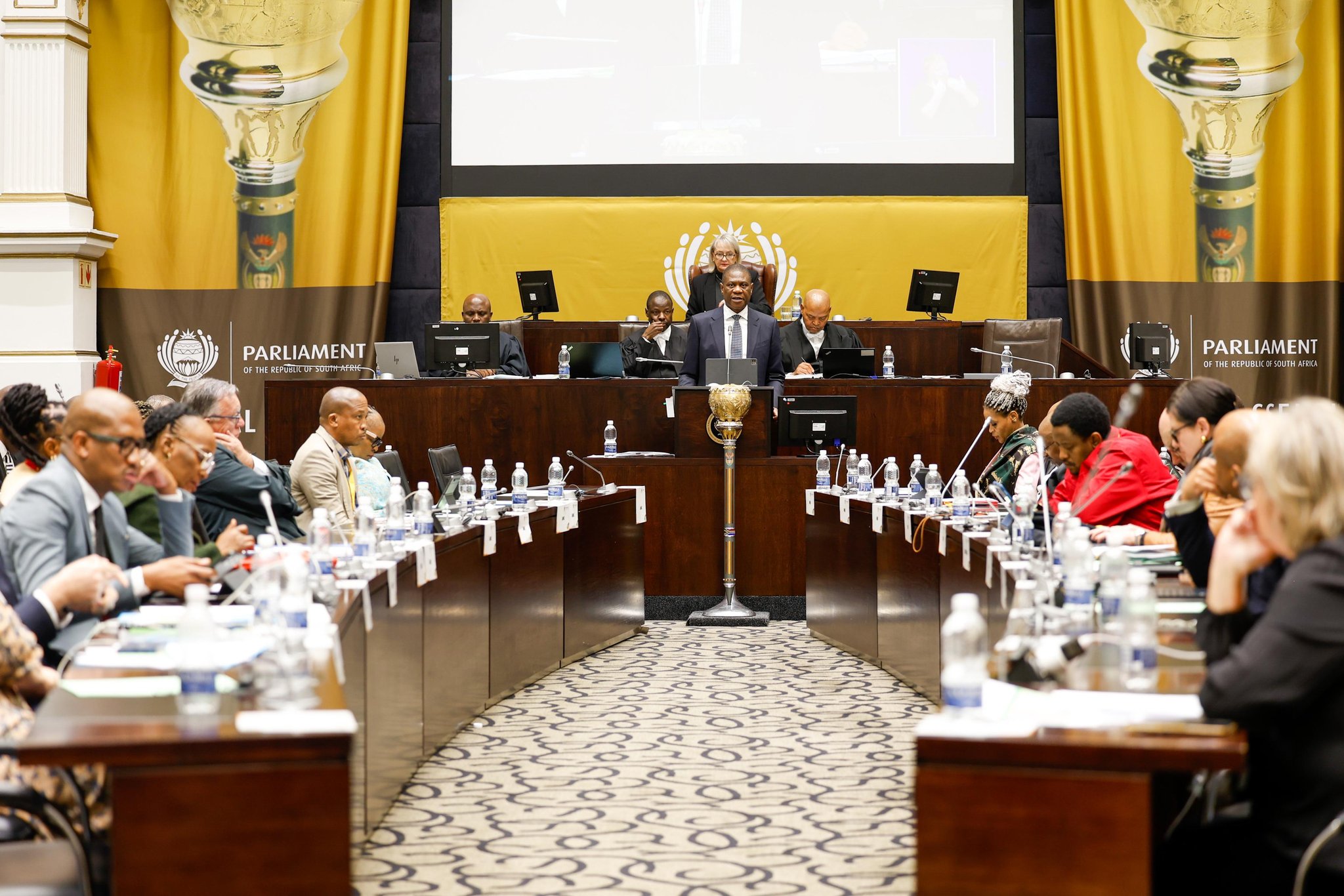
The Peace and Security Cluster Committee Chairpersons briefed the media and the public as part of the 7th Parliament’s regular Committee Cluster Media Engagement programme.
The media briefing was held under the theme: “Deepening the values of peace, justice, safety and security.”
Nhlanhla Mkhwanazi, the police commissioner in KwaZulu-Natal province, said Mchunu and senior national police officials in March seized dockets with information on political killings and effectively froze the probes.
He questioned the motives behind what he said were Mchunu’s plans to disband a task team established to look into the deaths.
Mchunu has denied the allegations of interfering with police and misleading parliament.
He said the “wild allegations’ required “an urgent, thorough and transparent investigation, on a proper platform’.
“The Minister of Police will never allow his integrity, that of the Ministry or the SAPS at large to be undermined by insinuations made without evidence or due processes, from anyone, including Lieutenant General Mkhwanazi. We will be reviewing the Provincial Commissioner’s statements and consider appropriate action,” said Mchunu.
Mkhwanazi also accused Mchunu of misleading Parliament about his relationship with an associate allegedly linked to organised crime, and specifically to tenderpreneur Vusumuzi Matlala who, despite facing criminal allegations, was awarded lucrative SAPS tenders.
“If true, it explains why the system has not been able to effectively arrest the ever-increasing criminality in the country.”
Cameron said he had not reached out to the minister after Mkhwanazi’s allegations. “I did not want any form of interference, premature discussion, or anything like that,” he said
He further added that Mkhwanazi was aware of the dangers that would likely follow after his comments, but said the commissioner was able to look after himself.
“I think Mkhwanazi is likely aware of any potential risk regarding what happened yesterday [on Sunday]. He has a very competent team, from what I saw during our oversight visit to KZN a few months ago, who also assist with the relevant protection.”
“I also think he is quite capable of defending and looking after himself, “Cameron said.
Cameron added that the allegations point to a systematic weakening of the police to enable corruption and undermining of the rule of law. He also urged President Cyril Ramaphosa to implement an intensive investigation into the corruption allegations at SAPS to protect and promote the credibility of the service.
Ramaphosa expressed serious concern on Sunday over the public statements made by Mkhwanazi.
He called the matter a “grave national security concern”.
Ramaphosa emphasised the need to uphold the integrity of the country’s security services. He further warned that the ongoing exchange of accusations could erode public trust and disrupt the cohesion of the police.
“The committee welcomes the assurance that the President will give the matter attention it deserves upon his return from Brazil (Ramaphosa is attending the BRICS Summit) but has urged that this matter be priority number one, said Cameron.
Chairperson of the Select Committee on Security and Justice, Jane Mananiso, said: “With regarding the allegations made yesterday, for us as the select committee, it is a grave concern; however, we hope that the President will swiftly respond to that issue as soon as he comes back. All of us do believe that lawlessness in the sector must be dealt with.”
She said the committee will have to determine the need for an urgent meeting where all the protagonists are called to account. He has also written to the Speaker of the National Assembly for an urgent debate on the integrity of SAPS, and the implications of the revelations on the credibility and standing of SAPS in the fight against crime.
The committee is also proposing the following immediate solutions to the integrity challenges within the SAPS:
- Appointment of a commission, with a clear timeline, to urgently investigate the allegations
- An external independent body to undertake lifestyle audits for all senior officers from Brigadier level upwards
- An independent body to undertake a vetting exercise on all senior SAPS officers
- Reconfiguration of the Crime Intelligence environment to ensure only fit and proper individuals are employed in that environment
- Skills audit of all senior managers within the SAPS
- Adequate resourcing of the Independent Police Investigative Directorate
Meanwile Parliament’s Portfolio Committee on Correctional Services chair Kgomotso Ramolobeng is calling for urgent action on the biggest problems facing South Africa’s prisons.
Ramolobeng said that the large number of remand detainees – prisoners awaiting trial – was the biggest contributor to overcrowding. There are currently around 57,600 remand detainees. Almost a third of people in South African prisons are awaiting sentencing.
Ramolobeng said both the departments of Correctional Services and of Justice and Constitutional Development must take responsibility. In the 2023/24 financial year, only around 3% of the cases referred to courts were successfully prosecuted. This is a “tiny success rate,” she said.
Legislation that is supposed to regulate remand detention is “producing very minimal results”. This includes Section 63A of the Criminal Procedure Act, which allows for people to be released on warning instead of bail, and Section 49G of the Correctional Services Act, which limits remand detention to two years.
Ramolobeng said the committee has invited the justice minister to address the committee on how to better process remand detainees.
Ramolobeng also highlighted the infrastructure backlog. There is not enough maintenance, and infrastructure is often vandalised by inmates, she said. Overcrowding puts a strain on infrastructure.
While some facilities need regular maintenance, others require major upgrades and repairs. For example, a kitchen in a Durban prison is temporarily closed for repairs after concerns were raised by the parliamentary portfolio committee, said Ramolobeng. The department also closed and repaired the kitchen at Modderbee prison in Gauteng earlier this year.
The department remains underfunded, she said. This year, the department has been allocated R29.2-billion.
“The committee has urged the department to tighten its belt and implement measures to cap expenditure, including placing more emphasis on a self-sufficient and sustainability model and using offender labour to cut costs,” said Ramolobeng.