
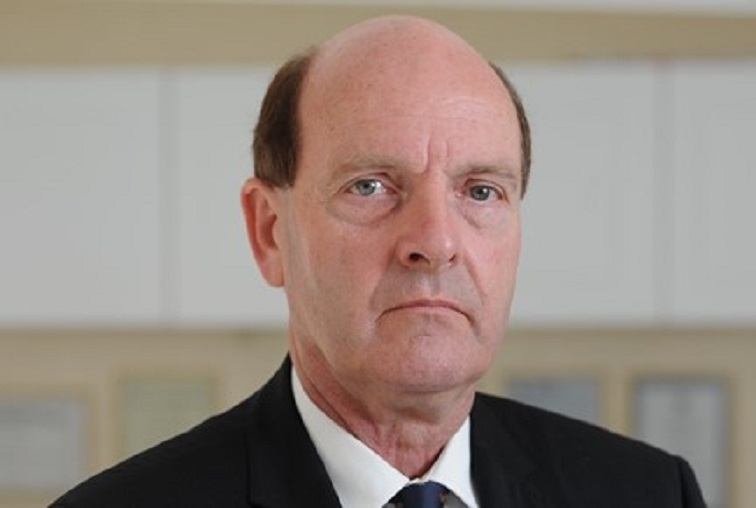
By Lehlohonolo Lehana.
The controversial forensic investigator Paul O’Sullivan clashed with members of Parliament’s ad hoc committee when questioned about his intentions for wanting to move to South Africa during the 1980s, when the country was under apartheid rule.
O’Sullivan was testifying before the ad hoc committee at the Good Hope Chamber in Cape Town.
He was implicated in police corruption by KwaZulu-Natal police commissioner Nhlanhla Mkhwanazi. He said it was an open secret that O’Sullivan had links to suspended deputy national police commissioner Shadrack Sibiya.
Mkhwanazi said O’Sullivan accused him of corruption after he mentioned Sibiya during his highly charged media briefing in July last year. He subsequently invited O’Sullivan to present his evidence before the commission.
Cedric NKabinde the chief of staff to suspended police minister Senzo Mchunu accused O’Sullivan of corruption before the ad hoc committee. He testified that he received threatening messages from O’Sullivan before his appearance at the committee.
Nkabinde said that O’Sullivan had extensive links within the Independent Police Investigative Directorate (IPID), South African Police Service and the National Prosecuting Authority describing his influence as “the real state capture”.
On Tuesday, O’Sullivan said he was not willing to provide information about his business interests, family and properties. He would provide information to suspects on trial for his murder attempts, he said.
“I made it clear that I’m not going to be providing that information. It’s just not going to be advanced. We can sit here all day and you can ask me a million questions. I’m not going to provide that information,” he said.
Malema pushed back against O’Sullivan’s claim that criminal networks would obtain his personal information during testimony about his history before 1990.
“That has nothing to do with criminality. That’s got everything to do with trying to demonstrate that you’ve captured the criminal justice system way before even 1994,” said Malema.
He urged the committee to compel O’Sullivan to answer every question fielded to him during his testimony.
UMkhonto we Sizwe MP Skosana said O’Sullivan’s request was “problematic” as he made allegations of criminality in his affidavit, which happened in 1978.
“He’s contradicting his own statement here,” Skosana said.
ANC MP Xola Nqola said O’Sullivan’s oath urges him “to answer fully and satisfactory”, adding the committee had questions about events that happened before 1990 that the witness mentioned on his own volition.
“We shouldn’t accept that there are matters before 1990 that shouldn’t be responded to,” he said.
Committee chairperson Soviet Lekganyane said O’Sullivan was required to answer all questions.
O’Sullivan earlier told the committee that he holds Irish-British citizenship and moved to South Africa in 1989 after obtaining permanent residency.
He applied for South African citizenship in 1994 and received it the following year.
He explained he had first visited the country as a “tourist” in the 1970s, returning once or twice a year for holidays.
He later invested in property and eventually moved permanently, citing his love for the country, the weather, and the people he met.
O’Sullivan used his appearance before parliament’s ad hoc committee on Tuesday to deny he is a foreign agent.
He also confirmed he trained President Cyril Ramaphosa as a police reservist in the late 1990s, a disclosure that placed him close to political influence in the inquiry set up to investigate the corrupt infiltration of the country’s criminal justice system.
While O’Sullivan presented his testimony as a straightforward account of lawful migration and public service, MPs approached his evidence with scepticism, repeatedly testing whether his background aligns with the authority he has exercised within South African policing circles.
O’Sullivan also told the committee that the political feud between former president Thabo Mbeki and Jacob Zuma, which came to a head in the run-up to the ANC’s decisive 2007 Polokwane conference, created conditions in which law enforcement and prosecutorial processes were allegedly used in an attempt to prevent Zuma from ascending to the presidency in the period between 2005 and 2008.
O’Sullivan said the feud created fertile ground for political interference in criminal investigations, especially at a time when the now-disbanded Scorpions were investigating high-level corruption cases.
“Not only that. You have heard of the so-called spy tapes. The spy tapes make it clear that there was a concerted effort on the part of certain persons, one of them being the then head of the Scorpions, a chap by the name of Leonard McCarthy,” O’Sullivan said.
“The spy tapes show his conversation with a person by the name of Andre Pienaar who is based in London. They used code words, but it demonstrated their plan to get Jackie Selebi off the hook and get Zuma on a hook.”
The so-called spy tapes later became central to legal challenges involving Zuma, who argued that political interference had tainted the timing of corruption charges against him. The recordings were cited when charges against Zuma were controversially withdrawn in 2009, a decision later overturned by the courts.
The recorded conversations were cited as the basis for withdrawing fraud and corruption charges against Zuma shortly before he was sworn in as president in 2009.
O’Sullivan said his investigation into Selebi was driven by principle rather than politics.
Selebi was convicted of corruption in 2010 and sentenced to 15 years’ imprisonment after being found guilty of receiving payments from convicted drug trafficker Glen Agliotti. He later died in 2015 after being released on medical parole.
The committee is examining whether political interference and senior-level misconduct undermined key investigations within SAPS and other law enforcement agencies, with O’Sullivan’s testimony forming part of a broader inquiry into systemic failures during one of the most politically charged periods in South Africa’s democratic history.