
By Lehlohonolo Lehana.
Political parties signed the Independent Electoral Commission of South Africa (IECSA) Code of Conduct on Wednesday, 23 September 2026 ahead of the 4 November elections.
The signing ceremony served as a unified front against political violence, intimidation, and the disinformation, with leaders emphasising that the integrity of the democratic process transcends individual political ambitions.
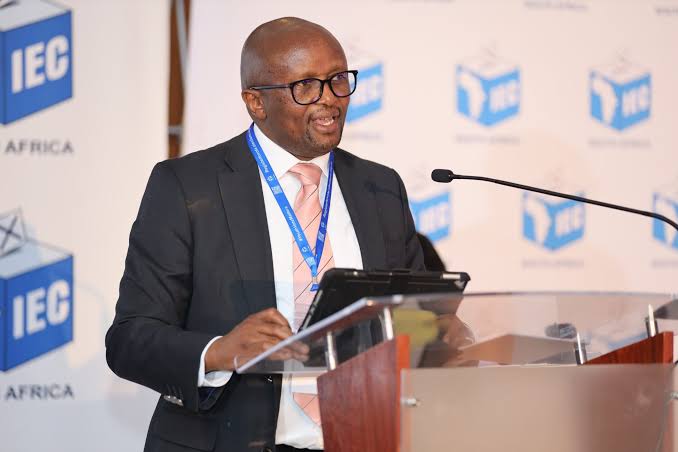
IEC chairperson Mosotho Moepya declared, that the signing of the electoral code of conduct is a “sacrosanct ingredient” to ensuring the integrity of the upcoming 2026 Local Government Elections.
Moepya framed the signing as a “solemn, binding contract” signed directly with South Africans at a critical historical crossroads.
He said recent findings from a voter participation survey conducted with the Human Sciences Research Council (HSRC) painted a stark picture of the national mood, revealing a significant decline in democratic trust, widespread institutional disillusionment, and growing public scepticisms.
“We stand at a profound historical crossroads, navigating what researchers describe as the most challenging pre-electoral climate ever observed in South Africa over the last 30 years,” Moepya stated.
Rather than viewing this as casual disengagement, Moepya described it as structural disillusionment.
“Our citizens are saying democracy must work, and work for them,” he noted, calling on political parties to use the elections scheduled for November to restore institutional integrity and prove that the democratic process can be responsive, clean, and accountable.
The Code of Conduct substantively protects all 136 790 candidates contesting the municipal elections, ensuring equal opportunities to campaign without fear of violence, intimidation, or unfair distortion.
Democratic Alliance (DA) federal chairperson Solly Msimanga emphasised that ensuring a peaceful election requires effort long before citizens head to the polls.
“Peaceful elections do not start on election day, but in the campaign leading up to the actual election day,” Msimanga stated.
He affirmed the DA’s commitment to protecting the integrity, freedom, and fairness of the 2026 elections, ensuring that campaigning is conducted freely and without any form of voter intimidation.
Other political leaders echoed these sentiments, framing the upcoming elections as a crucial moment for democratic choice.
African National Congress (ANC) secretary-general Fikile Mbalula described the elections as a vital milestone for accountability.
He stated that the ANC signed the code with a clear commitment to credible and peaceful elections, explicitly rejecting violence, lies, and disinformation while affirming respect for the lawful processes of the IEC.
Economic Freedom Fighters (EFF) secretary-general Marshall Dlamini committed his party to peaceful elections and urged members to respect voters.
Dlamini also made a direct call to law enforcement agencies to secure the elections and protect citizens without taking political sides.
ActionSA leader Herman Mashaba said, “By signing the Electoral Code of Conduct, we publicly demonstrate that ActionSA holds electoral integrity in high regard, not just for ourselves, but out of respect for the voters whose support we seek.”
He committed his party to campaigning peacefully and responsibly within the IEC’s rules, while maintaining that political competition should remain vigorous but free from violence.
With 42 days remaining before Election Day, the IEC confirmed that preparations were underway.
Nearly 60,000 electoral staff have been recruited and are undergoing training, while improvements are being made to voting-station layouts to improve voter flow and reduce queues.
The Commission added that it has also completed end-to-end functionality testing of its results system.
Political parties will be allowed to test the system using their preferred independent experts between 5 and 12 October, ahead of the elections.