
By Lehlohonolo Lehana.
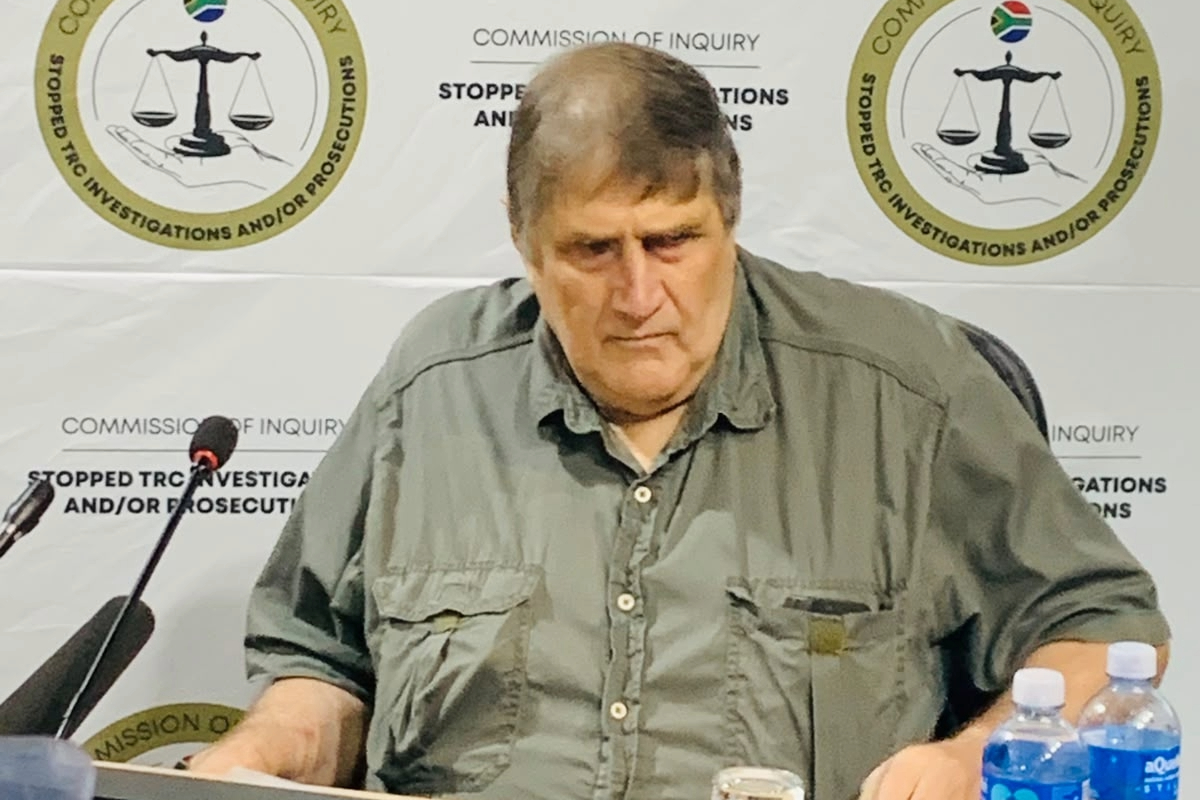
Eugene de Kock, has told the TRC Cases Commission of Inquiry into delayed post-TRC prosecutions that while he served 20 years in C-Max, no one in the prosecutorial authority approached him to provide the names, times and dates of those further up the chain of command who gave the orders.
De Kock’s appearance on Monday, 26 October, is a significant moment as the inquiry approaches its scheduled date for wrapping up this year.
It has emerged that the memo of a secret meeting of then president FW de Klerk and his last Cabinet 28 hours before South Africans were set to vote in the country’s first democratic election on 27 April 1994 was only prepared on 4 May that year and signed on the 5th.
Now 77-years-old, the former torturer, assassin, bomber and supplier of arms to the Inkatha Freedom Party (IFP) testified that prosecuting the generals who were his superiors would have “exposed the chain of command and those who gave instructions”.
“I can identify where the intelligence or target selection originated outside Vlakpaas. I can explain which senior people approached me and which structures possessed direct knowledge. Decisions and instructions moved through the chain of command and liaison. I am able to identify where the instructions came from and who executed them.”
He told the panel that out of all those involved in the violent application of apartheid ideology, “none served a day in a South African prison – except me”.
In an 18-page affidavit, De Kock, led by veteran advocate Geoff Budlender, recipient of the 2024 George Bizos Human Rights Award, set out that he was the central “operations figure” at Vlakplaas, a farm outside Pretoria along the Hennops River and which served as the secret headquarters for Section C1 (also referred to as C10) of the security police.
He singled out advocate Anton Ackermann, appointed by presidential proclamation by Thabo Mbeki in 2003 to head the Priority Crimes Litigation Unit to prosecute post-TRC matters, for the failure to prosecute the bigger fish in deeper, darker waters.
“In order to understand what was stopped and why this happened, it is necessary to understand what was available before 2003, who possessed this evidence, and the prosecutorial strategies.”
“I was arrested in 1994 and charged with 89 charges including six counts of murder, conspiracy to murder, attempted murder, assault and kidnapping.”
De Kock said he had been willing to provide information to prosecutors about several cases, including the Motherwell bombing case, the Cradock Four murders and the murders of Sweet Sambo, Goodwill Sikhakhane and Jappie Maponya but had never been asked to give a statement.
“I believe that it has been suggested that I was somehow unavailable to provide evidence in the prosecutions and this is why the chain of prosecutions did not happen. That is absolutely not the case.
“I was willing and able to give evidence as to where the instructions came from that would have exposed the chain of command.”
His testimony raises fresh questions about why his offered co-operation was not, according to him, taken up, and whether evidence that could have helped investigate senior figures was left unused.
Ackerman has accused African National Congress (ANC) leaders and others of political interference in prosecuting TRC cases.
The former Vlakplaas commander, who was known as ‘Prime Evil’, explained that while he was not tasked with dealing with politicians, the generals took instructions from above.
He named former ministers Louis le Grange and Adriaan Vlok, claiming Le Grange signed off on the 1988 bombing of the ANC’s London offices, and that Vlok had twice come to Vlakplaas to congratulate him on the bombings of Cosatu House in 1987 and Khotso House in 1988.
“When I was instructed by Brigadier [Willem] Schoon to bomb Cosatu House, he told me that the instruction to do this was from very high.”
“I asked him how high, and he said it came directly from President PW Botha,” said De Kock.
He stated that when the time came to testify on those matters, the issues were not addressed.
“I was willing and able to give evidence as to where the instructions came from that would have exposed the chain of command. I was not called as a witness to do so.”
“Those who gave the instructions to the generals would have been at risk of exposure. If one wants to know why prosecutions did not take place, an obvious question is who benefitted from the failure?”
“The answer is that those who benefitted where those who were at the top of the chain of command,” De Kock stated.
He also called for the Nobel Prize awarded to De Klerk to be revoked, on claims that he had the “blood of children on his hands.”
“He said he doesn’t have blood on his hands… but he’s up to his elbows in the blood of children, that his Nobel Prize must be retracted, because he gave the order to General George Meiring, so who pardoned De Klerk? Who pardoned Kobie Coetzee? Who pardoned General George Meiring, and who pardoned the shooters? Everything is just covered up.”
De Kock ended his testimony noting that he had mentioned the names of a number of people who were involved in the South African police death squad bombings “and related activities and who gave instructions in this regard.