
By Lehlohonolo Lehana.
The African National Congress (ANC) President Cyril Ramaphosa says liberation movements are under siege, with most having to contend with declining electoral support.
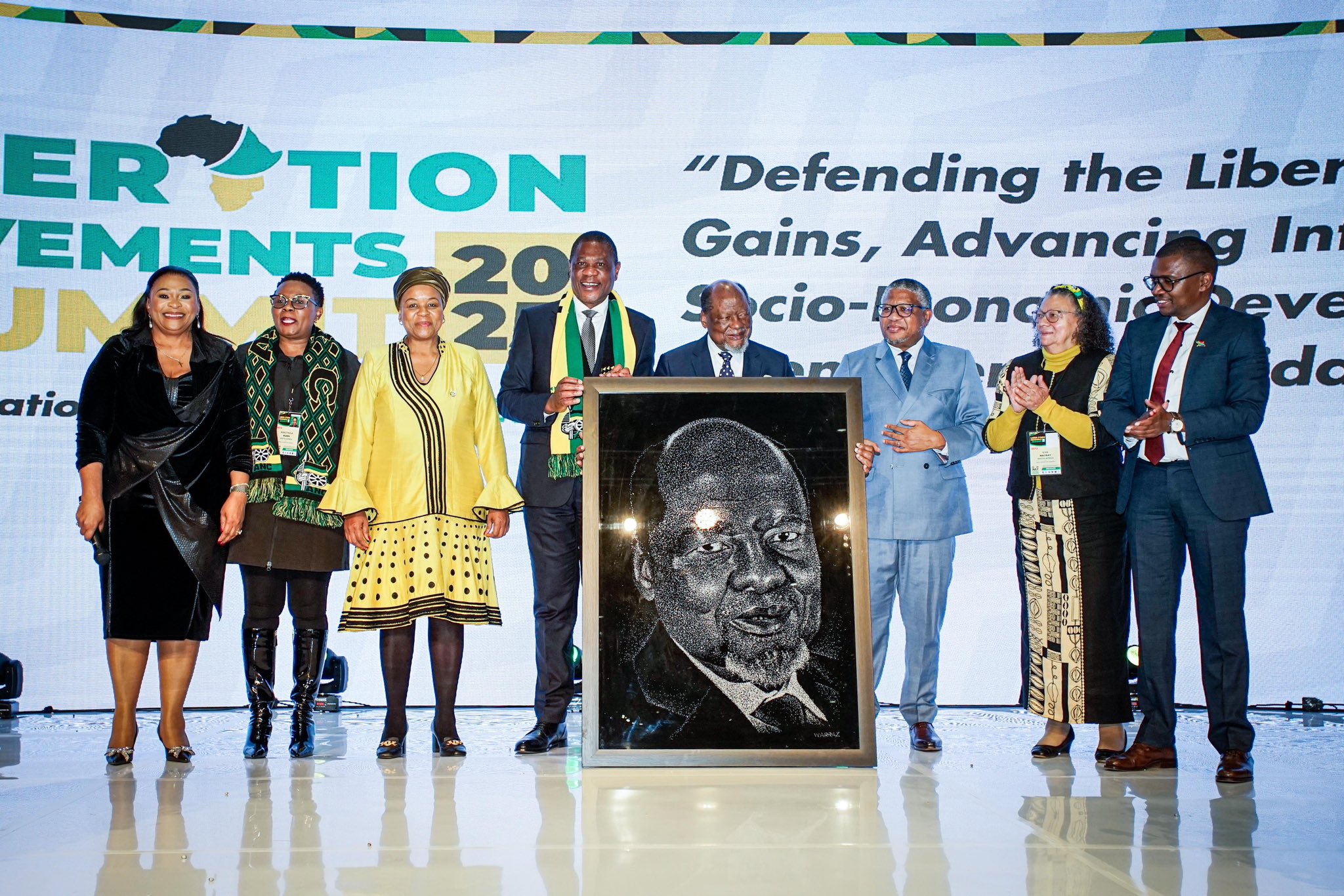
Ramaphosa delivered the keynote address at the Liberation Movements Summit in Kempton Park, Ekurhuleni.
He was joined by his counterparts from Namibia, Zimbabwe and Mozambique. The parties have been deliberating about way forward as they face a number of challenges.
The African National Congress (ANC) has lost its majority in parliament for the first time in 30 years, although it remains by far the country’s most popular party.
This mirrors the decline of other parties that battled colonial rule and made it to power, which have subsequently fallen prey to corruption, cronyism and a disgruntled population hungry for change.
Liberation movements in Angola, Mozambique, Namibia and Zimbabwe remain in power but have all experienced a decline in support and vote share in general elections.
Ramaphosa said liberation movements from southern Africa needed to acknowledge that many of the threats they faced were internal.
For many of us, corruption and patronage have contributed to various degrees to the destruction of our social fabric, to the weakening of the state and to the disunity of our movements.”
He said the competition for public positions and resources has undermined their ability as liberation movements to adequately respond to the needs of people.”
Ramaphosa said the countries needed to be united in efforts to rid societies of corruption and crime.
“We need to work together, drawing on each other’s experiences, to rebuild and renew our movements. Our movements were built through the struggles of the young people of the time. Today, we must rebuild our movements the same way,” he said.
He said liberation movements were under siege, with most having to contend with declining electoral support, shifting demographics and frustrated young people in various countries.
Ramaphosa said the continent was also grappling with economic inequality and foreign interference.
“These trends speak to a deeper crisis, the disconnect between our founding narratives and the lived realities of a new generation of young people. It is a generation that sees and appreciates less of our past victories and more of our present shortcomings,” he said.
Ramaphosa said the disconnect within the population emboldened external attacks on sovereignty, independence, development and security.
“In fact, there has been ample evidence that international actors use the legitimate grievances of our people to attack progressive governments. We have seen a revival of the forces of unilateralism, neocolonialism, and imperial extraction.”
Namibia, along with South Africa, are seen as relatively open democracies, the governing parties in Zimbabwe, Angola and Mozambique have been accused of shutting down dissent in order to maintain their hold on power.
Zimbabwean president Emmerson Mnagwagwa outlined the economic transformation strategy aimed at empowering the country’s youth, boosting rural economies, and positioning Zimbabwe as a driver of African innovation and self-reliance.
Mnangagwa emphasised that Zimbabwe’s development would be people-centered, inclusive, and anchored in Pan-African solidarity.
“In our case, ZANU-PF has adopted strategies to empower the youth,” Mnangagwa declared. “We are not only issuing mining claims but also providing equipment so they can actively participate in the mining value chain.”
He revealed plans to drill boreholes in each of Zimbabwe’s 35,000 villages.
Mnangagwa’s remarks come at a time when Zimbabwe continues to grapple with hyperinflation, high unemployment—particularly among the youth—crippling infrastructure, and the lingering effects of prolonged international sanctions.
Meanwhile the ANC is reportedly considering deploying a former minister Lynn Brown and Ebrahim Rasool to reverse the party’s poor performance in the Western Cape.
Brown was at the heart of the State Capture project as she enabled the Gupta network at Eskom, Transnet and Denel by using her position as the minister of public enterprises to influence board appointments at various state-owned companies, the commission of inquiry into State Capture found.
Rasool was expelled from the US and declared persona non grata by the Trump administration.
He said South Africa would resist pressure from the US, and anyone else, to drop its case at the international court of justice accusing Israel of genocide against Palestinians in Gaza. The Trump administration has cited that case against US ally Israel as one of the reasons it alleges South Africa is anti-American.
Watch Live in the video below:
Video Courtesy of MYANC.