
By Lehlohonolo Lehana.
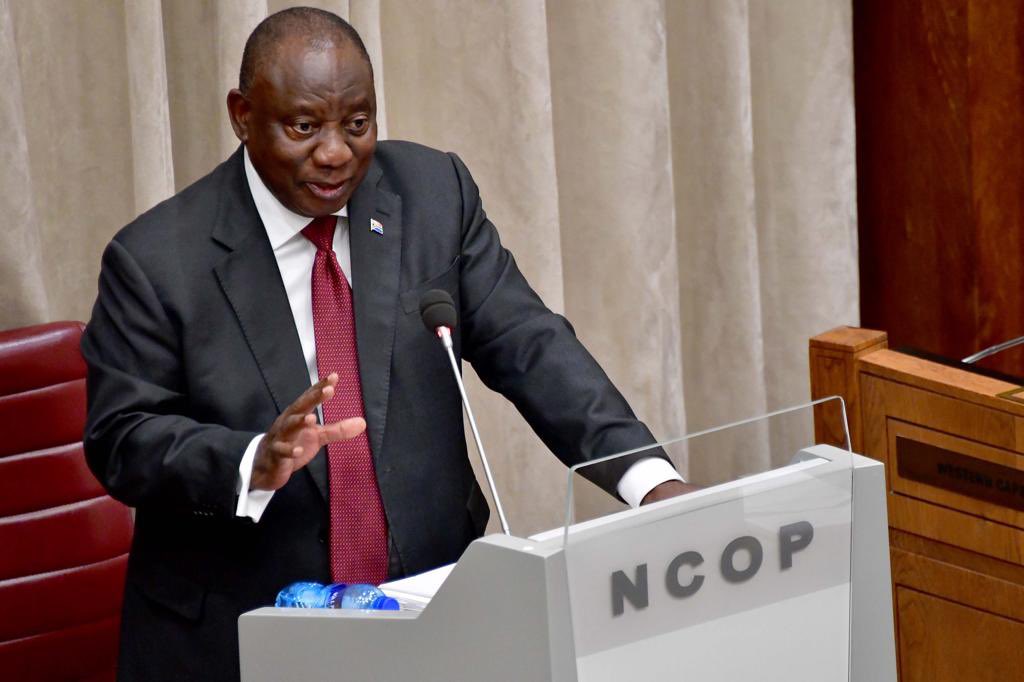
President Cyril Ramaphosa delivered his annual address to the National Council of Provinces (NCOP) in Parliament, Cape Town.
Ramaphosa was reflecting on the priorities of the 7th administration and the co-operation among the spheres of government.
He said that while South Africa’s poverty rate decreased from 71% in 1993 to 56% by 2010, many families struggled to meet basic necessities like food, water, electricity, and transport.
The president said the end of poverty and inequality in South Africa requires fundamental social and economic transformation.
“We made progress on many fronts, but we have also confronted severe constraints and challenges to our development path,” Ramaphosa said.
These include global financial crises, the Covid-19 pandemic, geopolitical rivalries, and climate change as external constraints, while state capture, corruption, policy missteps, service delivery failures, and civil unrest are domestic challenges.
The president said the government’s efforts to support the poorest and most vulnerable include social grants, free basic services, healthcare, education, and social housing.
“A vital part of the effort to reduce the cost of living is the provision of free basic minimum services to indigent households. Now, through this program, millions of people in our country have been able to access basic needs like electricity and water,” he said.
Ramaphosa said the program, however, falls short of its intended reach, currently covering only 2.3 million households out of an estimated 10 million eligible poor households.
He acknowledged that municipalities poorly manage these resources or misdirect them to other local council expenditures.
Social grants remain a lifeline for millions, particularly children, the elderly, and people with disabilities. Around half of all households benefit from social grants.
The president said there is a need to move social grant recipients into sustainable livelihoods and improve food security, noting that nearly a quarter of households consider their access to food inadequate.
Ramaphosa highlighted the measures to ensure affordable access to sufficient food, including expanding the basket of goods exempt from value-added tax and increasing agricultural output.
Many South Africans get their food from spaza shops and informal traders. These outlets are important to township and rural economies, the president said; however, the recent surge in foodborne illness has revealed the risks associated with these enterprises.
Spaza shop inspections
Within the past two weeks, inspectors have shut down more than 1000 non-compliant spaza shops, supermarkets, and warehouses.
“Since we announced a range of measures two weeks ago, multi-disciplinary teams have been conducting inspections of spaza shops across the country. Nearly 200,000 spaza shops have been visited. More than 1,000 spaza shops, supermarkets and warehouses have had to be closed down.”
Earlier this month, Ramaphosa issued a directive requiring all spaza shops and food-handling facilities to register with local municipalities within 21 days.
This measure follows a surge in food-borne illnesses linked to informal traders, which has claimed more than 20 lives and resulted in over 800 reported cases across the country.
“The tragic deaths of a number of children after eating food from some of these outlets requires urgent and decisive action to prevent the contamination of food by harmful substances, particularly pesticides that are being sold unlawfully,” added Ramaphosa.
Ramaphosa says large quantities of goods have been confiscated, and numerous fines have been issued for violations of by-laws.
In terms of transport, Ramaphosa said apartheid town planning, which kept black people at a distance, contributes to poverty in South Africa due to where people live.
“One of the consequences of this situation is that millions of South Africans, especially the poor, as well as the working class, spend a large portion of their income on transport costs. Studies suggest that poor households can spend more than a third of their income just on transport,” he added.
The president said restoring commuter train corridors to full operation is part of efforts to reduce the cost of living, with train travel being the least expensive mode of transport.
Ramaphosa emphasised that the government will utilise education as the most powerful instrument to end poverty by making education accessible and affordable through initiatives like no-fee schools and funding for tertiary students from poor and working-class backgrounds.
The number of students benefiting from the National Student Financial Aid Scheme (Nsfas) has increased from around 40 000 in the early years of democracy to over 780 000 last year.
Education access
The president added that the government will continue to focus on achieving universal access to early childhood development facilities and improving reading and mathematics in basic education.
Meanwhile, he noted that while the number of people in employment has doubled over the last 30 years, this has not kept pace with the growing workforce.
With more than 11 million people unemployed, Ramaphosa said the unemployment problem is most severe among young people.
“To address this, the government established the SA Youth Mobi platform for young people to find opportunities for employment, training, and development. More than 4 million young people participate in this, “the president said.
He added that the presidential employment stimulus has created earning opportunities for over 2 million participants, with 84% being young people.