
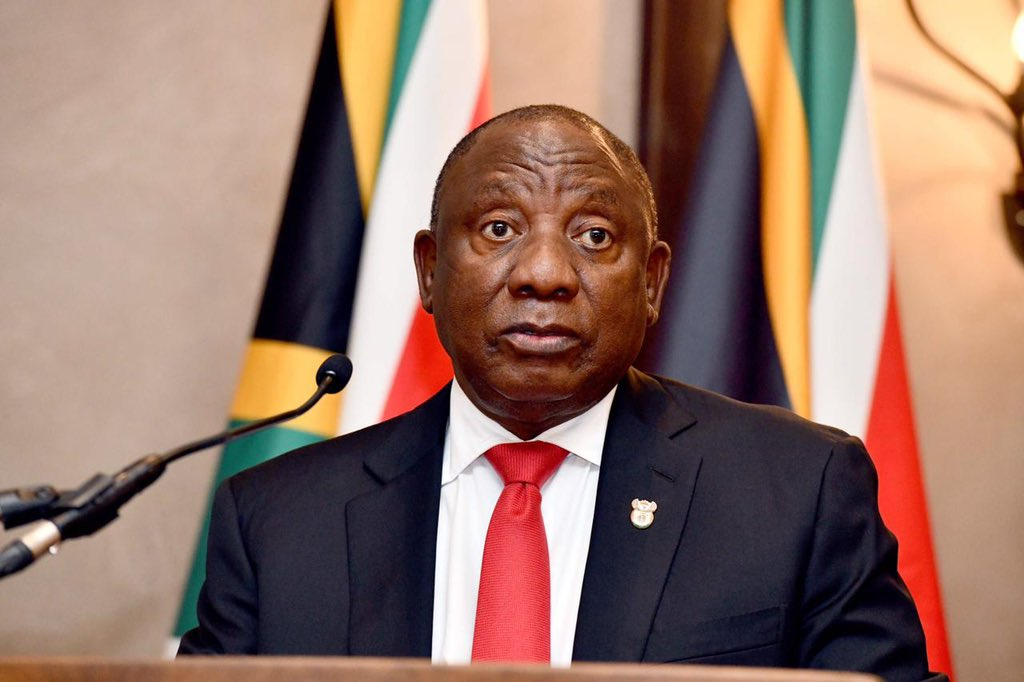
By Lehlohonolo Lehana.
President Cyril Ramaphosa honoured the more than 20 000 women who marched against the apartheid government’s pass laws on 9 August 1956.
This occasion marked the 70th anniversary of the 1956 protest march to the Union Buildings by at least 20 000 women.
The 1956 march opposed the apartheid government’s decision to extend urban pass laws to women, and was a precursor to major political changes over coming decades that led to the demise of the racist regime in South Africa.
The National Women’s Day commemorations this year take place under the theme “Empowered Women, Empower Nations”.
Since 1994, National Women’s Day is celebrated on 09 August every year as part of Women’s Month.
“Today is no ordinary commemoration. National Women’s Day is a day on which we honour the women of South Africa. But it is also a day of profound significance for our entire country.”
“The Women’s March of 1956 was not a footnote in our struggle for freedom. That helped to change the course, the character and the leadership of that struggle. It demonstrated that women were not merely supporters of the struggle. They were its leaders, its organisers and its authors,” Ramaphosa said.
On that day in 1956, women marched to the seat of apartheid power, bearing petitions with some 100 000 signatures and then stood in complete and determined silence.
“But theirs was not the silence of fear. It was not the silence of submission. It was the silence of courage gathering its strength. It was the silence of women who knew that they carried the justice of their cause within them.”
“For thirty minutes, there was no chant, no speech and no cry. Yet their silence said everything that needed to be said. The Union Buildings may have been quiet, but the conscience of a nation was being awakened,” the President said.
He saluted the four women who were at the forefront of the march, Lilian Ngoyi, Helen Joseph, Rahima Moosa and Sophie de Bruyn.
He emphasised, though, that they were strengthened by thousands of women behind them – names which ought to be recorded in history.
“We know the names of some, but we do not yet have the names of all of them. We therefore welcome the work of the Ahmed Kathrada Foundation and the Sophia and Henry De Bruyn Legacy Foundation through the “Write Her into History” campaign.
“Through the campaign…you are restoring the names and stories of the women of 1956 to our national memory. I call on every family and everyone who knew anyone of those women who marched, who took part in that march to come forward and present their story to these two foundations so that we can complete the roll call of courage and honour, “Ramaphosa said.
Since the advent of democracy in 1994, South Africa has made significant strides to empower women, with women occupying some of the country’s highest offices, including that of Ministers and Deputy Ministers and other political offices, Chief Justice, National Speaker of the National Assembly, Chairperson of the National Council of Provinces, Public Protector and Auditor-General.
“These gains matter. They were fought for. They must be defended.”
“South Africa ranks highly on global indices…for women’s empowerment, including for gender parity, educational outcomes, financial inclusion, and political representation and decision-making. We are proud of how far we have come. We are proud to stand on the shoulders of giants, of the imbokodo of 1956, “Ramaphosa said.
At the same time, he acknowledged that much work remains to be done, particularly in addressing gender-based violence and femicide (GBVF), which the government has classified as a national disaster.
“In 1956, the women of our country lived in fear of being arrested for not having a pass. Today, women live in fear of the gender-based violence that continues to stalk them in the streets of our country, in the pathways of our villages and in their homes.”
The President urged South Africans to come together to honour the legacy of the women of 1956 by “delivering the future for which they marched”.
“We commit to build a South Africa in which no woman’s potential is limited by poverty, prejudice, violence or discrimination. We will build a nation in which women are equal in law, equal in opportunity, equal in safety and equal in power.”